Agricultural & Biological Engineering
Agronomy
Purdue institute powers the future of Indiana, U.S. agriculture through AI, data
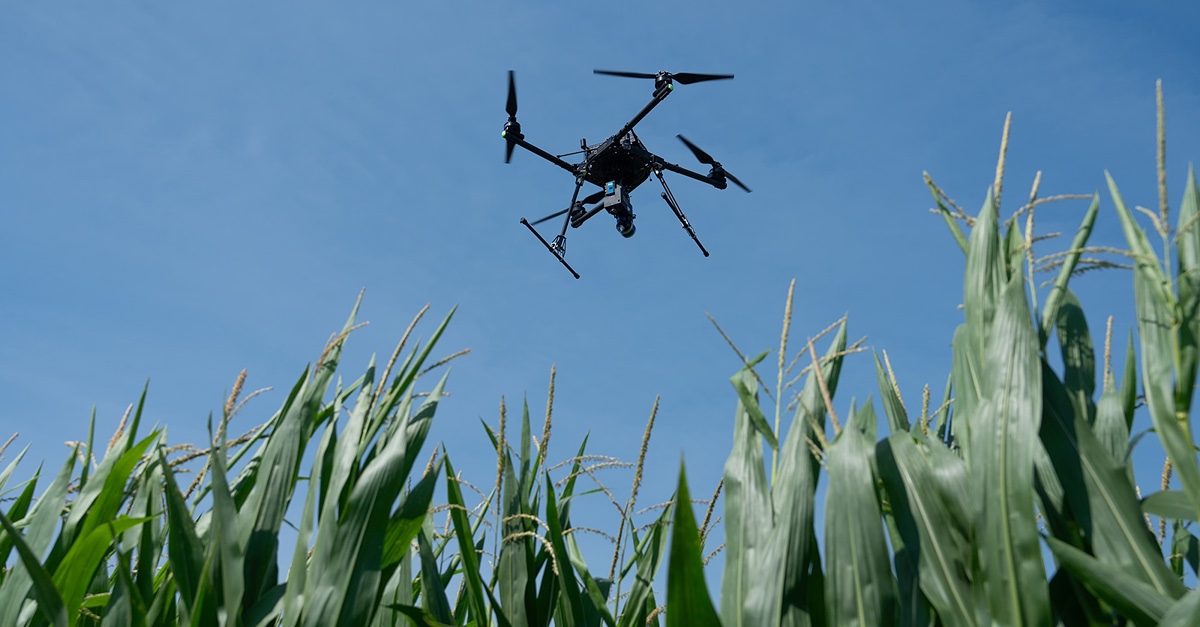 , opens larger image Purdue University’s Institute for Digital and Advanced Agricultural Systems (IDAAS) has supported 1,373 drone demonstrations, providing farmers, students and industry professionals with hands-on exposure to aerial imaging, multispectral crop analysis and precision scouting. (Purdue Agricultural Communications/Joshua Clark)
 WEST LAFAYETTE, Ind. — On any given day in Indiana, you will find farmers checking weather apps before sunrise, monitoring equipment diagnostics from their phones, and analyzing yield maps long after the combine has shut down. Agriculture has always depended on experience and instinct. Today, it also requires data. At Purdue University, that change is being addressed by the Institute for Digital and Advanced Agricultural Systems (IDAAS), led by co-directors Dennis Buckmaster, professor of agricultural and biological engineering, and Ignacio Ciampitti, professor of agronomy.
When IDAAS launched, the vision was to position Purdue as a global leader in digital innovation in agriculture to help producers build more resilient and profitable systems. The institute was designed as a people-centric hub — a connector of disciplines and ideas. More than 120 faculty and staff across the university are now engaged in IDAAS efforts, bridging agronomy, agricultural and biological engineering, data science, economics, and a growing number of other areas.
In one year, that collaborative model has translated into measurable impact. “We have reached thousands of participants through IDAAS programs, events and outreach activities,” Ciampitti said. “These numbers represent producers exploring drone technology for the first time, educators integrating AI into classrooms and students discovering careers they didn’t know existed.”
One of the most visible demonstrations of digital agriculture this year has taken place in the sky. IDAAS supported 1,373 drone demonstrations, giving farmers, students and industry professionals hands-on exposure to aerial imaging, multispectral crop analysis and precision scouting. For some participants, this was their first opportunity to see how quickly plant stress can be identified from above. For others, it confirmed that site-specific management is now a reality.
In livestock systems, IDAAS initiatives are advancing genomic data integration and precision monitoring tools that track animal health and performance in real time. Sensors, automation and AI-driven analytics are helping producers reduce waste, monitor feed efficiency and improve animal welfare outcomes.
This year, IDAAS delivered 270 classroom workshops and reached 1,165 K-12 students through camps, demonstrations and youth programming. At the collegiate level, digital agriculture is moving from concept to curriculum. Faculty are integrating AI-powered phenotyping tools, remote sensing analytics and data-driven decision exercises directly into coursework. Students are graduating not just with theoretical knowledge but with experience working alongside real datasets and real production challenges. With leadership from graduate students and support from private industry, the first digital agriculture symposium was established last year with more than 120 attendees. Workforce development is a central pillar; a new course coordinated by IDAAS and taught by a team of expert faculty on research fundamentals in the era of AI launched this spring with a cohort of 60 graduate students from the College of Agriculture.
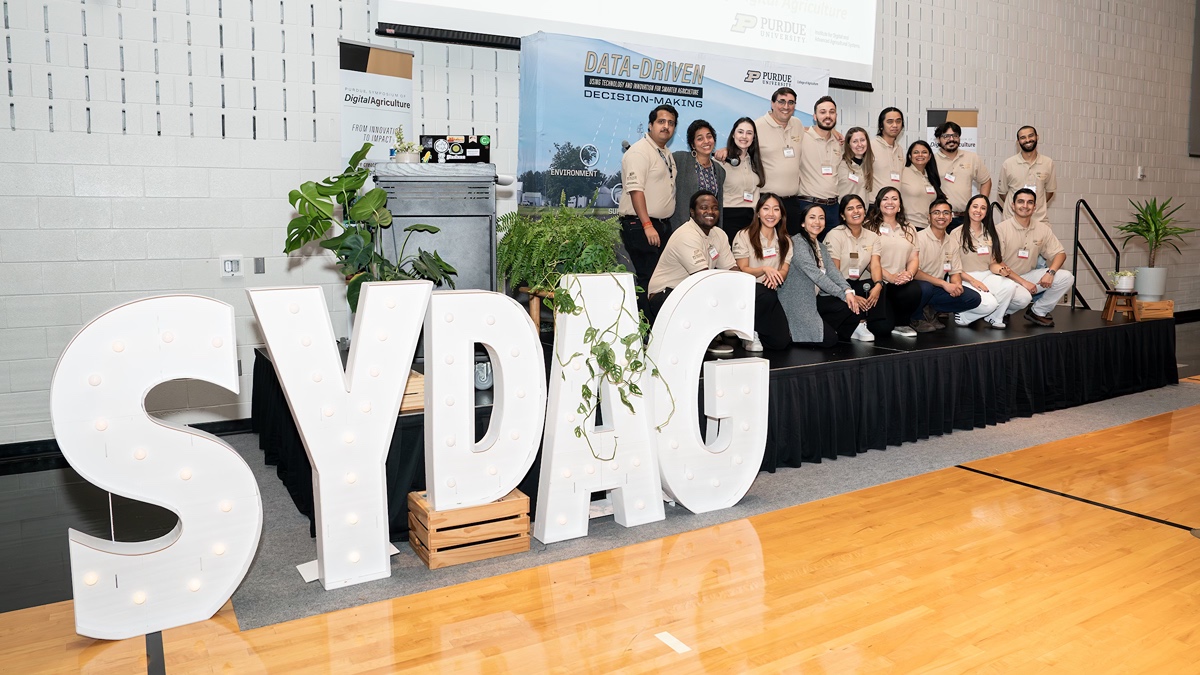 , opens larger image Led by IDAAS graduate students, the inaugural Symposium of Digital Agriculture (SyDAg) was held last year at Beck Agricultural Center. The 2026 event is scheduled for September 28. (Purdue Agricultural Communications/Joshua Clark)
 IDAAS’ outreach spans plant systems, livestock operations, social science adoption metrics and post-farm gate innovations such as food safety sensors and traceability tools. “Technology that will be adopted cannot be developed in isolation; it must be tested, refined and evaluated in context,” Buckmaster said.
IDAAS will continue to expand hands-on demonstrations, deepen industry partnerships, grow workforce training and strengthen global collaboration, building on an interdisciplinary foundation and producing results. Across Indiana, the next generation of farming is already taking shape — powered by data, guided by experience and connected through innovation — with farmers, agronomists and agribusiness professionals not just adapting to the future but leading it. To prepare for the next-generation workforce and to secure Indiana as a major hub for digital agriculture innovation in the country, IDAAS will coordinate the next national AI in Agriculture Conference in spring 2028, as the event moves to the Midwest for the first time.
Computer science and AI are cornerstones of Purdue Computes — a comprehensive initiative that spans computing departments, physical AI, quantum science and semiconductor innovation.
About Purdue Agriculture
Purdue University’s College of Agriculture is one of the world’s leading colleges of agricultural, food, life and natural resource sciences. The college is committed to preparing students to make a difference in whatever careers they pursue; stretching the frontiers of science to discover solutions to some of our most pressing global, regional and local challenges; and, through Purdue Extension and other engagement programs, educating the people of Indiana, the nation and the world to improve their lives and livelihoods. To learn more about Purdue Agriculture, visit this site.
About Purdue University
Purdue University is a research institution ranked among the top 10 public universities in the United States. More than 111,000 students study at Purdue across multiple campuses, including more than 57,000 at our main campus locations in West Lafayette and Indianapolis. As a land-grant university committed to affordability and accessibility, Purdue’s main campus has frozen tuition 14 years in a row, enabling more students than ever to graduate debt-free.
Media contact: Devyn Ashlea Raver, draver@purdue.edu
Sources: Ignacio Ciampitti, iciampit@purdue.edu; Dennis Buckmaster, dbuckmas@purdue.edu
Agricultural Communications: Maureen Manier, mmanier@purdue.edu, 765-494-8415
Journalist Assets: Publication quality images can be obtained at this link