

What are animals feeling? Purdue animal scientists are learning how to read their emotions.
Every pet owner has looked into their four-legged loved ones’ eyes and guessed what was going on in their mind. Whether improvising a dialogue with pets about wanting more treats or toys or the more serious inquiry of telling them not to chew on something, we clearly long to communicate with animals.
Heather Neave, assistant professor of animal science at Purdue, said farmers also face this challenge. Dairy cattle and other livestock can be stoic. Showing emotion would make the creatures susceptible to predation, but their evolved quiet features make it difficult to find out if they are happy or even in pain.
“Farmers will say this until the cows come home: if their animals are happy, then they're happy, but if their animals are not happy, then that really affects farmers’ mental states,” Neave said.
Neave researches animal welfare, a field focused on understanding what practices can improve the lives of animals on farms, which also makes them more productive. Lately, she’s been trying to tackle the big question of how to read an animals’ emotions.
Some of her experiments come from human psychology literature. As an indirect way to judge how an animal is feeling, she has used a “judgement bias” test, similar to asking a person if a glass of water is half empty or half full. Someone feeling more positive will interpret this glass as half full, while someone feeling more negative will interpret that same glass as half empty. People’s mood affects how they interpret uncertain information. This concept also applies to animals.
In this experiment, Neave showed cows and calves a computer screen. If it flashed red and the cow approached, they received a treat. If it flashed white and they approached, they did not get the reward, so the animals learned quickly to go to the red screen and back away from the white screen. Then, Neave presented them with an ambiguous pink screen and studied their responses. If they were already feeling negatively, like after having a medical procedure, they were less likely to take the risk of approaching the pink screen. This is how the judgement bias test examines emotional state, by examining interpretation of uncertain information.
By indirectly asking cows how they are feeling, researchers can understand what management practices, housing environments and other resources make animals more content or stressed.
“In my research, one element is the basic understanding of the animal and their behavior. How can we improve management that allows positive behaviors to be expressed or make the animal feel good?” Neave said. “The other element is: how can we make this easy for farmers to do? How can we use technology to help us measure behavior to better understand the animal?”
Using Cameras and Computer Vision:
Neave is working with colleagues in agricultural and biological engineering to apply new technology to the problem.
Neave and her lab are studying the way a cow’s ears move to see if they can quantify mood through a visual cue read by a camera. By measuring the distance from the nose to the eyes to the ears, they’re hoping to see if the ears droop or raise in accordance with positive or negative events or agents in their environment. They are training machine-learning computer algorithms with these points on the cows’ faces to determine if they accurately predict their mood based on their expression.
Grooming, which is generally accepted as a pleasurable activity for the calves and cows, might be something else cameras can pick up on for farmers. Neave expects that if animals are feeling upset or sick, they will quickly stop grooming since it isn’t essential for survival. If computer vision through continuous camera footage can identify an animals’ grooming behaviors abating, farmers might be able to catch and treat their ailments earlier.
Neave’s other non-invasive approach to studying a cow’s mood is to look at the milk. Endocannabinoids, a neurotransmitter partially responsible for mood and social bonding, exists in humans, cows and other mammals. Cows also release it in their milk, which is already being collected and sampled. While the work is still experimental, it might provide another avenue for farmers to check in on their animals.
Neave’s research is a component of Purdue University’s One Health initiative which supports scientists tackling complex challenges with real-world impact at the intersection of human, animal and plant health.
Neave’s lab is focused on cows, but this foundational knowledge may be applied to other animals. Eventually, you could truly understand what your cat or dog is trying to tell you with those sideways glances and tail wags.
Farmers experience some of the highest stress levels of any profession in the United States. I’m interested in how stress can move through the whole farm system, from people to animals and back again. When farmers are under pressure, it can affect their animals, which can then affect productivity and increase stress further. If we can support farmers better, that can improve both animal welfare and farmer well-being.
- Heather Neave, assistant professor of animal science
This research is a part of Purdue’s presidential One Health initiative, which involves research at the intersection of human, animal and plant health and well-being.
Featured Stories

For Brody Cox, preparing for the Indiana State Fair began long before he entered the show...
Carolyn Foley, a long-time member of the Purdue Forestry and Natural Resources (FNR) and...

In the September Purdue University/CME Group Ag Economy Barometer survey, 52% of respondents...

Purdue University’s College of Agriculture recognized nine alumni at the Distinguished...
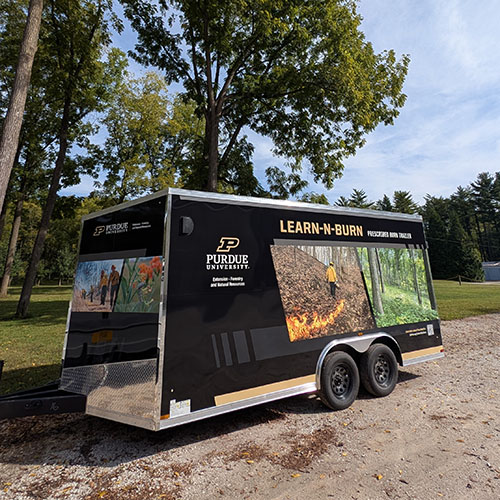
Keep your eyes peeled across Indiana for the newly minted Purdue Forestry and Natural Resources...
“Being at Purdue has changed my thinking entirely,” says Mingyu Zhao, a third-year...