Agricultural & Biological Engineering
Purdue agricultural engineers harness microbial activity for biofuels production
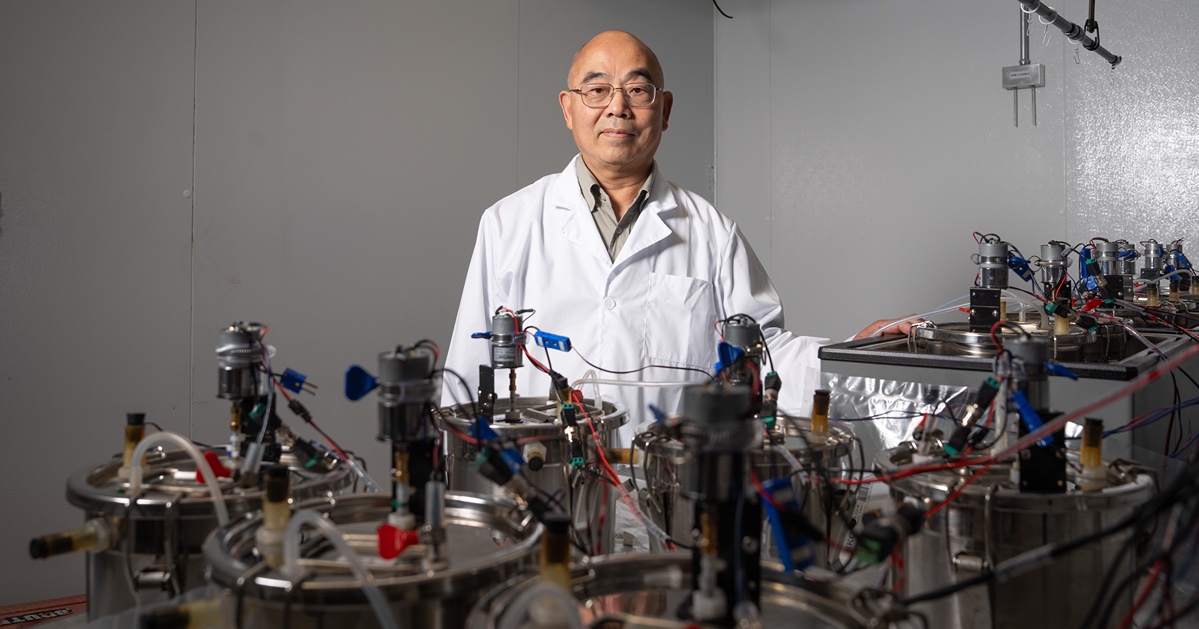 , opens larger image Jiqin Ni, professor in Purdue University’s Department of Agricultural and Biological Engineering, in his anaerobic digestion laboratory. Ni and his colleagues are developing strategies for converting aquaculture sludge into renewable biofuels.
 WEST LAFAYETTE, Ind. — Converting aquaculture sludge with a natural microbial process into a viable renewable biofuel presents a mind-numbing chess match of biochemical variables. This process — anaerobic digestion — involves microbes operating in a no-oxygen environment.
“Although the anaerobic digestion technology has been employed for more than a hundred years all over the world, there is still a lot that we need to investigate,” said Jiqin Ni, professor of agricultural and biological engineering at Purdue University.
Ni and his colleagues are steadily developing new strategies for controlling the complex variables of anaerobic digestion, a naturally occurring process. They have contributed three publications on anaerobic digestion to scientific journals in the last year alone.
“Anaerobic digestion is a complicated dynamic process involving different microbes,” Ni said. Some microbes perform hydrolysis while others produce methane. As the initial stage of anaerobic digestion, hydrolysis is the rate-limiting step. To enhance its efficiency, Ni and his group are currently investigating various pretreatment techniques. “Pretreatment is like chewing food before we swallow,” said Rajesh Nandi, a PhD candidate in Ni’s lab and a co-author of all three publications.
Two of the publications from their previous work explore the optimal mixing ratio for anaerobic codigestion of aquaculture sludge with corn residue and with dairy manure. The third publication assessed the status and future direction of a new research trend: applying biochar and nanomaterials to anaerobic digestion.
The three papers begin to fill significant gaps that Ni’s team identified in the anaerobic digestion research literature. In his new Biomass and Bioenergy paper, Nandi noted that no systematic evaluation of anaerobic codigestion of aquaculture sludge and corn residue had appeared as of May 2025.
Likewise, in last year’s Global Change Biology Bioenergy study, Ni’s team commented on the dearth of attention paid to optimizing the aquaculture sludge-dairy manure ratio for producing methane via anaerobic codigestion. A substantial body of existing research does delve into improving anaerobic digestion performance with biochar and nanomaterials. But as Ni’s team noted earlier this year in Fuel, a detailed understanding of which factors drive and control their impact on each stage of the process remains lacking.
All three publications address various issues that challenge commercial anaerobic digestion operations. “When they’re related to economic issues for technical performance, then some root causes can be explained scientifically,” Ni said. The carbon-to-nitrogen ratio of the feedstocks, pH levels and total solids in the mix and other factors may cause underperforming digesters. Underperforming systems that fail to generate revenue can lead to their shutdown.
“There is a range of pH, and pH is dynamic,” Ni said. During the first phases of anaerobic digestion, acids form, pH generally drops and those acids get converted to biogas. “After those acids get converted to biogas, the pH again goes up,” he said.
The low total solids content of aquaculture wastewater poses a challenge because anaerobic digestion efficiency requires a higher range of total solids. Either a larger digester or more energy input to separate the solids from the liquid would fix the issue. But both solutions would increase costs.
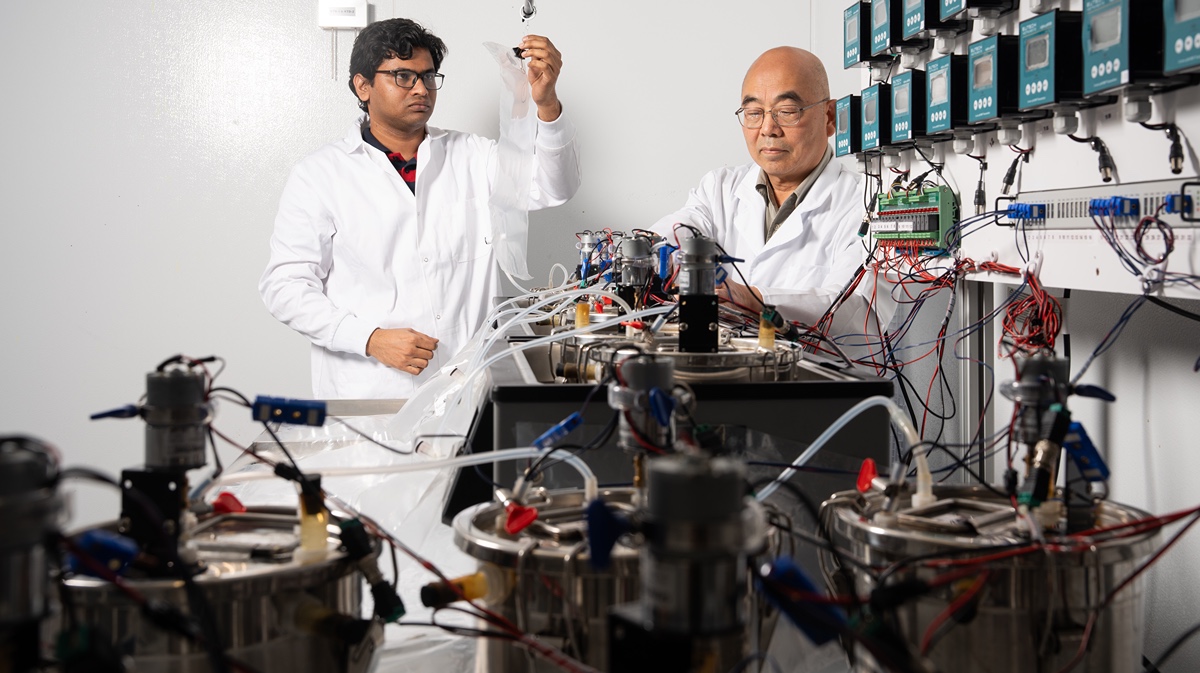 , opens larger image Rajesh Nandi (left), a PhD candidate, and Jiqin Ni, professor, both in Purdue University’s Department of Agricultural and Biological Engineering, adjust anaerobic digester equipment in Ni’s laboratory. Nandi, Ni and their co-authors have published three journal articles in the last year reporting new strategies for converting aquaculture sludge into renewable biofuels.
 The Purdue team conducted experiments for two of the studies with corn residue and dairy manure using sludge collected from a recirculating aquaculture system of tilapia fish at Purdue’s Aquaculture Research Lab.
“Aquaculture produces wastewater and other fish-processing waste. These production processes generate organic waste that can be recycled. One of the most economically feasible recycling methods is anaerobic digestion to produce energy,” Ni said.
They used batch-fed digesters, meaning that they added feedstock to the containers only once before starting the 30-day experiments. Ni’s lab is also equipped with continuously fed anaerobic digesters to better simulate commercial operations. Commercial operations usually add feedstock to their digesters at least once daily.
In the Biomass and Bioenergy study, Nandi examined the codigestion of aquaculture sludge with two types of corn residue. Nandi compared mixing ratios of corn stover (leaves, stalks, husks and cobs) and corn husk with aquacultural sludge. He and his co-authors assessed the optimal ratio for corn stover and corn husk to aquaculture sludge to be 50-50 and 30-70, respectively. The husk-sludge mix produced somewhat more biogas than the stover-sludge combination.
“We produce a lot of corn in the Midwest. So, it would be meaningful if the technology to use both wastes is successfully developed,” Ni said.
Corn stover contains a high proportion of carbon and a low proportion of nitrogen. The proportions are opposite in aquacultural sludge, Nandi said, making the two feedstocks quite complementary for anaerobic digestion. “Too much carbon or too much nitrogen are both bad for anaerobic digestion,” he noted.
Husk and stover both come from corn plants. Even so, “The biogas production trend was totally different for anaerobic codigestion of corn husk and of corn stover. It was surprising for us to see,” Nandi said. As with dairy manure, both types of corn residue showed more promise as codigestants with aquaculture sludge when compared with any feedstock undergoing breakdown without a codigestant.
A robust, highly accurate kinetic modeling will help researchers foresee what results to expect without performing additional experiments, Ni said.
In the Global Change Biology Bioenergy study, first author Mohit Singh Rana, a former postdoctoral scientist in Ni’s lab, placed the optimal mixing ratio for dairy manure and aquacultural sludge at 10-90.
In recent decades, a rising global population has driven large increases in fish production and aquaculture. This trend favors anaerobic digestion applications that conserve resources and benefit the environment, Rana and his co-authors noted.
A widely used sludge management technology, anaerobic digestion can promote bioenergy production and help provide nutrients for aquaculture and aquaponics operations. Anaerobic digestion also reduces the environmentally harmful by-products generated by fish production facilities. The high nitrogen and phosphorus content of that waste can trigger oxygen-starved dead zones in lakes and rivers.
In the recent paper published in Fuel, Rana and his co-authors assessed how biochar and nanomaterials could boost anaerobic digestion performance. Biochar derives from materials such as agricultural residues, animal manure, food waste and aquatic biomass. The nanomaterials consist of metallic nanoparticles. “Future research should focus on the metal-augmented biochar to leverage the properties of both biochar and nanomaterials,” Rana and his co-authors wrote.
About Purdue Agriculture
Purdue University’s College of Agriculture is one of the world’s leading colleges of agricultural, food, life and natural resource sciences. The college is committed to preparing students to make a difference in whatever careers they pursue; stretching the frontiers of science to discover solutions to some of our most pressing global, regional and local challenges; and, through Purdue Extension and other engagement programs, educating the people of Indiana, the nation and the world to improve their lives and livelihoods. To learn more about Purdue Agriculture, visit this site.
About Purdue University
Purdue University is a research institution ranked among the top 10 public universities in the United States. More than 111,000 students study at Purdue across multiple campuses, including more than 57,000 at our main campus locations in West Lafayette and Indianapolis. As a land-grant university committed to affordability and accessibility, Purdue’s main campus has frozen tuition 14 years in a row, enabling more students than ever to graduate debt-free.
Writer: Steve Koppes
Media contact: Devyn Ashlea Raver, draver@purdue.edu
Sources: Jiqin Ni, jiqin@purdue.edu; Rajesh Nandi, nandir@purdue.edu
Agricultural Communications: Maureen Manier, mmanier@purdue.edu, 765-494-8415
Journalist Assets: Publication quality images can be obtained at this link