

Your next burger might be thanks to a dairy cow
Even if you don’t know much about beef or dairy production, if you imagine a ranch or a milking barn, you probably picture different cattle breeds. A shiny Black Angus makes a great steak, whereas a black and white Holstein produces creamy milk.
These days, however, many dairy farms are incorporating beef genetics into their breeding programs, said Hinayah Rojas de Oliveira, assistant professor of animal sciences. The beef-on-dairy crossbred cattle produced help maximize profit for dairy farmers, who can see premiums of $350 to $700 per head for their meat quality compared to purebred dairy calves.
Dairy farmers replenish their herd by using sexed dairy semen on a group of select elite females to produce new heifers. Cows who are not top milk producers are eventually used to produce offspring sold for meat, but the quality of a dairy carcass is lower than cuts from beef cattle. Beef-on-dairy crossbreeding produces calves of intermediate quality, with improved muscling and meat yield.
What’s driving this trend? First, Rojas said, “The U.S. beef cattle inventory has hit its lowest level in 73 years, driven in part by drought-induced herd liquidations. This has created a real supply gap that beef-on-dairy crossbreeds are helping to fill. We have gone from just 50,000 crossbred calves in 2014 to over 3.2 million in 2024.”
The second factor is technology. “The widespread adoption of sexed semen and genomic selection has made this strategy much more precise and profitable,” Rojas explained. Sexed semen allows producers to select for the desired calf sex with about 90% accuracy.
Meat quality, and thus economic value, is determined by traits like carcass weight, yield, marbling and ribeye area. In beef cattle, these traits can often be predicted with high accuracy using genomic data — our understanding of an animal’s full set of alleles (DNA) and how that genetic data relates to desired traits. In beef-on-dairy crossbred cattle, the genomic architecture underlying high-value carcass and meat-quality traits is still less fully characterized.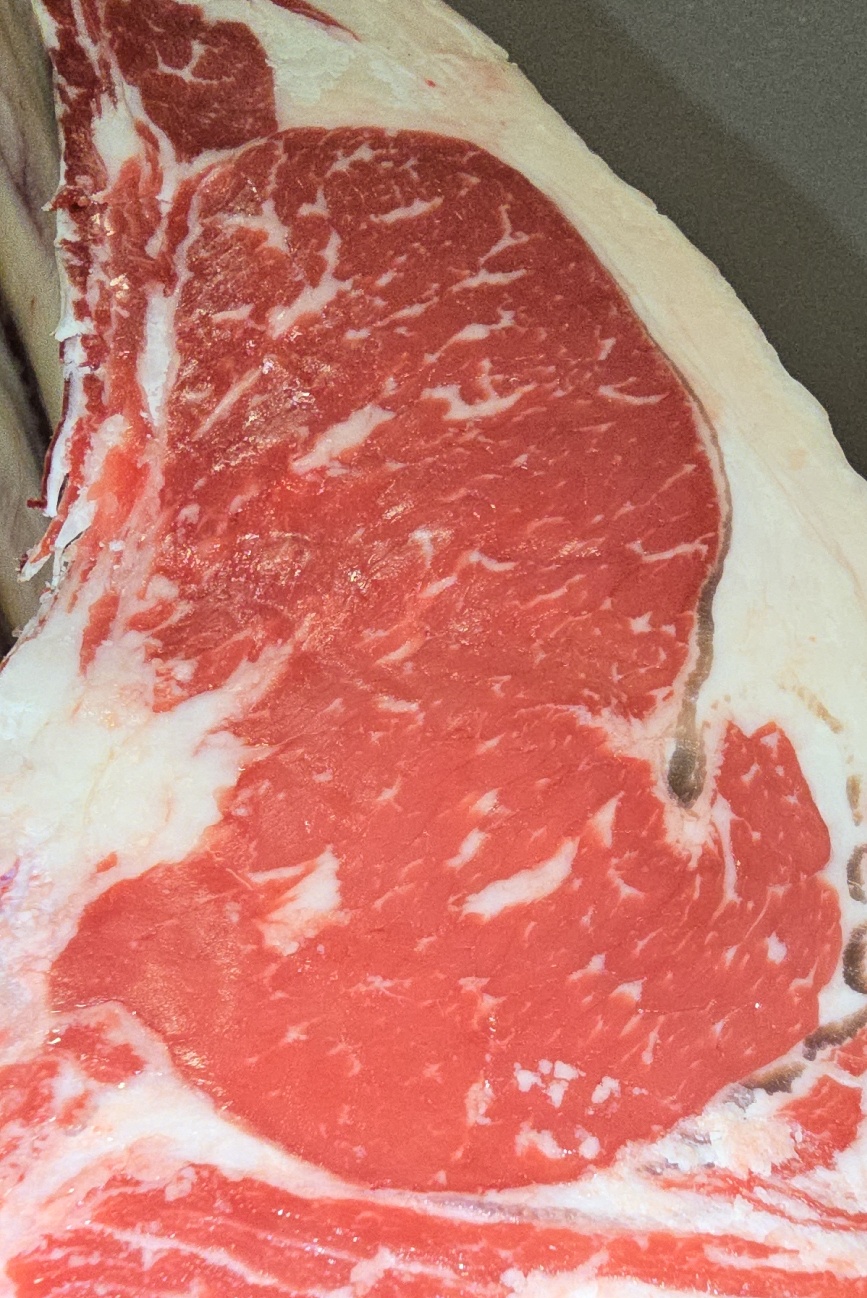 Ribeye sample from a beef cow, showing the total surface area of the muscle between the 12th and 13th ribs.
 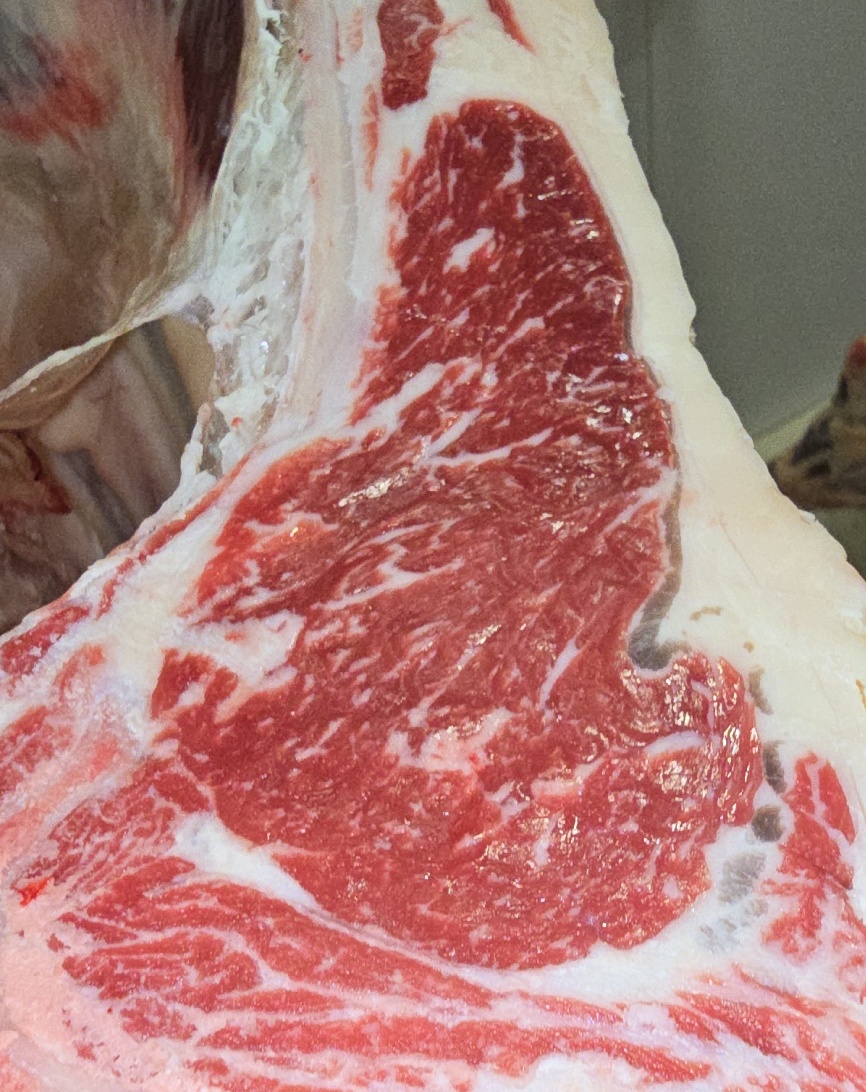 The same ribeye sample from a dairy cow.
 Shortly after arriving at Purdue, Rojas, who focuses on improving livestock through genomics, discussed this problem with colleague Brad Kim, professor of animal sciences and meat science expert. Traditional methods of collecting phenotypic data, the observable and measurable traits of an organism, include ultrasound scans and visual assessment, but those are time-consuming and expensive at large scale.
“We saw a clear opportunity to use technology to get more accurate data on more animals, and ultimately, speed up genetic improvement,” Rojas said. “However, we knew we couldn’t do it alone.”
Dennis Buckmaster, professor of agricultural and biological engineering and Dean’s Fellow for Digital Agriculture, put her in touch with Qi Guo, assistant professor in the Elmore Family School of Electrical and Computer Engineering, and Jian Jin, associate professor of agricultural and biological engineering, who have expertise in computational imaging and computer vision. Joseph Campbell, assistant professor of computer science, and Aaron Ault, senior research engineer in the Elmore Family School of Electrical and Computer Engineering, contribute expertise in machine learning and robotics, and Kim rounds out the team as a meat quality specialist with deep knowledge of muscle biology.
Rojas, Guo and Campbell now lead a collaborative research project, supported by an Artificial Intelligence Fusion one-year seed funding grant. This new initiative is managed by the associate deans for research in the colleges of Agriculture, Engineering and Science and the Office of Research, with input from Purdue’s Institute for Physical Artificial Intelligence.
The team will use hyperspectral imaging and other evaluation methods to capture carcass quality of beef-on-dairy samples. Hyperspectral imaging can detect subtle variations in muscle structure, fat distribution, and moisture content — crucial components of carcass quality. Commercial collaborators were willing to provide pictures of carcasses at their plants to contribute to the project, “so we are able to collect much more data than we initially thought,” Rojas said.
Next, they’ll analyze the images using machine learning to develop a model that can more rapidly identify economically favorable traits, then establish a foundation for linking the DNA information they collect to those traits. Once the genomic data is matched to meat quality characteristics, simply testing the DNA of a member of the herd could predict its carcass value.
Seed-grant funding “is an ideal way to collect some preliminary data that could support larger grant applications in the future,” Rojas said. “The industry demand for better evaluation tools is definitely here. This is a great example of how combining different fields of science can lead to a stronger, more innovative project.”Computer science and AI are cornerstones of Purdue Computes — a comprehensive initiative that spans computing departments, physical AI, quantum science and semiconductor innovation.
Featured Stories

For Brody Cox, preparing for the Indiana State Fair began long before he entered the show...
Carolyn Foley, a long-time member of the Purdue Forestry and Natural Resources (FNR) and...

In the September Purdue University/CME Group Ag Economy Barometer survey, 52% of respondents...

Purdue University’s College of Agriculture recognized nine alumni at the Distinguished...
Keep your eyes peeled across Indiana for the newly minted Purdue Forestry and Natural Resources...
“Being at Purdue has changed my thinking entirely,” says Mingyu Zhao, a third-year...