Agronomy
Newly discovered soybean biomechanism could increase crop yields
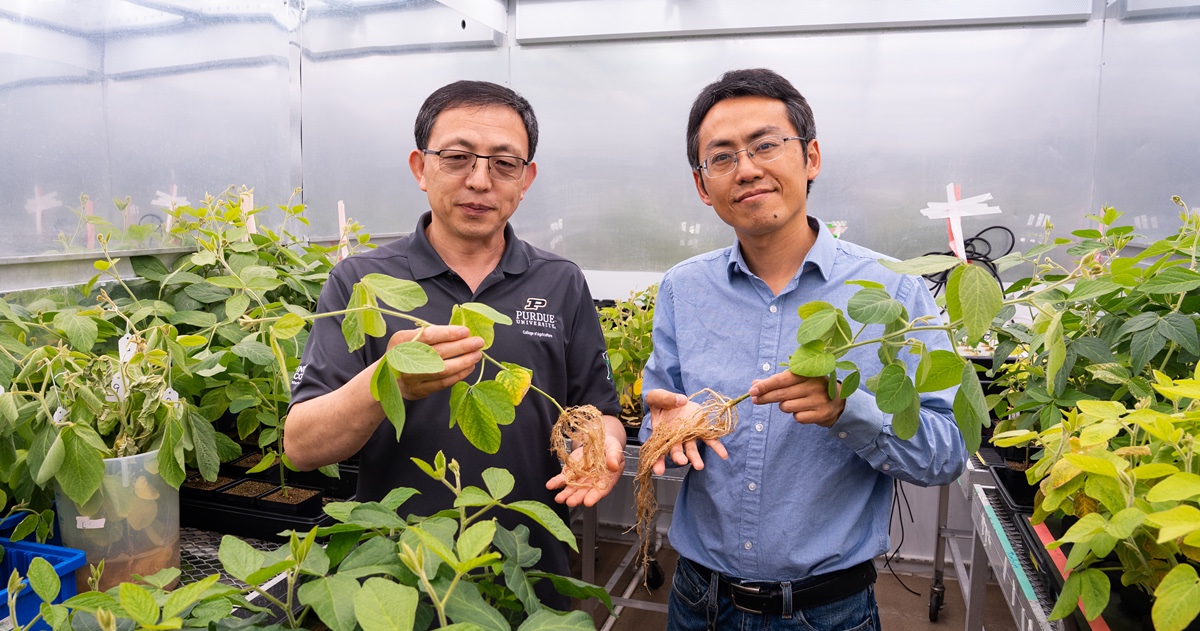 , opens larger image Professor Jianxin Ma and research scientist Jingbo Duan, both of Purdue’s Department of Agronomy, with soybean plants in a growth chamber. Their latest soybean research appears in the Proceedings of the National Academy of Sciences. (Purdue University photo/Joshua Clark)
WEST LAFAYETTE, Ind. — Scientists have discovered an evolutionary innovation in soybean plants that might improve crop yields if fine-tuned through alternative approaches such as gene editing, according to a study published this month in the Proceedings of the National Academy of Sciences.
“Legume-based crops can pull nitrogen from the air to meet their needs for growth through a process called biological nitrogen fixation,” said Purdue University’s Jianxin Ma, professor of agronomy and the Indiana Soybean Alliance Chair in Soybean Improvement. Soybean establishes a mutually beneficial relationship with soil bacteria called rhizobia through forming nodules — specialized root structures within which the bacteria fix nitrogen. “This study reports a new mechanism that promotes soybean nodulation, plant productivity and environmental resilience,” Ma said.
Ma co-led the study with Blake Meyers, a Distinguished Professor of Plant Sciences and director of the Genome Center at the University of California, Davis. Meyers described nodule formation (nodulation) in legumes as “hugely important for agriculture because of the elegant mechanism by which microbes supply accessible and necessary nitrogen for plant growth in exchange for the energy provided by the host plant via photosynthesis.”
Legumes, a large category of flowering plants, have evolved roughly 19,000 species over the last 60 million years. These include edible crops such as beans, lentils and peanuts. As a major protein source, soybeans play a critical role in global food security, Ma noted. Although people get most of their protein from livestock, animals get their protein from plants such as soybeans. “Whether we eat meat or plants, nearly all protein that humans consume ultimately comes from plants,” Ma said.
In 2019, Ma and his team announced the discovery of a rhizobia-based mechanism that promotes soybean nodulation. They found that the bacteria produce tiny RNA fragments from their transfer RNAs. These fragments enter the plant cells, where they act like dimmer switches on certain plant genes — tuning them down to help the plant form more nodules where the bacteria reside throughout the soybean growing season.
The discovery led researchers to suspect that soybeans must also have evolved mechanisms to promote nodulation. “In this new paper, we observed a complementary mechanism from the host plant side,” Ma said. That mechanism, acting like an accelerator pedal, promotes nodulation, enhances the nitrogen fixation capability, and, in turn, can increase soybean yield under low-nitrogen conditions.
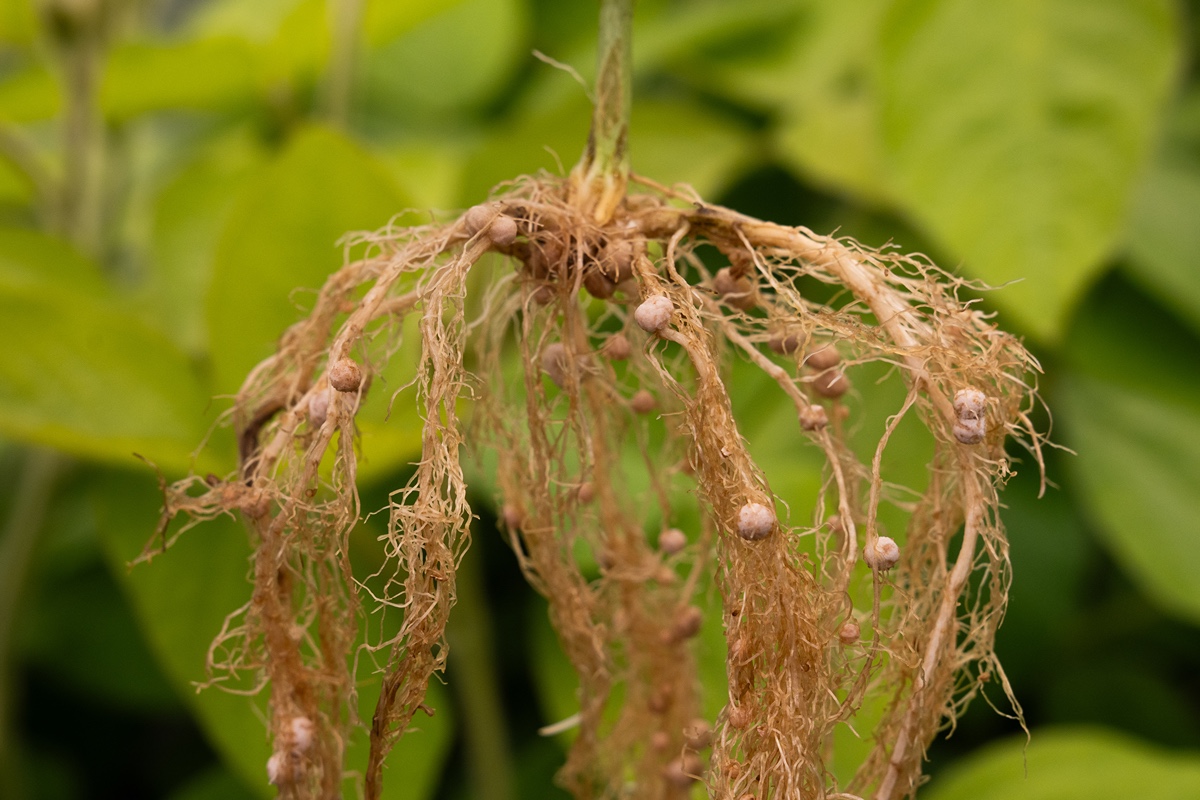 Soybean root nodules on a soybean plant. These specialized root structures enable soybean plants to utilize atmospheric nitrogen, which promotes productivity and environmental resilience. (Purdue University photo/Joshua Clark)
 The new findings documented the genetic circuitry and communications relays that keep the soybean nodulation system balanced. Excessive nodulation imposes a high energy cost on the host plant. Too little nodulation under nitrogen-poor conditions starves the plant of vital nutrients.
Previous work focused on one mechanism that limits the risk of runaway nodulation. “What was unknown until now was the mechanism that accelerates nodulation under low-nitrogen conditions,” Meyers said. The team showed that two types of signaling molecules — small peptides and microRNA — coordinate and optimize nodulation.
“A peptide is a short chain of amino acids, which are the basic building blocks of protein, like beads on a string,” Ma said. Soybeans produce this peptide within their roots. The plants move the small peptide from roots to shoots through their xylem, the tissue that also transports water and other nutrients to feed growth, to regulate the production of a specific microRNA.
The microRNA in the shoots, meanwhile, moves to the roots to suppress the expression of a specific soybean gene, forming a relay that coordinates nodulation. “Signals are sent from leaves to roots and back again, communicating the situation and needs back and forth. With these insights, we may be better able to optimize a natural process of nitrogen fixation and reduce our dependency on expensive fertilizer, at least for soybeans,” Meyers said.
The researchers identified this microRNA biomechanism in a major species of soybean crop but found it lacking in two model species widely used by researchers in experiments. Other major legume crop species, however, including the common bean, do share this biomechanism. This suggests that researchers may be able to transfer the knowledge gained in soybeans to other legume crop species.
The mechanism represents an evolutionary innovation that arose after the lineages of the soybean crop species diverged from the model species millions of years ago. The study’s authors emphasized the importance of integrating insights from model legumes and crop species alike to better understand how nodulation and nitrogen fixation have evolved.
Ma used gene-editing technology to modify the microRNA-mediated regulatory pathway for enhanced soybean nodulation and nitrogen fixation. With further testing, his technology, which has a patent pending, could complement two existing strategies that farmers already use in some regions: treating seeds with rhizobia before planting or spraying soybean fields with the beneficial bacteria after planting.
The soybean variety that Ma’s team used in this study, called Williams 82, was developed in the 1980s but is no longer used for crop production. The team observed that in this variety, modification of the biomechanism produces multiple benefits, including improved seed quality and higher protein content. Purdue’s Office of Technology Commercialization has signed multiple testing agreements with potential licensees to evaluate whether the technology can transfer such benefits to elite soybean varieties in crop production today.
Credited as co-first authors on the study were agronomy postdoctoral scientists Jingbo Duan, Jinbin Wang and Runze Guo. Also contributing were the University of Missouri’s Gary Stacey, along with W. Andy Tao and Natalia Dudareva, both professors in Purdue’s Department of Biochemistry. “This is truly a team effort,” Ma said.
Funding for the work came from the National Science Foundation, National Institutes of Health, United Soybean Board, Purdue AgSEED Program and the Indiana Soybean Alliance Inc.
“I’m particularly grateful to the soybean farmers in the U.S., including about 20,000 in Indiana,” Ma said. “We strive to convert their support into solutions that enhance farm profitability.”
About Purdue Agriculture
Purdue University’s College of Agriculture is one of the world’s leading colleges of agricultural, food, life and natural resource sciences. The college is committed to preparing students to make a difference in whatever careers they pursue; stretching the frontiers of science to discover solutions to some of our most pressing global, regional and local challenges; and, through Purdue Extension and other engagement programs, educating the people of Indiana, the nation and the world to improve their lives and livelihoods. To learn more about Purdue Agriculture, visit this site.
About Purdue University
Purdue University is a research institution ranked among the top 10 public universities in the United States. More than 111,000 students study at Purdue across multiple campuses, including more than 57,000 at our main campus locations in West Lafayette and Indianapolis. As a land-grant university committed to affordability and accessibility, Purdue’s main campus has frozen tuition 14 years in a row, enabling more students than ever to graduate debt-free.
Writer: Steve Koppes
Media contact: Devyn Ashlea Raver, draver@purdue.edu
Sources: Jianxin Ma, maj@purdue.edu
Agricultural Communications: Maureen Manier, mmanier@purdue.edu, 765-494-8415
Journalist Assets: Publication quality images can be obtained at this link