

Mapping the development of cotton fibers through multiomics profiling
Your favorite blankets and t-shirts begin as long, single cells growing out of the coats of cotton seeds. Cotton bolls, seed pods of the plant, are filled with tangled white fibers that have been used in textiles for thousands of years, but how these cells grow and develop has remained a mystery.
Daniel Szymanski, professor in Purdue’s Departments of Botany and Plant Pathology and Biological Sciences, has been analyzing trichomes, or hair-like cells that can feel fuzzy, on the leaves of the model plant Arabidopsis for more than 15 years.
“We were always curious to what degree the biology translated from Arabidopsis leaf hairs to cotton fibers. And a lot does, and some does not, in terms of their biomechanics of growth and shared evolutionary processes,” Szymanski said.
Szymanski and his former postdoctoral scholar Youngwoo Lee, lead author on their paper recently published in Plant Physiology, analyzed proteins in cotton fibers. Proteins are crucial to every living thing. They are major building blocks for cells and can also trigger actions on the molecular level.
Based on the unique chemical properties of proteins and their subcellular locations, collections of proteins work together to both program and sense the size, shape and material properties of the growing fibers. Understanding these networks is required in order to engineer fiber cells with increased strength, elasticity or specialized shapes.
Making a multiomics map
Like cartographers, Szymanski and Lee set out on to build a map, called a proteome, of how the proteins changed in the long cotton fibers and the seed coats and what reactions they cause in boll development across a month.
"From our previous publication developing a method for the functional analysis of cotton fibers, we noticed something fascinating: the presence of extracellular vesicles — particles present outside a cell — with highly distinct membrane compositions,” Lee said. “This discovery drove us to analyze the dynamics of proteins secreted by cells throughout fiber development. Ultimately, our predicted proteomic model suggests that these changes and many others reflect a carefully regulated biogenesis as the cotton fiber matures, opening new windows into how these fibers communicate and grow.”
A map of plant development is too complex to be described by proteins alone. The genetic code, DNA, holds the blueprints for different proteins and tells the cells when and how many of each kind should be built. RNA, a molecule that copies DNA’s code to carry out its instructions in the cell, adds to this puzzle, and there’s also coordination with the outside cell wall and the signals it receives from other cells.
Understanding this complex collaboration takes a team.
Szymanski and Lee partnered with Jonathan Wendel, distinguished professor of ecology, evolution, and organismal biology, and Olga Zabotina, a professor of biochemistry biophysics and molecular biology, both from Iowa State University, as well as Jun Xie, a professor of statistics at Purdue, to research the multiple dimensions responsible for cells behind the billion dollar industry.
With funding from the National Science Foundation Plant Genome Research Program, this group analyzed cotton fiber development through multiomics, an emergent and interdisciplinary field of science combining research that touches every aspect of development on the molecular scale to build a fuller picture of how life works.
Wendel’s lab conducted RNA sequencing on the cotton fibers, a process in which they collect all the RNA present in a cell and read it to find out what genes were being expressed at different times during the cell’s development. It can show which proteins the cell is making, but it doesn’t show where those proteins are or how they are acting in the cell.
Zabotina’s lab used glycome profiling to analyze the cell wall. They used antibodies — same as what the human immune system uses to target bacteria and viruses — that would attach to different polysaccharides, the sugars that make up plant cell walls. This gave them a picture of the chemical composition of the cotton fiber cell wall and how it changed throughout development.
Xie’s lab combined and integrated the data across disciplines. She used machine learning to help identify the trends across their large dataset and create a predictive network of what genes, proteins and polysaccharides are involved with different physical changes.
“The grand challenge of cotton research and for plant biotechnology is to engineer the architecture of plants to improve agronomic performance and market value.” Szymanski said. “Cotton was a good model plant because the fibers are single cells, which are easier to engineer but still highly challenging. This study gives us the key knobs that you can turn to tune the system in some desirable way.”
The group analyzed the subtle, molecular changes over the month of the cotton fibers’ development and built the Cotton Fiber Omics Atlas, an online portal where other researchers can search by genes, developmental time, proteins or the physical traits associated with their work.
Szymanski thinks multiomics is a challenge worth tackling. He said, “Four labs were growing cotton in two different locations, and we had 10 different data types to integrate across wide spatial and temporal scales. It was a data filtering and integration challenge, to say the least, and the team was wonderful. Together, we’re developing hypotheses about how systems of genes operate to coordinate important physical transitions and material properties of fiber cells during cell development. We’re providing a resource that has broad utility for the whole plant morphogenesis community.”
Featured Stories

For Brody Cox, preparing for the Indiana State Fair began long before he entered the show...
Carolyn Foley, a long-time member of the Purdue Forestry and Natural Resources (FNR) and...

In the September Purdue University/CME Group Ag Economy Barometer survey, 52% of respondents...

Purdue University’s College of Agriculture recognized nine alumni at the Distinguished...
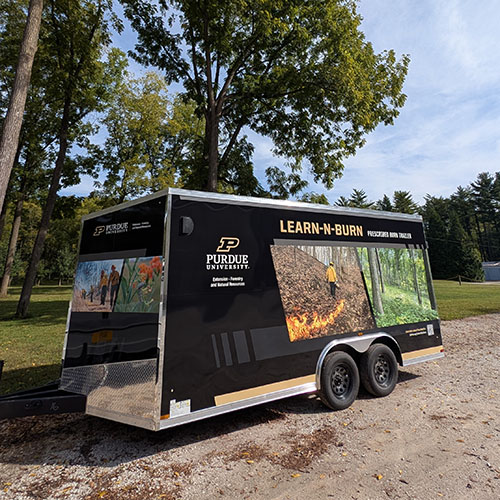
Keep your eyes peeled across Indiana for the newly minted Purdue Forestry and Natural Resources...
“Being at Purdue has changed my thinking entirely,” says Mingyu Zhao, a third-year...