

FNR Remembers Carolyn Foley, Names Great Lakes Research Award
Carolyn Foley, a long-time member of the Purdue Forestry and Natural Resources (FNR) and Illinois-Indiana Sea Grant (IISG) staff, passed away on April 22, 2026. A celebration of life will take place in late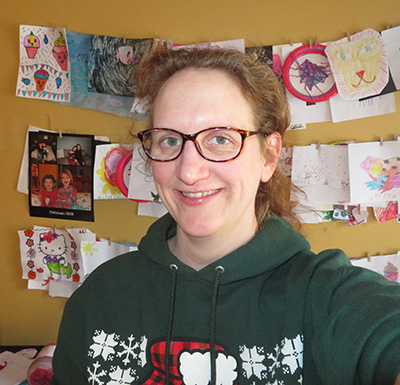 October in Midland, Michigan, and an undergraduate research award in her honor has been announced.
Born in Windsor, Ontario, Canada, Carolyn grew up in Amherstburg and completed her bachelor’s degree in honors biology with a thesis at the University of Windsor under Dr. Jan Ciberowski. She then came to Purdue to work on a master’s degree under Dr. Jeff Holland in the Department of Entomology. While on campus, she met her husband, Dave Ewoldt, at a bus stop. The two married in 2011 and had two children, Penelope and William.
Ciberowski, professor emeritus at the University of Windsor and recently retired professor at the University of Alberta, taught Carolyn in two undergraduate classes. Foley then joined his lab and spent two field seasons as a summer research assistant, leading a field crew all around the Great Lakes to sample wetland aquatic invertebrates, vegetation, fishes and water. Carolyn and her team “braved wind, water, biting flies, and uncooperative vans and boats to sample lakes Michigan, Erie and Ontario each summer.” She then she stayed on to serve as a coordinator and data manager on a multi-agency research project to sample and inventory the aquatic invertebrates of Lake Erie.
“Her energy, enthusiasm and love of fieldwork were infectious and they kept her team motivated. Carolyn was one of the most gifted and committed individuals to have ever worked in our group, and she made a lasting impression on everyone,” explained Ciberowski. “I don’t think we’d have successfully completed either our shoreline field seasons or the Lake Erie survey without her ability to lead and keep people engaged in and committed to their work. She was so interested in everything that it was a pleasure to discuss the week’s plans, accomplishments, breaking science news stories and the latest bit of trivia. She was equally enthusiastic in telling others about her discoveries and could stimulate their interest in what could otherwise be the most mundane things imaginable. Seeing people like Carolyn learn and excel has been the real reward of an academic career.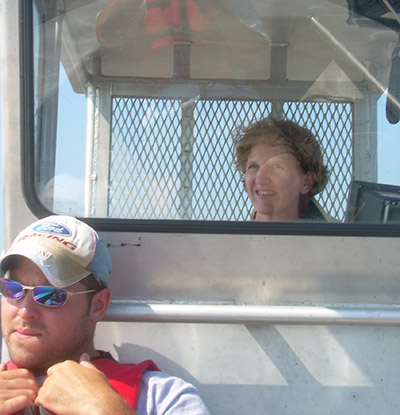
“We stayed in touch over the years, mainly exchanging bad jokes and Great Lakes research stories. Carolyn had a great sense of humor and a similar perspective on what was funny. I always looked forward to her email messages, recounting the latest adventures and observations of her, her family and colleagues. To this day, I still smile (when I think of) her question, “What do you call a fish with no eyes”? (Answer: “a fsh”)”
Professionally, Carolyn joined Purdue FNR in January 2009, working on a variety of aquatic ecology research projects with faculty, staff, postdoctoral scholars and students. She authored and co-authored research papers, synthetic reports and outreach publications; developed proposals; co-taught courses and trained a multitude of students.
“Carolyn was the first person I hired when I came to Purdue and career-wise I was extremely lucky to work with her as a close collaborator on all sorts of projects over the next 18 years,” FNR department head Tomas Höök said. “I am even luckier to have known the dedicated and caring person who made all those around her better. Being around Carolyn made you strive to be a better person.”
In 2010, Carolyn started to work with IISG, first as an assistant research coordinator and later as the research coordinator.
“Carolyn was chiefly responsible for leading IISG’s competitive research program, but she did so much more,” Hook, the former IISG director, continued. “She co-hosted a podcast, helped develop IISG’s buoy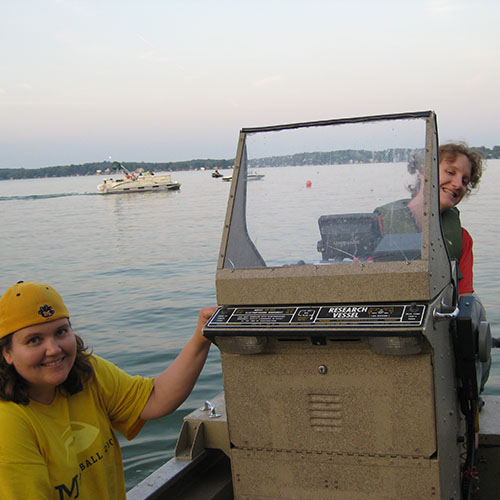 program and its associated social media, developed IISG’s Sea Grant Scholars program and led workshops on Great Lakes ecology and resilience. She was highly valued throughout the Sea Grant program, and served as the chair of the National Sea Grant Research Coordinators network and chair of the Great Lakes Sea Grant Research Coordinators.”
Current IISG director Stuart Carlton recalled the many ways Carolyn impacted his life and those of all of her colleagues.
“Carolyn was an invaluable part of Illinois-Indiana Sea Grant and was beloved by people across the greater Sea Grant network,” Carlton said. “She was a dear friend, a trusted confidante and the most thoughtful and caring person I knew. She was a nerd’s nerd with unusual empathy and a wonderful sense of humor. I miss her greatly.”
Carolyn was recognized for her leadership, resourcefulness and selfless contributions to FNR and IISG as well as her diversity, equity, inclusion and belonging efforts for both organizations as FNR’s 2023 Outstanding Administrative/Professional Staff Member. She also received the Purdue College of Agriculture’s Unsung Diversity Hero Award in 2021.
Carolyn’s legacy is not only found in the work that she did, but in the people she supported and the example she set throughout her life.
Catherine Riseng PhD, emerita research scientist with the University of Michigan School for Environment and Sustainability and former research program manager and interim director for Michigan Sea Grant, often collaborated with Carolyn. The two developed and implemented common research topics for the Great Lakes region and developed a platform for graduate students at Midwest universities to share their Sea Grant funded research.
“My main memories of Carolyn are of her being very innovative, collaborative and positive – the best kind of colleague to have,” Riseng said. “She was always thinking of new ways to showcase Sea Grant research,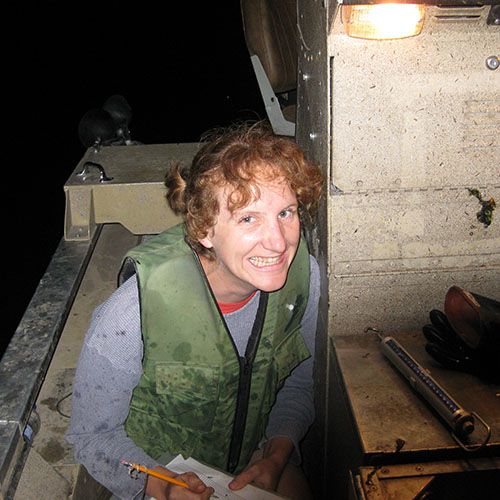 ways to cooperate with Extension and ways to collaborate to develop multi-Sea Grant projects in the Sea Grant region. Whenever I saw her at meetings and online, she always had the biggest smile and twinkle in her eye that just brought a bit of joy. I considered her one of my closest colleagues in the Sea Grant world, someone I could talk with about challenges in work and life. At national and regional meetings, I always knew she was there to share challenges and get insightful feedback and just hang out or take a walk with.”
Other colleagues recalled Carolyn’s balance of tenacity, positivity and a supportive nature.
“I absolutely loved working with Carolyn,” said Jennifer Hauxwell, associate director for research with Wisconsin Sea Grant. “She was exceedingly competent, creative, energetic, realistic yet a dreamer, driven to help people through the advancement of science. And, just as wonderfully, she made me feel appreciated and heard, respected and loved. She was the gold standard for research coordinators across the Sea Grant network. She leaned in on creating and leading when opportunities arose. She was a great listener when you were working through challenges. She had the best smile and laugh. She was a top-notch scientist.
“The privilege of working with Carolyn was a gift in my career and my life. I treasure the time we had together and think of her often as an example to live up to professionally and personally. Her last message to me was a simple ‘Hug, Jen Hauxwell.’ I treasure that because it summed up so simply the way we felt about each other as professionals and as people.”
Kate Mulvaney, a research social scientist at the U.S. Environmental Protection Agency, collaborated with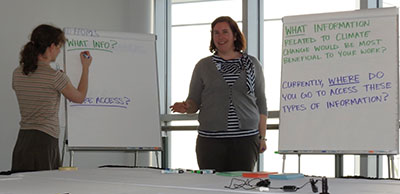 Carolyn on a NOAA climate change and fisheries research project when Mulvaney was a PhD student at Purdue (2013).
“Carolyn was so smart, interesting, kind, quirky, funny, supportive and hard working,” Mulvaney said of her colleague, with whom she visited all five Great Lakes. “Each of those traits is great on its own, but rarely do we get to have people in our lives that are all of them. We worked together on an interdisciplinary research project for which my advisor and I were the only social scientists. I often felt that I owed it to the project to understand others’ science. Carolyn encouraged me to believe that others also owed it to me to work to understand the science I was doing. This theme has played out many times in my career and I think she’s given me a little extra spine in a lot of circumstances.”
Carolyn’s impact on the many colleagues and students she worked will be felt long into the future.
Charlie Roswell, a master’s student (2011) and researcher in the Höök lab from 2009 to 2013, said Carolyn taught him how to manage undergraduate students with a wide range of backgrounds and how to be a better scientist.
“Carolyn cared; that’s the summary,” said Roswell, now an assistant aquatic ecologist at the Illinois Natural History Survey’s Lake Michigan Biological Station. “In every interaction she had with people, even if she was critical about something or pushing folks to be a little better or do a little more, there was never any doubt that she had others’ best interests in mind. She wasn’t self-serving, but instead was always helping those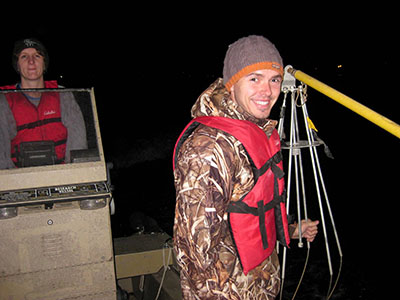 around her to be better versions of themselves. If she didn’t know the answer, she could connect you with someone who did. Knowing her has helped me remind myself to self evaluate a little more often and look for ways to be better, especially in listening to voices of those less privileged than myself. She helped give me the perspective that being a scientist/ecologist is about continuous growth, a path shared across all levels of experience.”
Current FNR undergraduate researcher Sarah Agostin said Carolyn helped her develop research skills as a technician on Illinois-Indiana Sea Grant projects, as well as connect with and learn about the professional field.
“She was supportive and kind,” Agostin said. “She was great at teaching me the ropes of getting into ‘real-world’ research and was always supportive of the work I did for her. Even when I didn’t do something right, she would always make it a learning opportunity and never make me feel bad for it. Thanks to the work Carolyn gave me the opportunity to do, I have been able to carry on my own independent research in a similar direction using what she taught me. We also bonded over stories about our pets when they would frequently interrupt zoom work meetings, which was always a welcome thing.”
Sara (Andree) Craft, now an environmental scientist advisor with the Kentucky Division of Water, also credits Carolyn with guiding her as a student and along her career path.
“Carolyn was one of a few folks who supported me early in my career and took an interest in helping me succeed when I arrived at Purdue in 2011 as a culture-shocked undergrad from an impoverished background who knew next to nothing about fisheries but had chosen to study them anyway,” Craft, a 2014 fisheries and aquatic sciences alumna, shared. “She had a gift for making those around her feel seen and welcomed in spaces that are not always the most approachable. By being her own unapologetically weird, curmudgeonly, but ultimately very kind self, she made others feel at ease and gave us permission to be our authentic selves as well. Whether raging against a new piece of legislation or poring over a cool bug, she allowed herself to experience all of life’s highs and lows in an uncommonly honest and vulnerable way. Over the years, Carolyn was always someone who proactively continued to check in on me and commiserate with me as well as motivate me throughout many phases of my early career.
“I have always thought of Carolyn as someone I wanted to be more like, as a scientist and as a person. As I have gotten further in my career and had the opportunity to encourage and foster the growth of students and young professionals, I have been conscious of the gift that I received in knowing Carolyn Foley. I will be forever grateful and I hope forever mindful of the example that she set for me early on of what it means to do science and scientific communication with integrity, humility and compassion for one’s fellows.”
To continue to remember Carolyn’s legacy, FNR and Illinois-Indiana Sea Grant have created an undergraduate Great Lakes research award in her honor. Click the link to donate to the Carolyn Foley Great Lakes Research Award.
Featured Stories
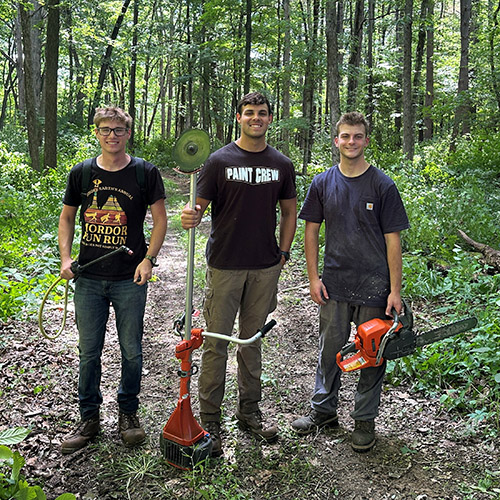
Senior Isaac Johnson, a forestry major with a concentration in forest management, worked as an...
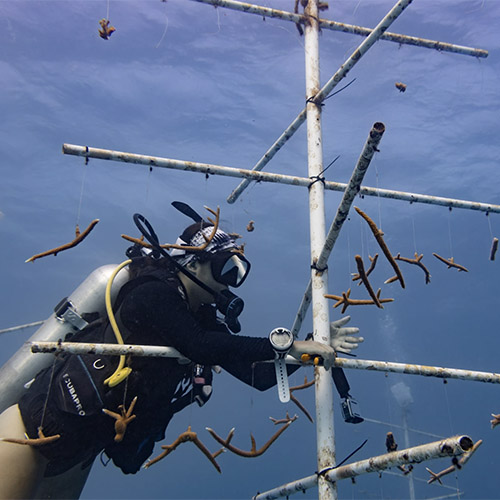
Ashlynn McLaughlin, a senior aquatic sciences major with a concentration in marine and freshwater...
Purdue University’s College of Agriculture recognized nine alumni at the Distinguished...
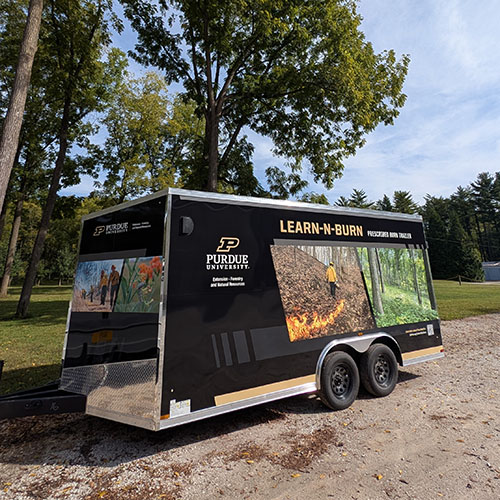
Keep your eyes peeled across Indiana for the newly minted Purdue Forestry and Natural Resources...
Senior wildlife major Madison Medley spent her summer as a natural resource intern with Hamilton...
Addy Ellis, a sophomore aquatic sciences and political science double major, spent the summer as...