

Of mice, birds and men: Purdue researcher builds a simulation of how wild birds and rodents affect the spread of avian flu on farms
At age 15, Jared Trask transformed his family’s kitchen in Newfoundland, Canada, into his own science lab. Bottles of algae covered their breakfast nook, and Trask used his free time doing what most teenagers can only dream of: gathering fish waste and turning it into a biodiesel.
Biofuels may have been his beginning, but Trask has explored all sorts of disciplines. He studied in a genetics lab, majoring in behavioral neuroscience as an undergraduate. For a few years after, he did biomedical research at the Center for Mental Health and Addiction Services, looking at novel drugs to treat depression and anxiety. In Trask’s master’s program, he studied ways to treat post-traumatic stress disorder in female mice and was introduced to his next career — studying how effective ultrasonic (noises at wavelengths above what humans can hear) plug-ins are at deterring rodents.
“Rats and mice are often portrayed to be the villains because they've been associated with plague and disease, and they get a bad rap,” Trask said. “When I was younger, I had the opportunity after I was done with a study to take home a couple of mice and rats. That's when I really fell in love with them. They really have personalities, and they're actually quite smart. I sort of got known as ‘The Rodent Guy.’”
Trask is writing a new narrative about rats, birds and people as he pursues his doctorate in Purdue’s Animal Sciences and Forestry and Natural Resources departments. Using computer simulation, he is predicting how wild birds and rodents might move around different farm setups, where that might pose risks to hens, and how changing some aspects of the landscape or farm could reduce risk to the avian flu or other contamination.
“A simulation enables us to test scenarios that otherwise could be costly or dangerous, so we can look at disease scenarios and what happens if a disease gets inside a farm, or see what happens if we make changes to try to prevent disease getting there,” Trask said. “I often compare it to a farming game or The Sims.”
Building a simulation that accurately predicts the behaviors of wildlife and other points of interest on the farm requires data. To model rodents, Trask spends a lot of time out on Purdue’s Animal Sciences Research and Education Center (ASREC) figuring out how rats and mice are getting into facilities, measuring their populations and trying out new management practices around the farm to see how they respond. Trask places “chew cards,” small index cards covered in canola oil to attract rodents, and then checks the amount and pattern of bites to find out what animals are where. Over time, when the environment changes, those cards allow him to see the impact on the rodent populations around the farm.
Trask and the poultry management lab at Purdue are also listening to rodents. They’ve placed ultrasonic microphone recorders at ASREC to hear rodents communicating with each other. Different species can have specific calls for fear, mating, socializing and calling others to come over. Trask is hoping to use what they learn about rodent communication in farm management — for instance, playing the fear call where farmers don’t want rats around. His lab is also using recordings to measure what wild birds are around at different times of the year using their calls, which might help them identify times of increased risk for the avian flu, like migration, which require greater biosecurity on the farm.
“This isn’t New York City, and I’m not here to impose a war on rats,” Trask said. “We don’t need to get rid of rodents — we just need to manage them. Maybe give them alternative environments. Think about if someone put up a hotel that you could get in whenever you wanted and they had free food and snacks, you would be living there, too. It’s about changing our behavior as people and managing the relationship between us and rodents, because they like to live where we are. It’s the nature of them.”
By improving their relationship, humans and rodents will both benefit. Urban spaces will be cleaner, rats and mice would have safe places to live and nest, and poultry farms might better protect their flocks from the H1N1 virus.
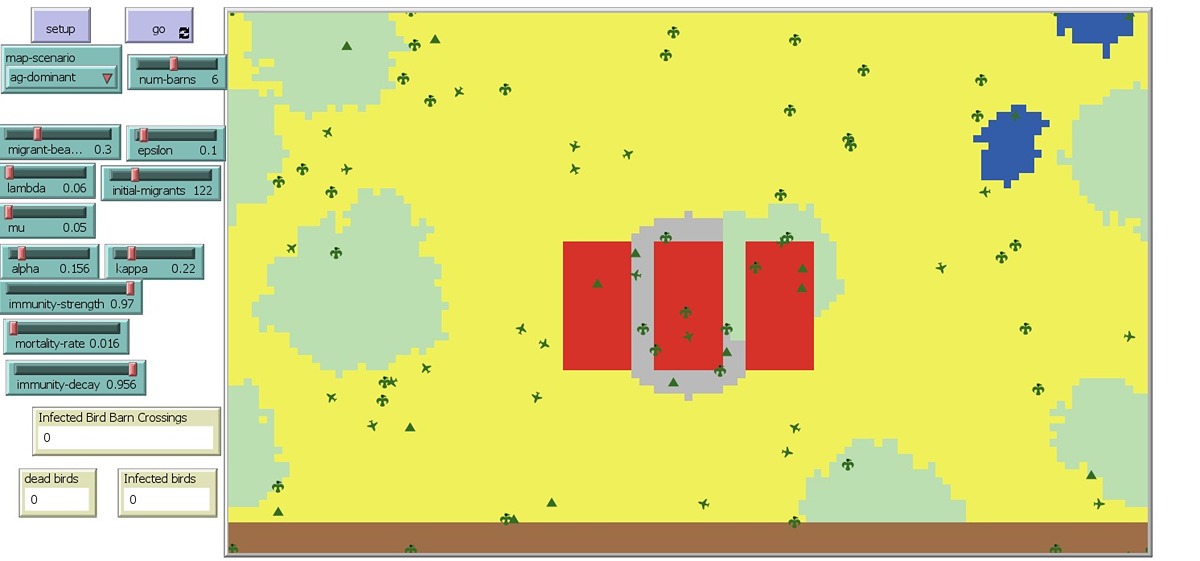 , opens larger image Jared Trask has built two simulations, one of migratory bird patterns (pictured above) and one of rodents. He will soon combine these into one model to predict the spread of the avian flu.
 Simulations like Trask’s aren’t new. The finance industry has been using and trusting them for several years, and models sometimes influence company and legal policies as well. Trask is hoping his simulation will bring this predictive power to poultry farmers, who could use it to figure out how best to prevent contamination from rodents and protect their farms from avian flu or other diseases they may be carriers of.
Where simulations represent how events could unfold after different conditions are applied, Trask is looking into another emerging type of modeling for the future of his simulation — digital twins. Digital twins are like a carbon copy of the real thing they simulate, just digitalized. They require more sensors, more data collection and more computer processing than a simulation does. They can get messy and complicated, but they reduce the assumptions a representative model makes for simplicity.
Trask didn’t make this alone, and his next steps won’t be taken by himself either. He said, “A lot of this work is interdisciplinary, and I think that’s my goal going forward. In my work, there’s contributions from animal sciences, computer sciences and quantitative studies. It’s such a team effort.” Not only does that collaboration between fields strengthen the project, but it also teaches all those involved about research outside of their normal realms.
Featured Stories
PFAS have been shown to increase risks to immunity, reproductive health, developmental delays,...
Senior Isaac Johnson, a forestry major with a concentration in forest management, worked as an...
Alisa Tilson (BS '96, Natural Resources and Environmental Science) works for CDOT’s...
Behind every jar of honey is a fascinating story of pollination, research, and hands-on learning....
Maksym Chepeliev, a leading international scholar recognized prominently for his work in...
In recent years attendees at Purdue Agriculture alumni, donor, and faculty and staff events have...