

Grimes Researching Vineyard Sustainability, Biodiversity
You never know where you will end up when you take advantage of the opportunities available to you. 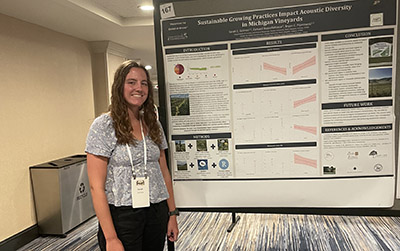
PhD student Sarah Grimes was always interested in nature as a child. She spent a lot of time in the woods at her parents’ house in Plainwell, Michigan, and at Lake Michigan.
When she went to Hope College for her undergraduate studies, she knew she wanted to get experience working with wildlife. The biology and psychology major found research opportunities working with birds was of the few ways to do so.
“I was not always interested in birds, but developed that interest through my research experiences,” Grimes said. “I did research with house sparrows and house finches. My mentor was Dr. Kelly Ronald, who inspired me to pursue graduate school.”
Grimes’ research included conducted a sound propagation study to determine the effect of urbanization (i.e., anthropogenic noise) on house sparrow and house finch song. She also performed behavioral studies to examine bird antipredator and foraging behavior after exposure to air pollution.
After completing her bachelor’s degree from Hope in 2023, Grimes went straight into her PhD program at Purdue.
“I really enjoyed the liberal arts program at Hope College and hoped to earn my PhD at an institution that offered interdisciplinary programs, which was what first drew me to the Ecological Sciences and Engineering program at Purdue,” Grimes shared. “I wanted to meet and collaborate with people outside my discipline. My undergraduate research was on avian vocalizations, so I connected with Dr. Bryan Pijanowski to inquire about his soundscape ecology work.”
Unbeknownst to Grimes, Pijanowski shared a similar path. He too went to Hope College, earning his bachelor’s in biology 40 years earlier (1983). He also did research on birds, working under ornithologist Dr. Eldon Greij, founder of Birder’s World magazine, who passed away last year.
“He convinced me to be an ecologist,” Pijanowski said. “I remember the day well and tell this story in all of my classes. He changed my life. I was pre-med at the time.”
Similarly, working with Pijanowski in his field of expertise has changed Grimes’ career path.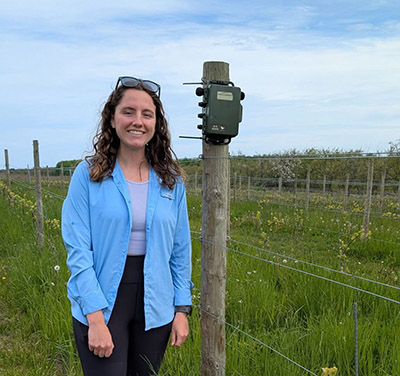
“I was not always interested in acoustic monitoring and did not truly know about it until joining Bryan’s lab, but I now recognize the importance of soundscape ecology as a discipline for landscape management,” Grimes said. “I entered Purdue hoping to become a wildlife biologist, but now after completing my PhD I hope to work a land conservancy, ecological consultant or other similar organization that prioritizes landscape conservation.”
The Research
Grimes’ work in the Pijanowski lab focuses on how sustainable management practices at vineyards can increase biodiversity, reduce negative impacts of farm operations and create more efficient management for operators.
“My research investigates how sustainable growing practices and management affect biodiversity in specialty cropping systems, specifically vineyards which grow grapes for wine production,” Grimes explained. “The initial goal was to investigate biodiversity across different certifications (comparing organic vineyards to conventional vineyards) in one project, and the other project investigated how cover crops affect vineyard biodiversity. The importance of the research and findings include aspects like encouraging vineyard growers to use nature-based solutions (such as cover crops or outlawing pesticides) and instead enhance biodiversity on their vineyards, which then improves ecosystem services provided by nature. One good example of this is cover crops increase pollinator habitat, and the increases in pollinator diversity then improve pollination services to crops. Overall, I hope my results will encourage the use of sustainable growing practices in vineyards to enhance vineyard biodiversity.”
Although her data collection took place in Michigan and analysis is not yet complete, Grimes says her results should be widely applicable and impactful to Indiana vineyard owners and managers and others across the country.
“Although this project is ongoing, we will be able to make specific recommendations for growing practices to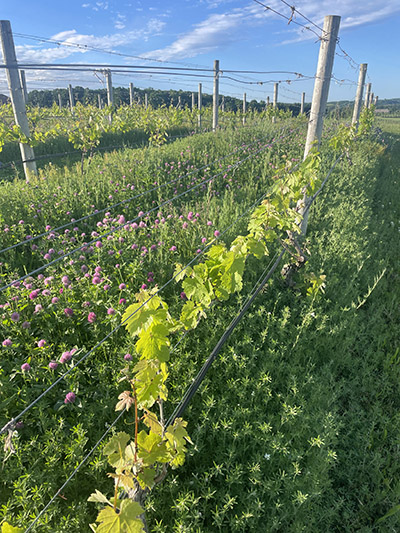 vineyard managers,” Grimes said. “Preliminary analyses suggests that vineyards can increase biodiversity by maintaining cover crop vegetation height at about 30 centimeters, as this is when biodiversity peaks. Preliminary findings also suggest that organic vineyards tend to have a higher probability of detecting bird species who are either threatened, endangered or a Michigan Species of Concern, suggesting that organic growing practices enhance biodiversity. Preliminary results also showed that maintaining high amounts of natural area such as trees around the vineyard improves biodiversity.
“We also found that bird activity is greatest on the exterior rows of vineyards. This is important as exterior rows may be most vulnerable to bird damage, and that vineyard managers can tailor bird management to exterior rows rather than applying management techniques like bird netting throughout the entire vineyard, which thus reduces labor and financial costs of management. Secondly, this finding also suggests conversely that exterior rows may be most important for maintaining vineyard biodiversity as those locations harbor the most wildlife.
“Overall, as I continue to discern project results, we will be able to discover what growing practices and habitat management are best to enhance biodiversity without sacrificing farm yield and profit. Also, farmers may see financial benefits of investing in sustainable growing practices as other studies have shown that wine consumers are willing to pay more money for sustainably produced wine products.”
This project fits into the broader scope of sustainable agriculture work, which aims to reduce the negative impacts of farm operations and reduce the biodiversity loss which is associated with agricultural land use.
“Sarah's work takes a next giant leap into the use of advanced acoustic monitoring technologies, AI, and habitat modeling to determine if alternative agricultural practices can benefit the environment,” Pijanowski said. “Her breakthroughs are innovative and consequential.”
Grimes has already begun sharing her findings at science and vineyard related conference across the country. She presented “Using Acoustics to Monitor the Impact of Growing Practices on Bird Habitat Selection and Biodiversity” at the 2025 Michigan Spring Grape Kick-Off meeting. She also shared a poster detailing how “Sustainable Growing Practices Impact Acoustic Diversity in Michigan Vineyards” at the American Ornithological Conference last year. Grimes gave poster presentations on “The Effect of Sustainable Cover Crop Growing Practices on Avian Habitat Selection in Vineyards of the Northwest Lower Peninsula of Michigan” at the International Congress of Conservation Biology meeting in Brisbane, Australia, and at FNR’s own poster symposium this spring.
When she isn’t hard at work in the classroom, the field or the lab, you can find Grimes running, hanging out with her dog, writing, reading and spending time with her fiancé, friends and family.
Related Publications and Presentations:
Grimes, SE., Nasrollahiazar, E., Pijanowski, BC. (2025). Using Acoustics to Monitor the Impact of Growing Practices on Bird Habitat Selection and Biodiversity [Oral presentation]. Presented virtually at the 2025 Michigan Spring Grape Kick-Off Meeting.
Grimes, SE., Nasrollahiazar, E., Pijanowski, BC. (2025). Sustainable Growing Practices Impact Acoustic Diversity in Michigan Vineyards [Poster presentation]. Presented at the American Ornithological Conference in St. Louis, MO.
Grimes, SE., Nasrollahiazar, E., Pijanowski, BC. (2025). The Effect of Sustainable Cover Crop Growing Practices on Avian Habitat Selection in Vineyards of the Northwest Lower Peninsula of Michigan [Poster presentation]. Presented at the International Congress on Conservation Biology in Brisbane, Australia.
Grimes, SE., Nasrollahiazar, E., Pijanowski, BC. (2025). Cover Crop Growing Practices Have Positive Impacts on Avian Habitat Selection in Fruit Cropping Systems: Applications for Michigan Vineyards [Poster presentation]. Presented at the Purdue Forestry and Natural Resources poster competition at Purdue University in West Lafayette, IN.
Featured Stories

The Office of Indiana State Chemist (OISC) is warning Indiana residents about an illegal...
A prominent protein on most human cells may be key to unlocking the code that makes humans...
Ava Hoskins, a double major in aquatic sciences (fisheries concentration) and natural resources...
Ashlynn McLaughlin, a senior aquatic sciences major with a concentration in marine and freshwater...
For Brody Cox, preparing for the Indiana State Fair began long before he entered the show...
Carolyn Foley, a long-time member of the Purdue Forestry and Natural Resources (FNR) and...