

Mayara dos Santos Rocha - Graduate Ag Research Spotlight
That’s the good thing about agronomy — you can work on so many different things and everything’s related.
- Mayara dos Santos Rocha, PhD candidate, Agronomy
The student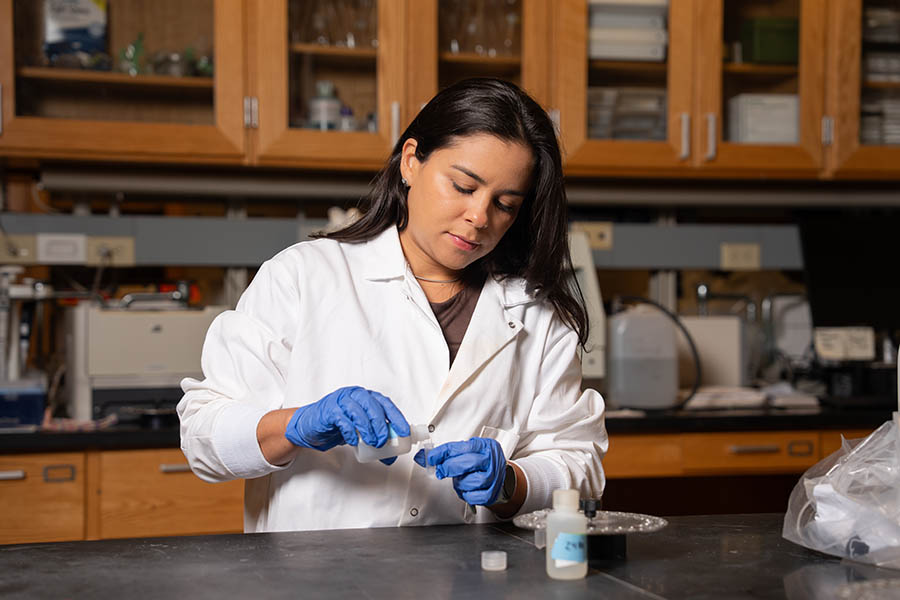
As a child in Rio de Janeiro, Mayara dos Santos Rocha loved animals so much she figured she’d become a veterinarian. But when it came time for college, her father, a former agronomy student and now a retired fisherman, suggested, “Why don’t you start in agronomy? You can work with anything,’” she recalls.
“In a way, earning my degree in agronomy felt like carrying on his dream.”
One of Rocha’s most pivotal undergrad experiences was an internship with Embrapa, Brazil’s state-owned agricultural research corporation. She worked at Embrapa Agrobiology, a center dedicated to sustainable agriculture and soil-plant-microbe interactions.
“That was my first contact with research,” she says. “I realized that was what I wanted to do.”
Rocha also had the opportunity to study abroad, spending a year and a half in Australia. There, she interned with a professor at the University of Adelaide whose laboratory was based at CSIRO, Australia's national science agency.
“It was amazing,” she says. “I figured out that doing research could open up so many opportunities.”
Rocha returned to Brazil for a master’s degree. She learned about the CAPES fellowship, an agreement between the Brazilian government and Purdue that co-funds PhD candidates in the College of Agriculture. She was accepted and began her doctoral studies in August 2021.
The research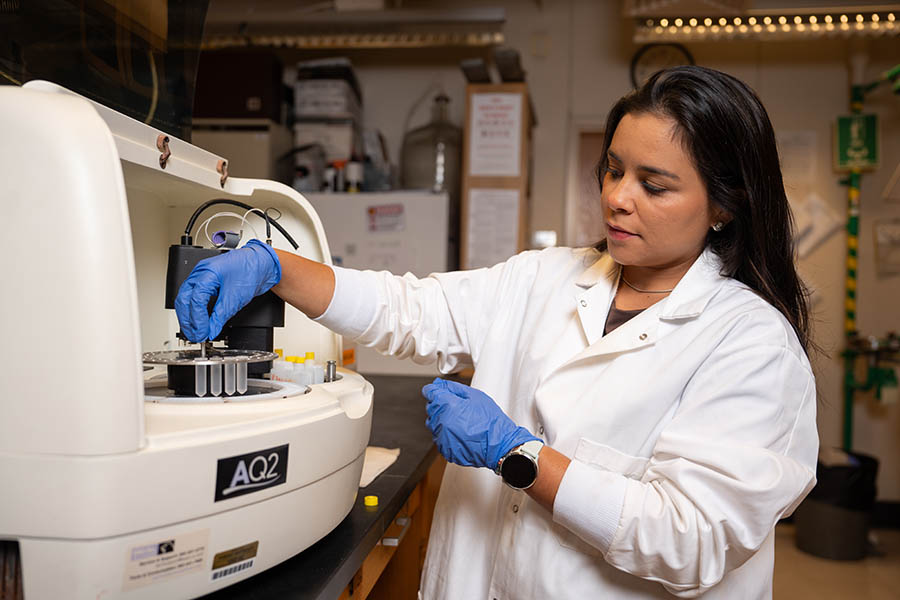
Rocha works with advisor Sylvie Brouder, professor of agronomy and Wickersham Chair of Excellence in Agricultural Research. She has three research projects, all focusing on nitrogen and carbon cycling in sustainable cropping systems.
“I study kura clover, a perennial legume that can be grown as a living mulch with corn,” Rocha says. “Kura clover has the potential to improve soil quality, reduce erosion and bring nitrogen into the system. Since it's a legume, it can fix nitrogen straight from the air.
“The hardest part of a cropping system like this is managing it carefully, so the clover isn't competing with our cash crop for water and nutrients, especially during corn's early growth stages, which is the most critical period.”
This research takes place at Purdue’s Water Quality Field Station (WQFS), a 10-acre research site with 48 plots. Every plot has a drainage lysimeter, which lets researchers measure subsurface drainage water and collect samples after rainfall. They also track greenhouse gas emissions using airtight containers called static chambers, which Rocha and the rest of the team check weekly from April through December.
“One of the goals of my project is to do a nitrogen balance,” Rocha says. “Working at the WQFS, it's possible to quantify how much nitrogen this system is losing, whether through nitrate leaching or through denitrification, which we track via N2O emissions. The big question we're trying to answer is: Can we get all these benefits from kura clover without decreasing corn yield?”
A second project, with co-advisor Jeffrey Volenec, a professor of agronomy specializing in crop physiology, looks at the morphological and physiological mechanisms that make kura clover tolerant of herbicides and defoliation.
“That’s the good thing about agronomy — you can work on so many different things and everything’s related,” Rocha says.
A third, lab-based project, with professor emeritus Jim Camberato, involves determining the impact of residue management techniques on nitrogen loss through another pathway, ammonia volatilization, from kura clover and cereal rye tissues.
Rocha is currently deep in the dissertation writing process; she expects to graduate next spring.
Opportunities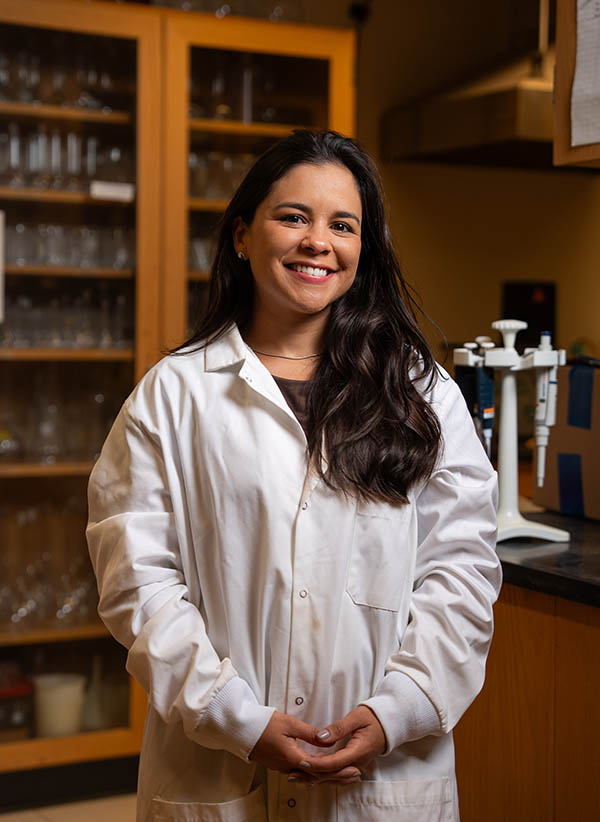
Brouder has been a fantastic advisor, Rocha says. “She gives me lots of independence, which at first I found a bit difficult because it was so different to me, but now I’m used to it. She really understands the struggles of international students.”
Rocha is vice president of the Agronomy Graduate Student Association, participates in an organization for Latinas in earth and planetary sciences, and has attended conferences all over the U.S.
“I met the people I cite in my papers,” she says. “It’s amazing!”
Rocha participated in Bayer’s B4U, a competitive program matching students with industry researchers.
Future plans
Rocha spends her weekends cooking and hiking with a large group of Brazilian friends who are like family, she says. Though she admits she misses the beaches of Brazil, she’s compensated with a new hobby: running. She’s done two half-marathons and plans to finish another in September.
After graduation, Rocha hopes to find a research job in industry.
“Fingers crossed!” she says.
More Graduate Spotlights
“Being at Purdue has changed my thinking entirely,” says Mingyu Zhao, a third-year...
Most parents want to encourage their child’s hobbies, signing them up for chess club,...
At 25, Noah Berning has already accomplished a goal held since middle school: he’s going to...

Growing up in lush northern Florida, Natalie Allen spent much of her childhood outdoors, catching...
When Elizabeth Ogar was growing up in Nigeria, a weevil infestation hit her family’s corn...
Luping Xu is proud to be from Ningbo, a port city in eastern China with a long history of...