

Plants employ rare method to produce valuable chemical compound
Land plants have spent nearly half a billion years honing a vast array of metabolic skills that help them survive an onslaught of ecological threats.
“Plants are great chemists,” said Xing-Qi Huang, a postdoctoral scientist in biochemistry at Purdue University. “They can easily synthesize complicated compounds without expensive catalysts and expensive equipment. Just ambient temperature, sunlight, rain and soil. That’s all it takes.”
A Purdue-led team has now discovered the unusual method that plants use to synthesize benzaldehyde. Many plant species use it to attract pollinators and as an antifungal agent. An ancient compound, benzaldehyde is also widely produced by other organisms, including microbes and insects.
“We, as humans, use it a lot,” said Natalia Dudareva, Distinguished Professor of Biochemistry, Horticulture and Landscape Architecture. Many beverages, for example, contain a bit of benzaldehyde because of its sweet, almond taste. Dudareva, Huang and colleagues at Purdue and Northeastern University in Boston published the details of their findings in Science Advances.
“Our paper focused on how the enzyme composed of two inactive subunits, which is a very rare phenomenon, catalyzes the formation of benzaldehyde and elucidates the role of each subunit in this process,” Dudareva said.
The work stems from 2022, when Dudareva’s team identified a rare phenomenon: an enzyme consisting of two inactive subunits that contribute to plant metabolism. “When they work together, they produce benzaldehyde,” a compound important to the flavor industry, Dudareva said. “We could not understand why this enzyme requires two subunits and why each subunit alone is inactive.”
To help solve this problem, Dudareva enlisted Jing-Ke Weng, professor of chemistry and chemical biology at Northeastern University. A 2009 Purdue PhD alumnus in biochemistry, Weng and his team determined the enzyme’s crystal structure at the Cornell High Energy Synchrotron Source. The crystal structure revealed the three-dimensional shape of the protein at the atomic level and how its subunits interact with their targets.
Weng’s data showed that catalysis occurs in the enzyme’s alpha subunit, with assistance from the beta subunit. “Without the beta subunit, you can’t produce anything,” she said.
The enzyme’s crystal structure shows how these subunits interact and is used to predict which amino acids are catalytically important. “A prediction sometimes happens as expected and sometimes it doesn’t,” said co-author Ji Hee Lee, who recently completed her PhD in biochemistry at Purdue. “We ended up validating what we predicted through the structure analysis.”
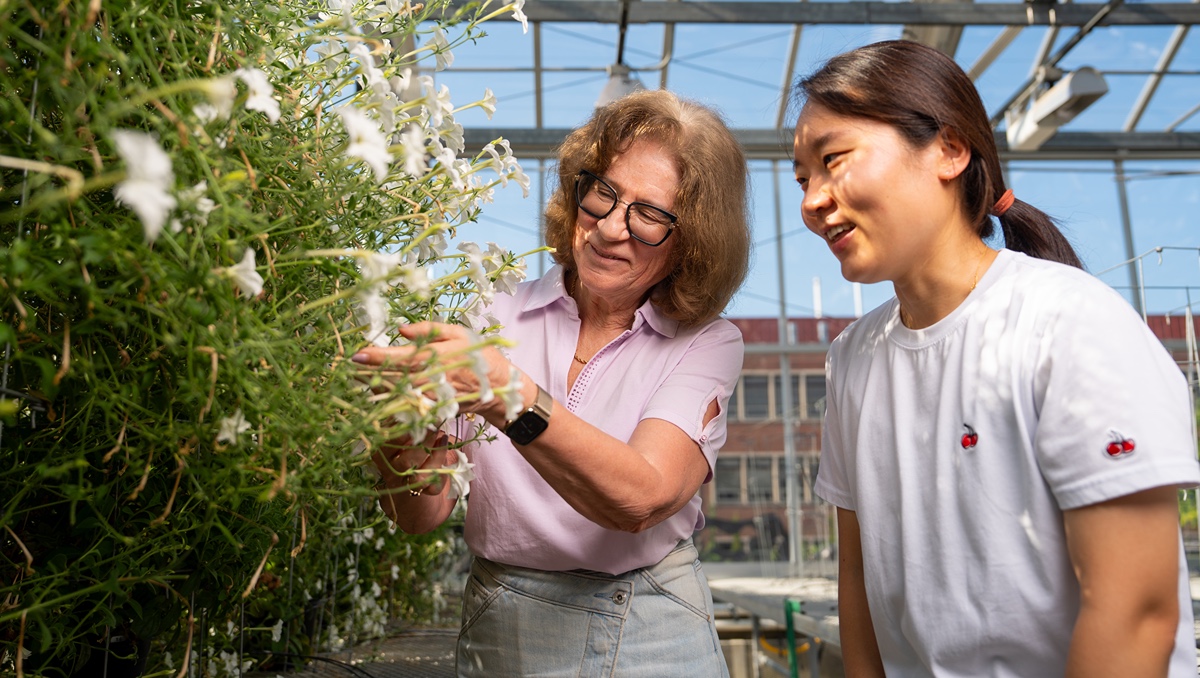 , opens larger image Natalia Dudareva (left, Distinguished Professor of Biochemistry, and Jihee Lee, who recently completed her PhD in Dudareva’s lab. Dudareva and Lee examine petunia flowers, the subject of a new publication in Science Advances.
 Lee and Huang tested the interactions between the subunits with all the mutations predicted by the crystal structure. The researchers found that the tail of the beta subunit joined with the alpha subunit to form an active enzyme.
The gene responsible for making the beta part of this enzyme is remarkably similar across many flowering plant species. “That particular subunit was catalytically inactive, since its key residues involved in catalysis were mutated. In nature, it’s not capable of catalyzing chemical reactions,” Huang said.
The alpha subunits, far more genetically diverse in plants, act as catalytic subunits. “However, the right alpha subunit has to pair with this conserved beta to be functional,” he said.
Lee analyzed the benzaldehyde production in the enzymatic reaction by replacing one amino acid with another to create a mutation. Then she performed assays to determine how those mutations affect enzyme activity. She attempted to restore activity to the beta subunit’s catalytic site with a mutation, but the effort failed.
“This mutation actually led to disruption of the alpha and beta subunit assembly. It seems like the beta subunit evolved to have a supportive role rather than contribute to the activity as a functional subunit. That surprised me,” Lee said.
Matthew Bergman, another co-author and a postdoctoral fellow in biochemistry at Purdue, did further follow-up. Applying a different method from those used by Lee and Huang, he examined how mutations in certain amino acid residues affected the formation of the alpha-beta subunit complex and target molecule binding.
“This was important to show that indeed these residues were contributing to complex formation and molecule binding,” Bergman said. It also explained whether or not activity occurred in the molecular pocket where subunits connect.
Naturally produced benzaldehyde accounts for only a few percent of its commercial applications, Dudareva noted. Lacking the critical enzyme for catalysis, commercial operations chemically convert the rest using cinnamaldehyde, a plant-derived compound. Further work on the enzyme could lead to the expansion of natural benzaldehyde production, she said.
Funding sources for this project include the Schooner Foundation, the USDA National Institute of Food and Agriculture, and the National Science Foundation-French National Research Agency and the National Sciences and Engineering Council of Canada.
Featured Stories

The Office of Indiana State Chemist (OISC) is warning Indiana residents about an illegal...
A prominent protein on most human cells may be key to unlocking the code that makes humans...
Ava Hoskins, a double major in aquatic sciences (fisheries concentration) and natural resources...

Ashlynn McLaughlin, a senior aquatic sciences major with a concentration in marine and freshwater...

For Brody Cox, preparing for the Indiana State Fair began long before he entered the show...

Carolyn Foley, a long-time member of the Purdue Forestry and Natural Resources (FNR) and...