Agricultural & Biological Engineering
New molecular diagnostics instruments provide improved accuracy
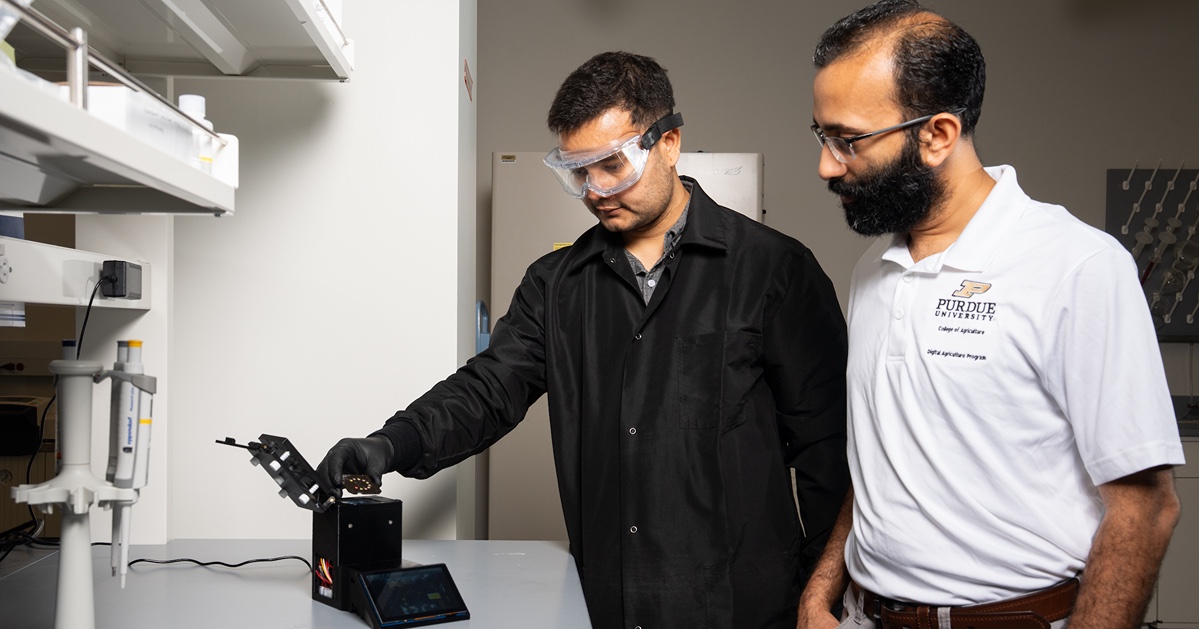
WEST LAFAYETTE, Ind. — Purdue University researchers have developed prototypes of three new molecular diagnostics instruments designed to rapidly and affordably deliver results in a user-friendly manner.
The new instruments — created by Mohit Verma, associate professor of agricultural and biological engineering, and his team — can be used for human and animal diagnostics as well as environmental and food safety monitoring. They are designed to be low-cost and point-of-need, meaning they can be used at home or in the field.
“Our goal is to create diagnostic tools that are accurate, affordable and easy to use wherever testing is needed,” Verma said. “By combining advanced molecular detection capabilities with simple, user-friendly designs, these instruments have the potential to bring more rapid testing directly to homes, farms, food production facilities and other field settings.”
Verma is the chief technology officer of Krishi, a startup company that creates molecular assays — tests that detect specific genetic sequences to diagnose infectious diseases or identify pathogens. The team has assigned their pending patents for the instruments to the Purdue Research Foundation. Verma is a leading expert in developing biosensors with a wide variety of applications, from agriculture to defense to healthcare.
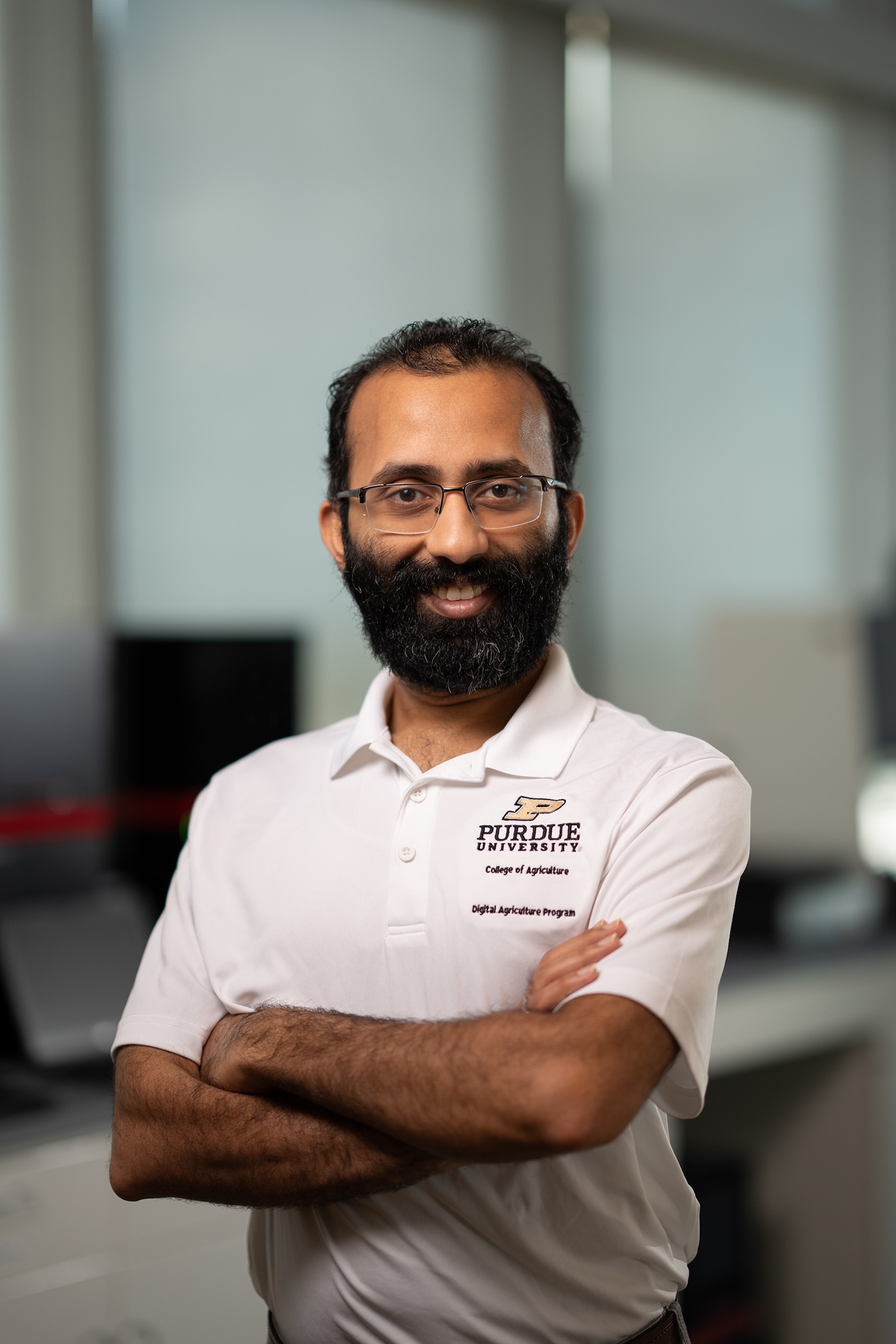 , opens larger image Mohit Verma, associate professor of agricultural and biological engineering at Purdue, and chief technology officer of Krishi, a startup company that develops molecular assays.
The instruments reflect design advancements on a new paper-based biosensor that the Verma lab developed in 2021. The biosensor employs a method called loop-mediated isothermal amplification to detect microbes by making extra copies of target nucleic acids, the blueprints of life. When the biosensor detects target DNA or RNA in a sample, it changes color.
The method first involved running biochemical reactions on a paper-based biosensor placed inside an airtight plastic cartridge to detect the pathogen that causes COVID-19. In following years, the team further demonstrated the innovation’s applications in animal health diagnostics and food safety risk management.
Verma, Bibek Raut, who recently completed his PhD in the Weldon School of Bioengineering, and their team developed three ThermiQuant™ instruments, each designed for a different setting and scale of use. They developed the ThermiQuant MegaScan for high-throughput lab use in which large amounts of samples are processed rapidly.
They also developed the ThermiQuant AquaStream, a portable benchtop instrument designed for clinics, farms and field environments, and the ThermiQuant VitroMini, a smaller, solid-state version.
In all three instruments, samples are maintained at a constant temperature. The MegaScan and AquaStream use temperature-controlled water baths, while the VitroMini uses transparent solid-state heaters constructed from indium tin oxide-coated glass and an aluminum heater. All three instruments use custom-built Amplimetrics software, off-board for MegaScan, onboard for the other two. The AquaStream and VitroMini instruments process reaction runs on a miniature computer to generate results.
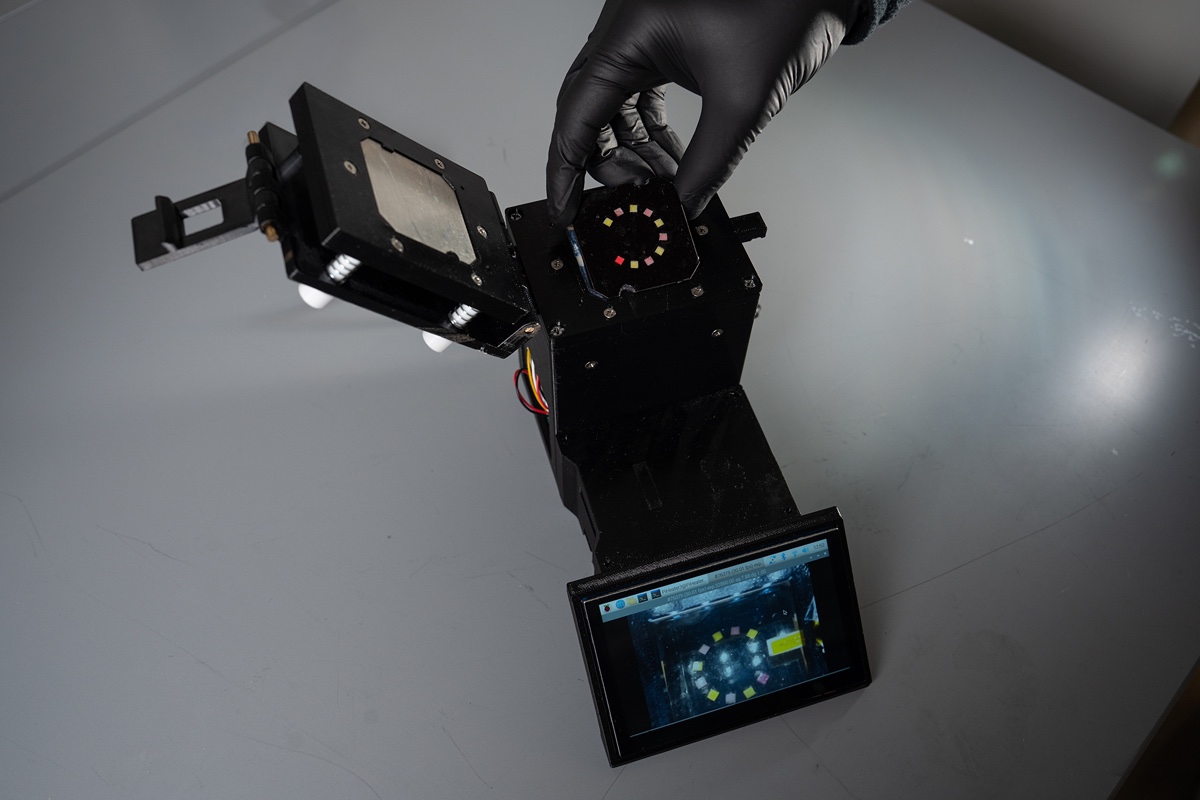 , opens larger image Samples placed in the ThermiQuantTM VitroMini instrument developed in the Verma Lab at Purdue. The VitroMini is one of three new molecular diagnostics instruments the Verma Lab has recently introduced for broad application to animal health, human health and environmental monitoring.
The paper-based biosensor developed in 2021 allowed naked-eye interpretation. To eliminate user subjectivity, the Verma Lab decided to build an instrument that left interpretation to software.
In 2024, Verma, along with Jiangshan Wang, now a postdoctoral scientist, and associates introduced their first instrument that included a water bath and a camera for time-lapse imaging. The instrument served mainly as a proof-of-concept system that still required substantial manual processing. Verma’s team has refined the method to make the color-based results easier to read, while also adding the ability to estimate DNA target concentrations in similar but unknown samples.
MegaScan is designed so researchers can focus on multiple DNA targets with an array of tests at the same time. Including a scanner in the MegaScan instrument provides high-quality images once every 30 seconds. The instrument uses data collected over an hour to reconstruct color changes that show a positive or negative reaction.
Most instruments built for high-throughput molecular analysis use narrow beams of light to take single-point measurements in widely used, tube-based reactions. But reactions vary across the pads used in the paper-based tests, which required Verma’s team to custom build a system that images the entire reaction area.
The portable AquaStream instrument uses a camera instead of a scanner. AquaStream also reduces the need for multiple instruments that create lab workflow issues.
To accelerate their workflow, many labs start the testing process with tube-based liquid assays, then translate those results to paper. This requires two instruments that yield different results. AquaStream allows users to run their tests with paper or tube-based reactions in one instrument for consistent results.
User feedback received after AquaStream field testing led to the VitroMini, a solid-state version that eliminated the water bath.
This instrument contains onboard software in a much smaller device. It also solves a widely reported problem with instruments that use a single-sided thin-film heater to heat their reactions. That system heats only one side of the test chip, leaving the other side exposed to ambient conditions, which produces a wide temperature gradient that affects the reactions.
To solve that problem, VitroMini includes a dual-sided heating design with a transparent heater on the other side of the sample. This maintains a stable and accurate reaction temperature under simulated cold and hot outdoor conditions ranging from 4 to 50 degrees Celsius (39 to 122 degrees Fahrenheit), while capturing time-lapse images through the heater to track real-time color changes.
Verma’s team now seeks to design a handheld instrument. Back in his home country of Nepal in 2021 during the COVID-19 outbreak, Raut wanted to get tested after coming down with a fever. But even the major city where he lived lacked an adequate supply of test kits.
“That got me curious about how we could solve this problem,” Raut said. Specializing in molecular diagnostics at Purdue, he learned that much of the needed biotechnology already exists. But engineering problems, which include making the technology user-friendly, remain unsolved.
“I realized that I could use my engineering skills to develop broadly applicable technology, at much lower cost, not just in the U.S. but globally,” he said.
Funding sources for this work include the U.S. Department of Agriculture, Center for Produce Safety, the Foundation for Food and Agriculture Research, Applied Research Institute, Krishi, and Purdue University.
About Purdue Agriculture
Purdue University’s College of Agriculture is one of the world’s leading colleges of agricultural, food, life and natural resource sciences. The college is committed to preparing students to make a difference in whatever careers they pursue; stretching the frontiers of science to discover solutions to some of our most pressing global, regional and local challenges; and, through Purdue Extension and other engagement programs, educating the people of Indiana, the nation and the world to improve their lives and livelihoods. To learn more about Purdue Agriculture, visit this site.
About Purdue University
Purdue University is a research institution ranked among the top 10 public universities in the United States. More than 111,000 students study at Purdue across multiple campuses, including more than 57,000 at our main campus locations in West Lafayette and Indianapolis. As a land-grant university committed to affordability and accessibility, Purdue’s main campus has frozen tuition 14 years in a row, enabling more students than ever to graduate debt-free.
Writer: Steve Koppes
Media contact: Lindsey Macdonald, macdonl@purdue.edu
Sources: Mohit Verma, msverma@purdue.edu
Agricultural Communications: Maureen Manier, mmanier@purdue.edu, 765-494-8415
Journalist Assets: Publication quality images and videos can be obtained at this, link