

Calculating the cost of heat stress on the global economy
Record-breaking heat and humidity gripped much of the United States, Europe, Africa and Asia this past summer. These extended periods of extreme temperatures damaged crops and strained power and transportation systems. They also took a toll on workers, especially those working outdoors, putting millions at risk of heat stress.
Heat stress occurs when high temperatures and humidity make it difficult for the body to cool itself. Agriculture, construction, mining and other workers in physically demanding jobs can experience fatigue, nausea and heat stroke, which can lead to missed workdays and lower productivity.
As extreme heat events become more frequent and widespread, the costs can add up. To better understand such impacts, a team of researchers, including three from Purdue University’s Center for Global Trade Analysis, examined how lost productivity due to climate-caused heat stress affects the global economy.
“Our question was very simple: What happens to the economy when people cannot work efficiently in extreme heat? We wanted to put a dollar value on the impacts, and we found that the result can be substantial." says Iman Haqiqi, associate director of the center.
To quantify the effects of heat stress, Haqiqi and his fellow researchers analyzed the varying complexities of labor conditions, industry sectors, geography and climate. The result is a new framework that adds an average of $41 per ton of carbon (CO2) to the social cost of carbon, a widely used estimate of the economic damage caused by climate change.
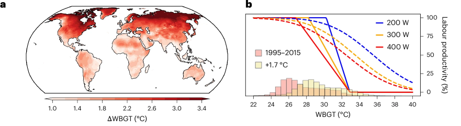 , opens larger image a. Projected increase in annual average heat stress (WBGT) under a +1.7 °C warming scenario. b. How heat affects labor productivity at different work intensities, shown using two established physiological response models (ISO and Lancet). Source: Moore et al. (2026)
This estimate is more comprehensive and accurate both in terms of the biological impacts of heat stress on people and the global economic impact, explains Tom Hertel, executive director of the center. “The economic impact of climate-induced human heat stress on workers’ productivity was not previously included in assessments of the social cost of carbon,” Hertel says. “Including this component is important since the social cost of carbon is used to assess the costs and benefits of investments in publicly funded projects around the world.”
In addition to Haqiqi and Hertel, the other multidisciplinary research team members are Uris Baldos (Agricultural Economics) and Matthew Huber (Earth, Atmospheric and Planetary Sciences) from Purdue, as well as Frances C. Moore (Environmental Science and Policy) and Hamsa Ganapathi (Geography Graduate Group) from University of California, Davis; Qinqin Kong (Woods Institute for the Environment), and Lisa Rennels (Doerr School of Sustainability) from Stanford University. The group’s findings and analyses were recently published in Nature Climate Change.
The framework integrates actions taken to mitigate the impact of heat on worker productivity, which is one reason why its labor-loss estimates are more accurate. For example, cooling cabins equipped with fans or air conditioning provided for construction or agricultural workers to periodically rest and recover help offset the negative impacts of the extreme heat on their productivity.
“Solutions like these can create benefits for businesses and workers that are bigger than their costs. That can give early adopters a competitive advantage over others, especially as temperatures continue to rise,” Haqiqi says.
Simple solutions can also be very effective. “Productivity improves and losses are lowered simply by providing shade and hydration breaks for workers,” he adds.
“Taking into account the impact of human heat stress on labor productivity can change the balance of costs and benefits of new investments in technology for agriculture, as well as other sectors of the economy,” Hertel says.
“Heat stress isn’t only a health issue.” Haqiqi adds. “By highlighting the economic impact on jobs and the economy, people can begin to see that protecting workers in these conditions is also a smart economic choice for business.”
Q&A with an agricultural economist

Featured Stories
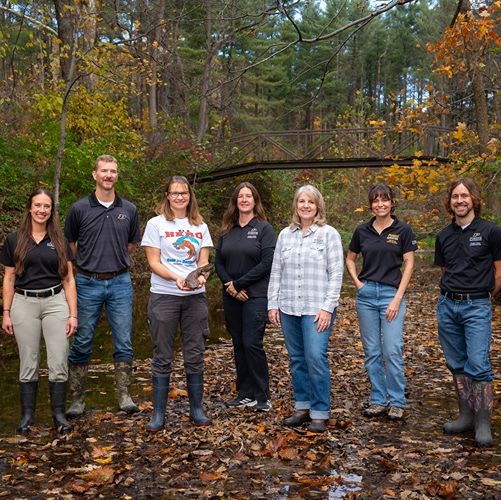
The Help the Hellbender research program, which is housed within the Department of Forestry and...
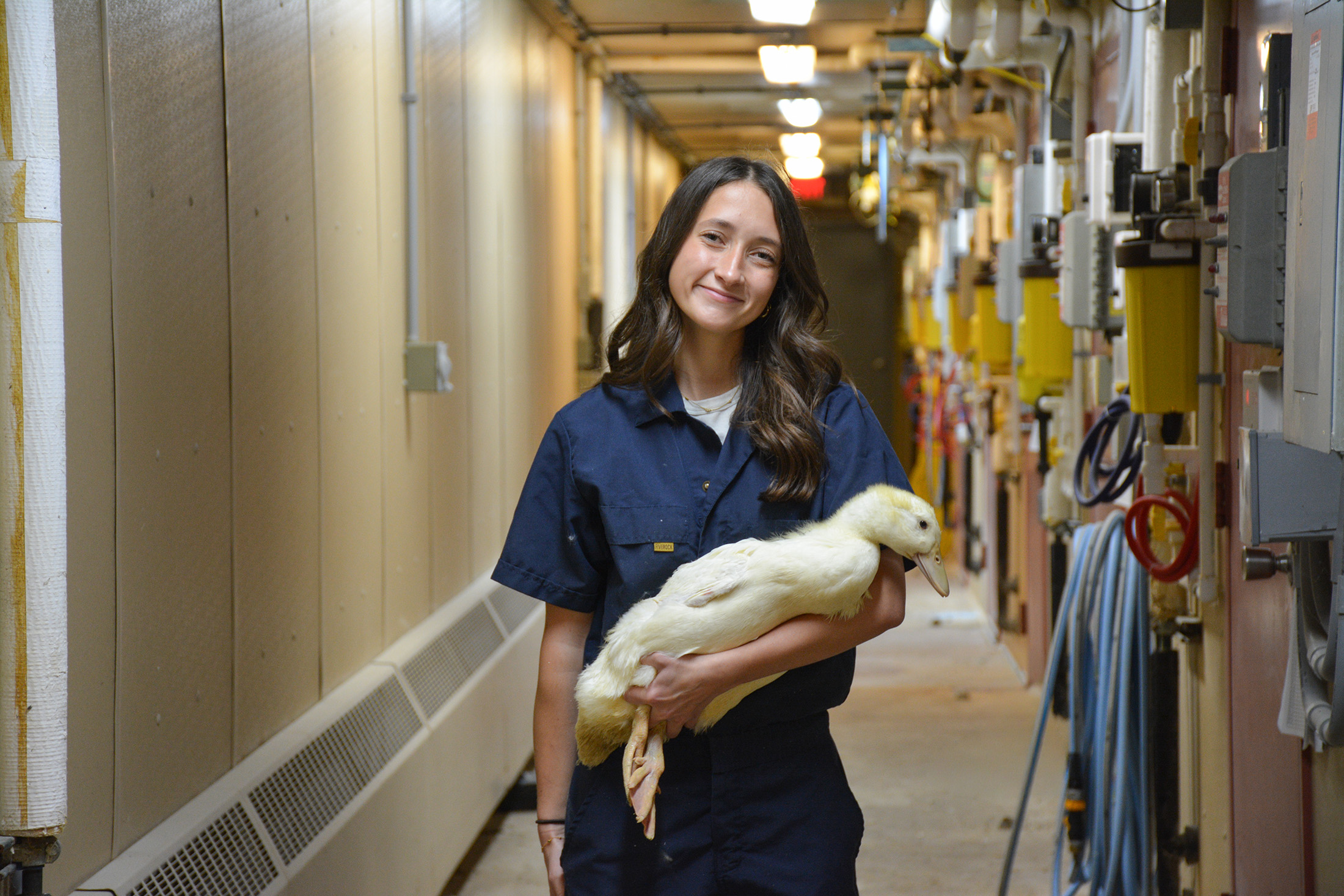
Kaitlyn Mossett gains hands-on experience in poultry research, leadership and industry internships.

Gary Steinhardt’s father once told him that he would never leave their farm because living...

Purdue Animal Sciences celebrated student creativity with an art show and departmentwide costume...
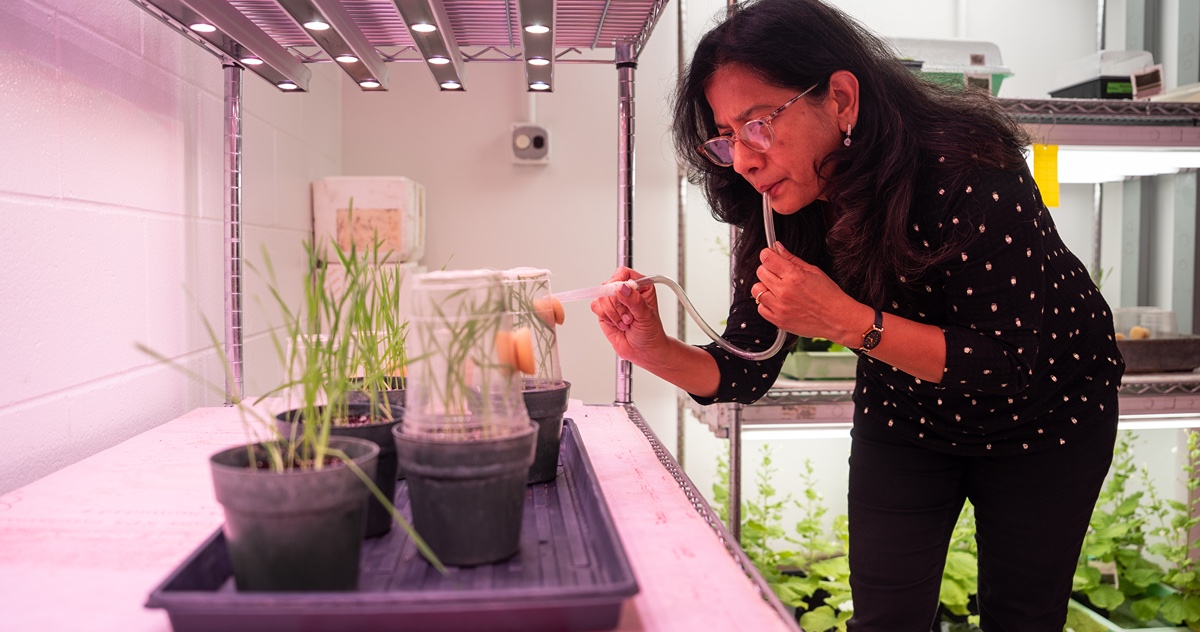
A tiny insect called the Hessian fly began plaguing U.S. wheat fields during the American...
Although Dean Zimmerman (BS Wildlife 1971) retired in 2015 after spending 43 years with the...