

Reviving rivers: Purdue's Help the Hellbender lab wins 2026 TEAM Award
The Help the Hellbender research program, which is housed within the Department of Forestry and Natural Resources (FNR), has been awarded the Purdue Agriculture TEAM Award. Established in 1995, the TEAM Award recognizes outstanding interdisciplinary team achievements of faculty and staff that support Purdue Agriculture’s mission in teaching, research or Extension. In addition to this recognition, award recipients will receive $10,000 to further strengthen and support their program initiatives.
What began as a request for help from the Indiana Department of Natural Resources (DNR) to the Department of Forestry and Natural Resources over 20 years ago about a declining species in the southern part of the state has become a decades long collaborative project to “help the Hellbender.”
“The Help the Hellbender program has made an important impact during its decades long team efforts. The dedication and innovation of its team members make it highly deserving of the College’s 2026 TEAM Award,” said Bernie Engel, Glenn W. Sample Dean of Purdue Agriculture.
Jason Hoverman, project lead for the Help the Hellbender research program, explains that eastern hellbenders are the largest salamander in North America, with adults reaching 2 feet long. They inhabit rivers and streams throughout the eastern United States, including Indiana’s Blue River and they require clean, cool, swift-flowing water containing high levels of dissolved oxygen. Because they require high-quality water and habitat, their presence can indicate a healthy stream ecosystem.
In 2007, Indiana DNR reached out to Rod Williams, previously a professor in forestry and natural resources with Purdue University and now vice provost for outreach and engagement at Texas Tech University. Data showed that there were decreasing populations of the hellbender being found in southern Indiana. Could Purdue help? Williams was the first to lead the project for Purdue, before passing the leadership role to Hoverman when he accepted a new position.
“What was discovered at the time was that years of farming practices had degraded water quality that was greatly impacting the stream and the hellbender population. There was a discovery of a lot of sedimentation in the water. That sedimentation goes into all the little spaces that hellbenders need to live,” said Hoverman, professor of vertebrate ecology.
While the project has evolved over time, Hoverman explained that the initial focus of Help the Hellbender was to understand the ecology and the biology. “Rod Williams did a fantastic job of getting the project off the ground and laying a very strong foundation. So much of the success of this project goes to him. There was a lot of upfront work done to find the hellbenders, sample them, and try to track them in streams at the start,” Hoverman said.
Then the focus shifted to answer, “What can we do to help their population grow?”
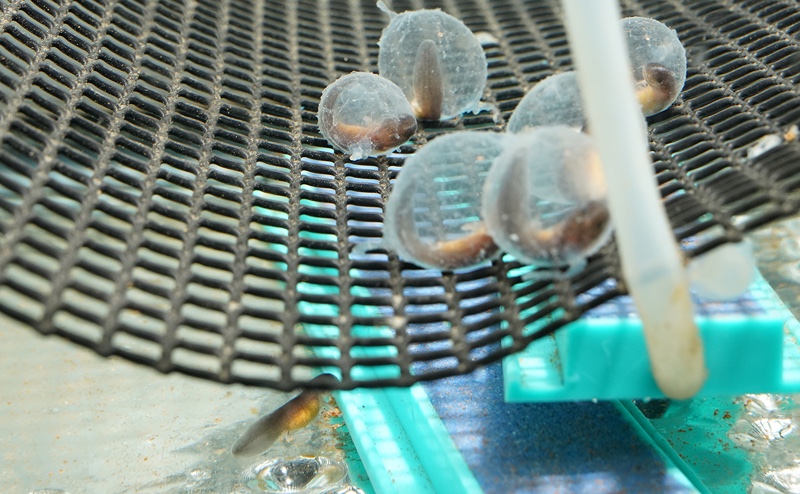
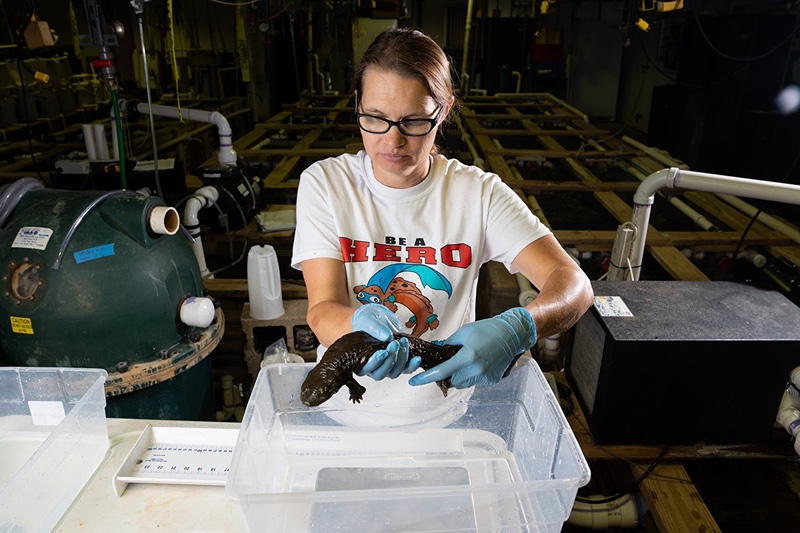
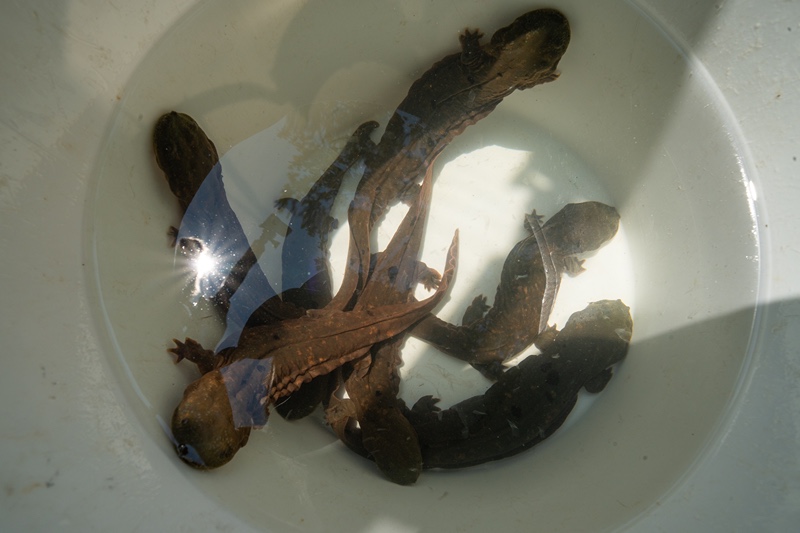
The team’s emphasis over the past 10 years has been on developing a captive breeding or rearing program. “We realized we don’t have a lot of reproduction occurring in the wild in Indiana, so we have established collaborators to help us raise up hellbenders, grow them to a decent size, and then put them back in the stream,” said Hoverman.
Outreach through Extension has also played a major role in the success of this work.
“One of the greatest needs of the project has been to make the public aware that they have an amazing species in their area and letting them know what we are trying to do to bring them back,” Hoverman said. “Having a good relationship with our community and the general public has been an important piece of this project. It’s just amazing at this point if you go down to southern Indiana that everyone knows what a hellbender is.”
Diana Evans, Extension and web communications specialist, and Wendy Mayer, communications coordinator, have shared responsibility for communication.
“I've had the privilege of helping share the Help the Hellbender team's conservation message for over 16 years through websites, publications and outreach efforts. Watching the program grow and inspire new audiences to care about water quality, habitat conservation and this remarkable species has been incredibly rewarding,” Evans said.
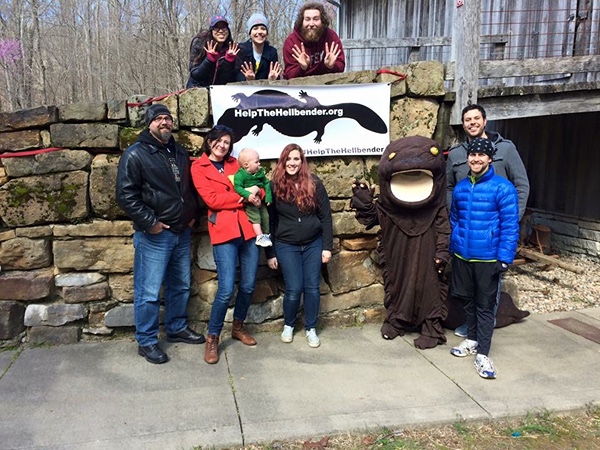

Last year was a milestone for the project team as they released over 1,000 hellbenders into the Blue River. “Not only are they being grown and released, but we are proud to say we currently have a 75-80% survival rate,” said Hoverman.
Hoverman credits his team’s success to forming more than 30 partnerships across the state and the nation. “It has been great to see the involvement of all these different groups for the shared goal of improving hellbender populations in the state, from zoos, non-profits, state agencies, federal agencies and more. It has been a diverse group of partners with one common goal,” Hoverman said.
Hear from part of the Help the Hellbender Team
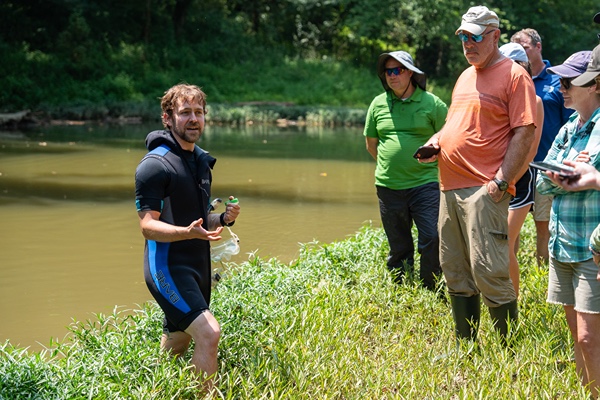 "We've been conducting this work as a team for nearly 20 years, and we've put a lot of effort into crafting a holistic partnership and successful program. My work with this project has played a significant role in my career and has helped shape me as a professional." -Nick Burgmeier, research biologist and Extension wildlife specialist
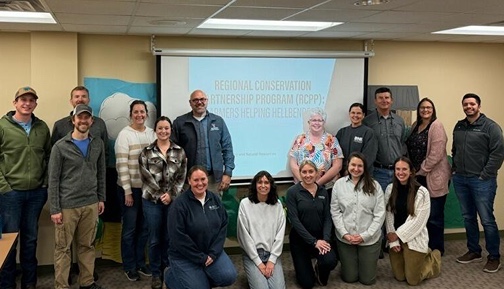 “I am honored to be part of a team that’s incredibly passionate about our goals and is constantly bringing people and organizations together to achieve those goals. Our team has delivered local, state, regional and national impacts, and I know that’s due to years of hard work and implicit trust in each other with our individual areas of expertise. I am so grateful that the Help the Hellbender team has continually supported my professional growth, giving me the resources to be the most effective conservation professional possible.” Eliza Hudson, Farmers Helping Hellbenders RCPP project coordinator
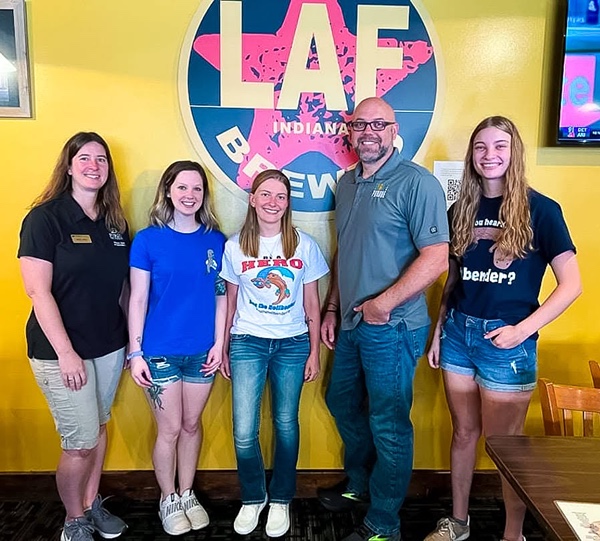 “From publications to outreach events to the amazing new game in the Minecraft Education realm, this team continues to find creative and impactful ways to support eastern hellbenders through their research and share the message about water quality, habitat needs, landowner best practices and more. Being a part of getting that message out to a broader audience has been really fun for me.” Wendy Mayer, communications coordinator
The team’s work will not only benefit the hellbender but also the ecosystem at large. “We think about activities on those streams. People kayak. They fish. If we have the hellbenders back and they’re thriving, that’s indication that this is a healthy stream,” Hoverman explained. “This is proof it’s recovering from some of the impacts that have been occurring over decades and decades of human activities. A healthy stream is healthy for us all.”
Recently, the team launched a Farmers Helping Hellbenders Project, in partnership with the USDA, to incentivize area farmers to adopt conservation practices to help retain soil on their land and reduce nutrient run off.
“What has made the hellbender team special is the collaborative aspect. Everyone who has been a part of it over the years from undergraduate and graduate students and staff to our many partners, has had a willingness to contribute to ensure the longevity of the program,” Hoverman said. “Receiving the TEAM award is a testament to how great the group has been over the past 20 years and all the hard work that has been put into these efforts. We have more work to do, so it’s good motivation to keep it up and to keep moving forward.”
Featured Stories
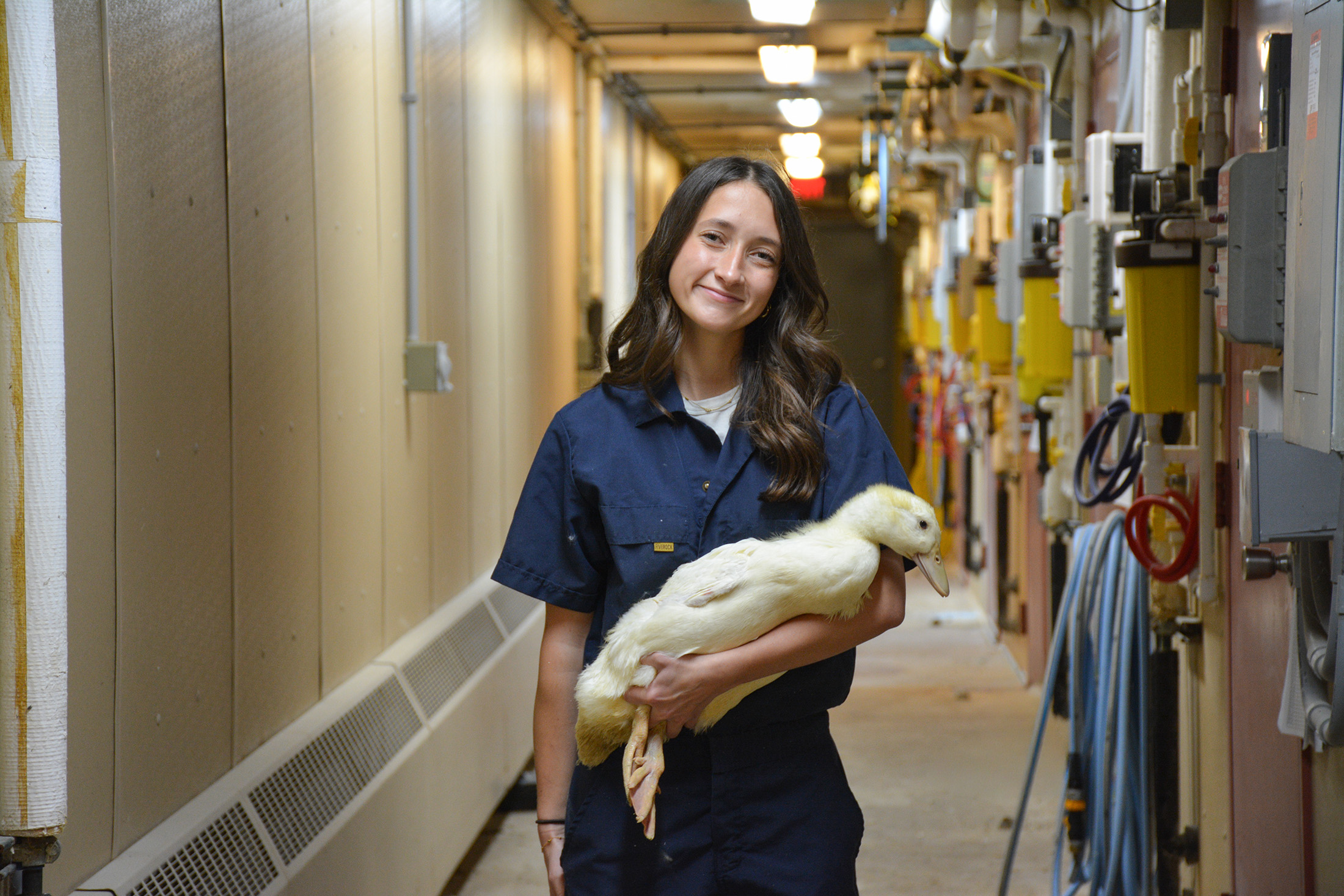
Kaitlyn Mossett gains hands-on experience in poultry research, leadership and industry internships.

Gary Steinhardt’s father once told him that he would never leave their farm because living...

Purdue Animal Sciences celebrated student creativity with an art show and departmentwide costume...
A tiny insect called the Hessian fly began plaguing U.S. wheat fields during the American...
Although Dean Zimmerman (BS Wildlife 1971) retired in 2015 after spending 43 years with the...

Dr. Jessica Gurevitch invites readers into a deeper understanding of the Earth system and its...