

Terry Torres Cruz - Postdoctoral Scholar Feature
The Path Here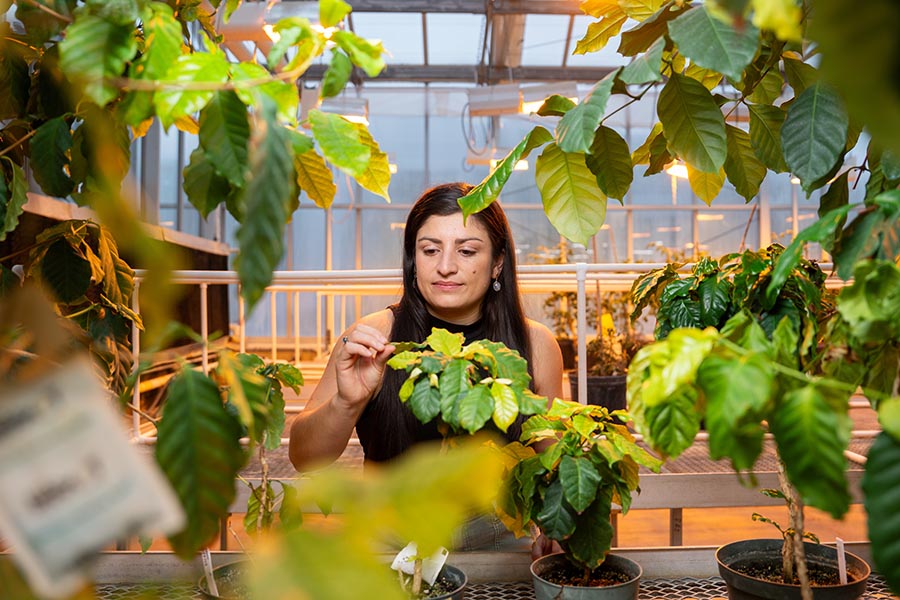
Terry Torres Cruz’s path to mycology — the study of fungi — has been guided by lots of curiosity and a little bit of fate. Growing up in rural Costa Rica, Torres Cruz wasn’t sure what she wanted to study.
“I didn’t know what all my options were,” she says. “Just general ideas: police officer, firefighter, doctor.”
She’d seen the show “CSI,” which made criminology look interesting. So she applied to several science-related college programs, figuring she’d go with the most selective one that accepted her. That turned out to be biotechnology engineering. The program required all students to do an internship or thesis, so Torres Cruz got in touch with an alumna who had a lab at Western Illinois University.
The lab focused on fungi, something Torres Cruz knew little about. But she found the work fascinating, so she stayed on for a master’s degree. For her thesis, she described a new fungal genus and species in the Mucoromycotina subphylum — Bifiguratus adelaidae, one of the “Top 50 most wanted Fungi.”
“I thought that was really cool,” she says. “Not a lot of people get to do that.”
She went on to do her PhD in plant pathology with a dual title in biogeochemistry at Penn State. Her dissertation project focused on a plant-fungal interaction in a type of South American grass. Her research required travel to Guyana, so her advisor told her to contact Purdue’s Cathie Aime, professor of botany and plant pathology.
“Her lab has been going to Guyana yearly for over 25 years,” Torres Cruz says. “My advisor put me in touch with her so I wouldn’t have to travel there alone.”
Torres Cruz joined Aime’s team conducting field research in remote areas in 2019 and 2021. The trips involved long journeys down muddy roads and sleeping overnight in hammocks. On their last day in the field, Aime asked Torres Cruz about her postgraduation plans.
“She said, ‘Once you are certain, let me know. I might have a postdoc open,’” Torres Cruz recalls.
Torres Cruz arrived at Purdue in 2023.
The Work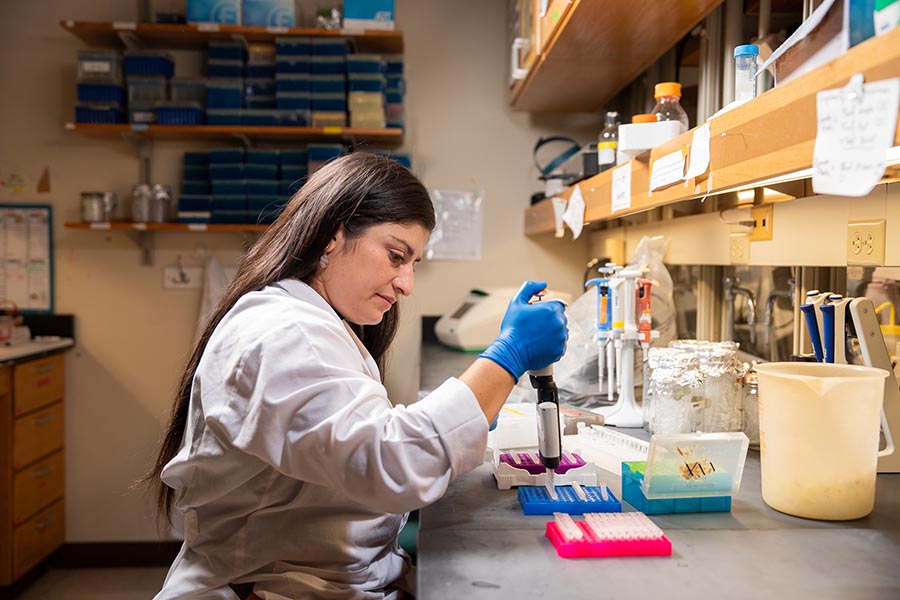
In Aime’s lab, Torres Cruz studies coffee leaf rust, a fungus capable of decimating coffee crops. She and her teammates work on the genetics of the fungus, hoping to help growers breed more resistant cultivars. The work involves investigating the movement of coffee leaf rust around the world. Torres Cruz has gathered about 300 historical specimens from various herbariums. Thanks to a Global Impact Fund New Ideas Grant from Purdue’s Office of Global Partnerships, she had the opportunity to do field work in Kenya last fall, collecting coffee leaf rust samples near Lake Victoria. The samples might help her team understand some fundamental facts about the pathogen.
“Some rusts tend to jump between different hosts for different parts of their life cycle,” she says. “For this rust, we know one of those hosts — coffee — but we don’t know what the other is . So we sampled other plants in Kenya, looking for signs of rust.”
The team is just beginning to process the samples. Understanding the rust’s full life cycle may allow researchers to guide farmers about which plants to grow or avoid near their coffee plants.
Torres Cruz has been deeply involved in the larger mycology community, attending conferences worldwide, from the Netherlands to Panama. Her “mycofamily” can be found at the annual Mycological Society of America conference, where she has led the SPORES program for two years. It provides mentoring for undergrads from underrepresented communities attending the conference for the first time.
“We create little cohorts so they feel welcome and hopefully remain in mycology,” she says.
Future Plans
Torres Cruz likes hiking, traveling and doing Crossfit. She’s recently become involved with Purdue’s Costa Rican Student Association.
“I’m impressed. There are more than 20 Costa Ricans here,” a large number for a country of only 5.3 million people, she says.
As her postdoc winds down, she’s beginning to apply for faculty positions.
“We will see!” she says.
Featured Stories

For Brody Cox, preparing for the Indiana State Fair began long before he entered the show...
Carolyn Foley, a long-time member of the Purdue Forestry and Natural Resources (FNR) and...

In the September Purdue University/CME Group Ag Economy Barometer survey, 52% of respondents...
Purdue University’s College of Agriculture recognized nine alumni at the Distinguished...
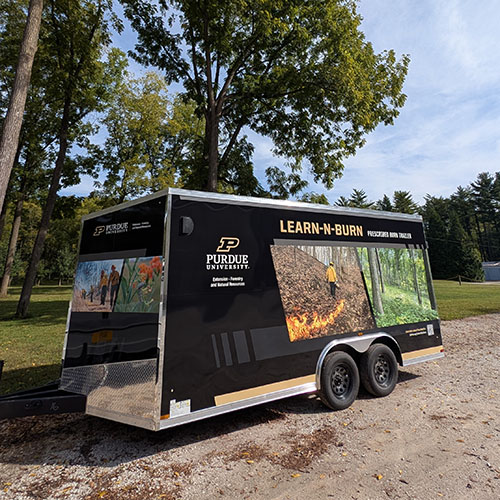
Keep your eyes peeled across Indiana for the newly minted Purdue Forestry and Natural Resources...
“Being at Purdue has changed my thinking entirely,” says Mingyu Zhao, a third-year...