

From biosystems engineering to dairy science
For Isabela Santos, the path to dairy science didn’t begin on a farm. It began in biosystems engineering.
Santos is a PhD student in the Department of Animal Sciences. She grew up in a large city in Brazil surrounded by technology. Although she had limited contact with livestock as a child, she always loved animals — especially horses — and knew she wanted them to be part of her future.
She earned her bachelor’s degree in biosystems engineering from São Paulo State University. During her undergraduate studies, she was introduced to dairy cattle while assisting her advisor with a dairy Extension project. Even after earning her degree, she wasn’t certain dairy would be her long-term focus. However, she knew one thing clearly: she wanted a career that combined animals and technology.
Santos continued her education by pursuing a master’s degree, where she worked with small dairy producers to improve sanitary practices and reduce the microbiological content in milk. Through that experience, she realized she wanted to return to her engineering roots while continuing to work with animals, fusing the two disciplines together.
She received her master’s degree in May 2023 and came to the Department of Animal Sciences at Purdue University as a visiting scholar in the lab of Jackie Boerman, associate professor, later that year. In January 2024, she officially began her doctoral studies in Boerman’s lab.
Applying technology on the farm
Santos’ research focuses on using image analysis and computer vision to improve dairy nutrition management. Her primary project focuses on evaluating the uniformity of total mixed rations (TMR) using camera systems installed on farms.
“We are using computer vision on farms, taking videos and pictures of TMR samples,” Santos said. “I’m developing programs to measure uniformity of TMR and particle size, which can help nutritionists and farmers understand what they are feeding to the cows and how it is being delivered.”
In additional projects, she uses image analysis to evaluate feed ingredients, such as soybeans, to determine how factors like roasting temperature affect nutritional quality. She is also developing systems to count birds on dairy farms using camera technology to monitor potential biosecurity concerns.
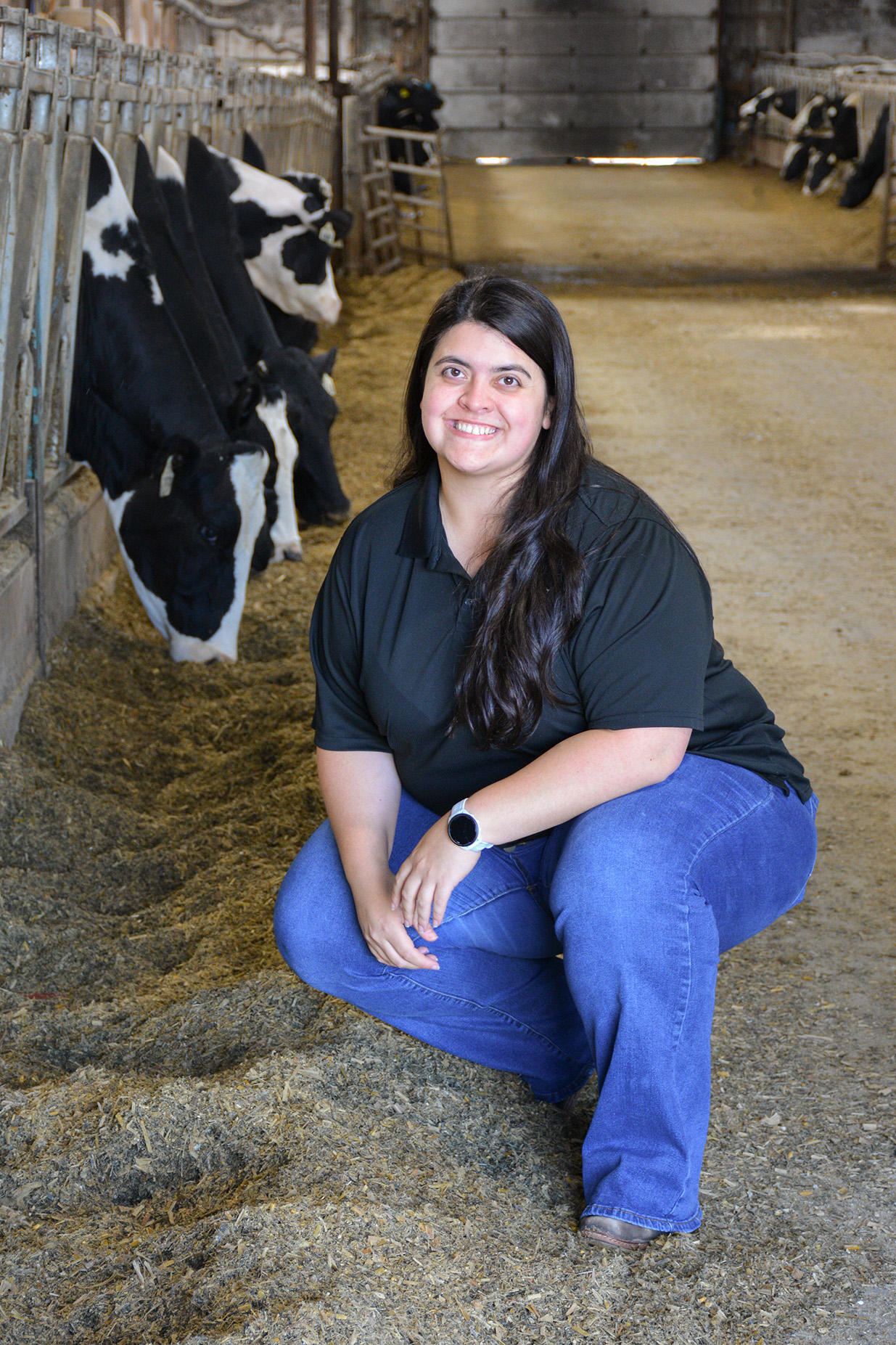 From biosystems engineering to dairy science, PhD student Isabela Santos is using technology to improve dairy nutrition and support practical solutions for farmers.
 Her research is rooted in practical application.
“We are always trying to focus on something that can really be applied to farmers,” Santos said. “We don’t want something that will only be a paper published. We want something the farmers can use.”
Because feed is one of the largest expenses on dairy farms, improving feed quality and uniformity can directly impact farm profitability.
Building a bridge between engineering and dairy science
Santos says her biggest challenge has also been the most rewarding part of her doctoral experience.
Working at the intersection of engineering and animal science requires constant collaboration across disciplines.
“As a biosystems engineer, I know a lot about cows, but not as much as an animal scientist,” she said. “And I know a lot about technology and programming, but not as much as a computer scientist or electrical engineer. I am kind of in the middle.”
She describes herself as a bridge between engineering and animal science.
“I want to be a bridge between the different areas,” Santos said.
Learning where she fits has been a defining part of her graduate journey.
“My biggest reward is feeling that this is getting easier with time,” she said. “I’m learning where I belong and how I can apply technology on farms to really help.”
For students considering graduate school, Santos offers honest advice.
“Grad school can be hard,” she said. “Sometimes you can feel frustrated or not qualified enough, but you are here to learn. It’s okay to have bad days. Good days will come. You just need to keep going.”
In addition to her research, Santos has volunteered with the Dairy Skill-a-thon at the Indiana State Fair, helping educate youth about dairy science. She also earned first place in the Ph.D. competition at the 2025 Tri-State Dairy Nutrition Conference.
Looking ahead
Santos plans to complete her doctorate in 2027. After graduation, she hopes to pursue a postdoctoral position continuing to apply technology on farms. Her ultimate goal is to remain in academia and become a professor, inspired by the mentors who guided her throughout her academic journey.
Outside of research, she enjoys her time at home watching movies, cooking and baking.
Featured Stories
For Brody Cox, preparing for the Indiana State Fair began long before he entered the show...
Carolyn Foley, a long-time member of the Purdue Forestry and Natural Resources (FNR) and...

In the September Purdue University/CME Group Ag Economy Barometer survey, 52% of respondents...
Purdue University’s College of Agriculture recognized nine alumni at the Distinguished...
Keep your eyes peeled across Indiana for the newly minted Purdue Forestry and Natural Resources...
“Being at Purdue has changed my thinking entirely,” says Mingyu Zhao, a third-year...