

Ian Rimer - Graduate Ag Research Spotlight
Some plants play it risky – it’s really fascinating.
- Ian Rimer, Botany & Plant Pathology
The student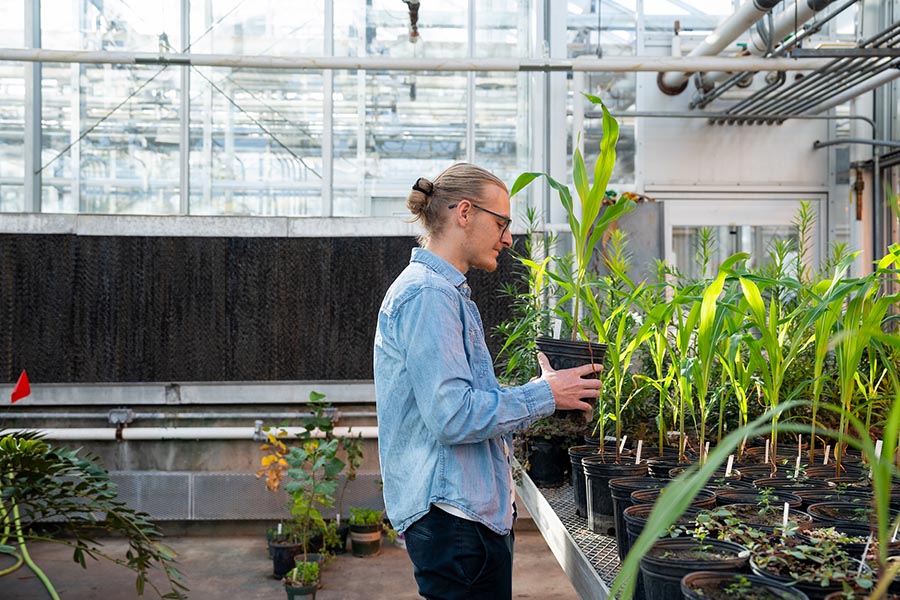
Growing up in Greenwood, Indiana, Ian Rimer was the quintessential outdoor kid, spending most of his time running around in cornfields or exploring the forest near his house. From a young age, he was aware that the natural world he loved was under threat. His father, a school principal, was an ardent environmentalist, and Rimer grew up learning about drought in Australia and the ravages of beetles in the boreal forests of the far north.
“I feel very blessed to have had that awareness at such a young age,” he says.
As a Purdue undergrad, Rimer initially majored in pharmacy before switching to biology, but found himself increasingly drawn to plant sciences. He emailed several plant sciences professors to see if they had any research opportunities, and was put in touch with a new faculty member, Scott McAdam. He began working in McAdam’s lab, which investigates plant water use and drought tolerance.
“That really interested me because I’m a climate activist, and I knew I wanted to look at whole plant responses to the environment,” Rimer says. “So it was a good fit.”
When Rimer decided to apply to grad school, McAdam suggested he consider staying at Purdue. Rimer began his PhD in botany and plant pathology in January of 2023.
The research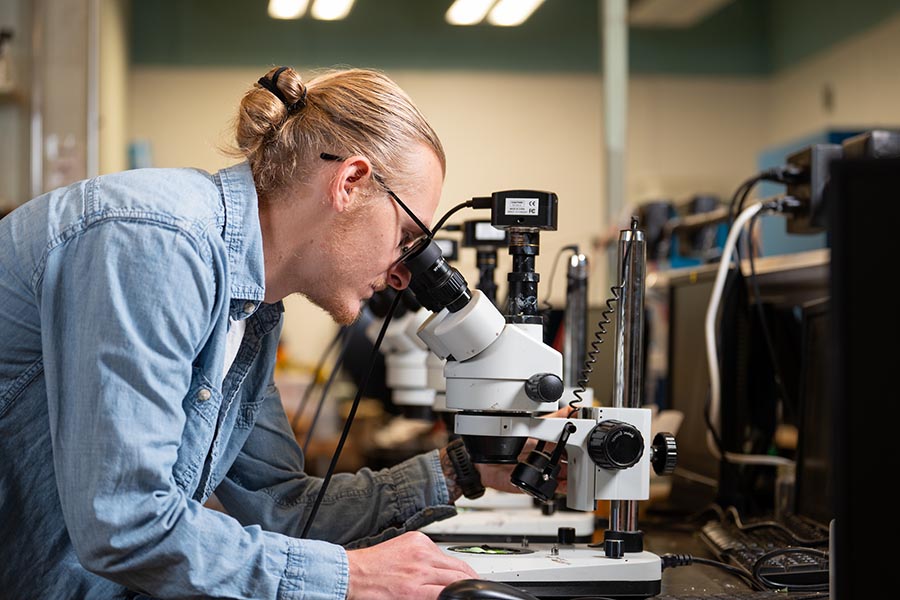
Rimer studies mechanisms that lead to plant death during a drought. As a plant is facing drought, the stomata – the tiny pores on plant leaves allow for the exchange of carbon dioxide in and oxygen and water vapor out – begin to close, preventing more water from escaping. But eventually, air bubbles called emboli begin to form in the xylem, the tissue that transports water from roots to leaves. Once 50 percent of the plant’s vessels are blocked by emboli, the plant is considered dead.
Rimer is interested in the plant’s “stomatal safety margin” – the time between when the stomata close and the emboli form. Understanding this better allows researchers to predict which plants will do better in drought conditions, which in turn could help farmers and others decide what – or what not – to plant.
“Some plants play it relatively safe and will close their stomata well before, while some plants play it risky,” he says. “It’s really fascinating.”
Rimer’s dissertation examines community-level variation in drought tolerance across trees and herbaceous plants.
“A lot of work in the past has looked at trees and woody tissue, but herbaceous species are really underrepresented in our total knowledge of how plants will respond to a changing environment,” he says.
Opportunities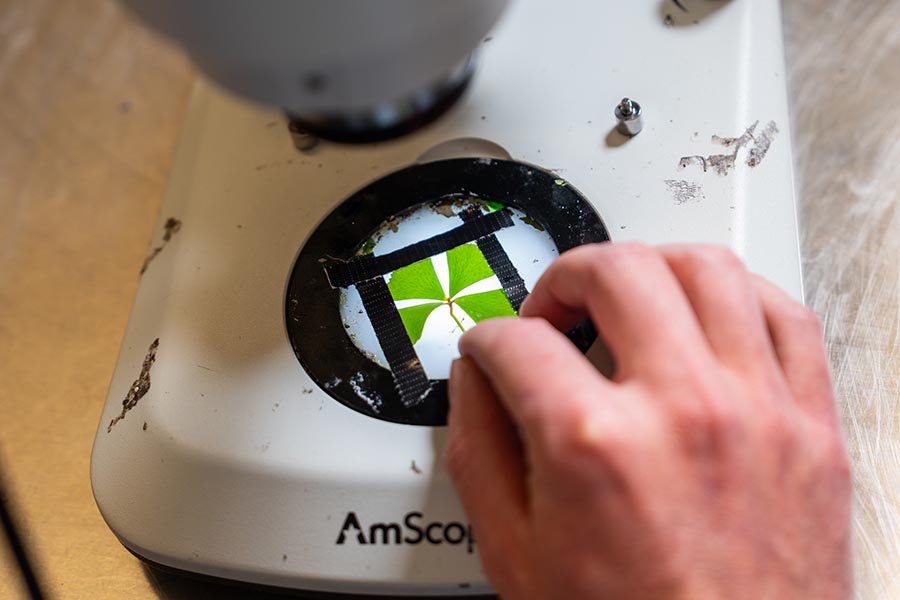
Rimer’s favorite part of research is field work. He recently took part in an experiment at Purdue’s Martel Forest, where the principal investigator had fitted trees with tarps to simulate drought. The team used a crane to install dendrometers to measure water in the leaf canopy.
“That was such a great experience – building the dendrometers and figuring out how we’re going to put them 50 feet up in a tree and get power to them – it was an engineering problem and a biology problem,” he says. “Experiments like that are so much fun and you learn so much.”
The environment in McAdam’s lab is also “really fun and exciting,” Rimer says. “Scott’s a great professor to work with, and so energetic – he’s always throwing out ideas, and when you have an idea, he’ll take it and run with it. It is very much a collaborative environment.”
As a grad student, Rimer has been able to travel to Lisbon for a workshop, to Slovenia to help set up a study abroad course, and to Spain to present his own work at a conference.
“That was great,” he says. “I got to meet and talk to people whose work I’ve cited in my papers. It really made me feel like I was part of the community.”
Future plans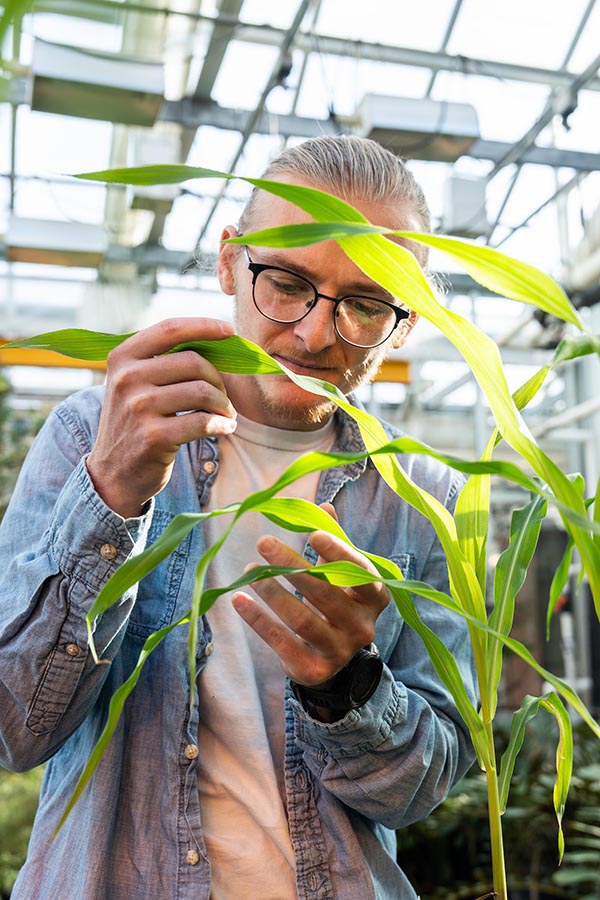
Rimer expects to graduate in fall 2026. He hopes to pursue a postdoc position where he can continue to study plant responses to drought, but at a larger scale.
When he’s not working, he likes to play chess, play guitar, and hike. For hiking locally, he’s fond of Black Rock Nature Preserve, near Otterbein, or, slightly further afield, the hills of Brown County. But his real passion is multiday backpacking trips.
“Putting all my stuff on my back and hiking 20 or 30 miles is one of my favorite things in the world,” he says. “You really get reconnected with nature, being out there for a week at a time.”
Featured Stories
Ashlynn McLaughlin, a senior aquatic sciences major with a concentration in marine and freshwater...
For Brody Cox, preparing for the Indiana State Fair began long before he entered the show...
Carolyn Foley, a long-time member of the Purdue Forestry and Natural Resources (FNR) and...

In the September Purdue University/CME Group Ag Economy Barometer survey, 52% of respondents...
Purdue University’s College of Agriculture recognized nine alumni at the Distinguished...
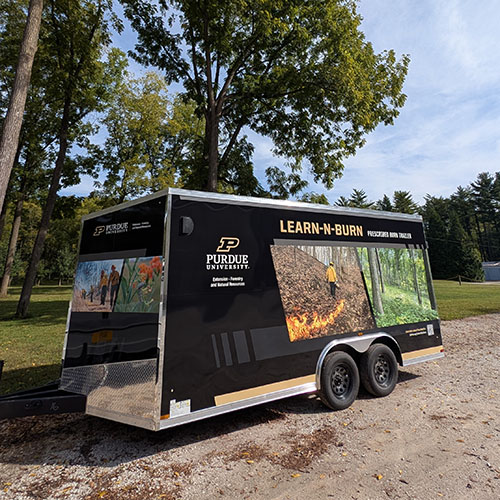
Keep your eyes peeled across Indiana for the newly minted Purdue Forestry and Natural Resources...