

Elizabeth Ogar - Graduate Ag Research Spotlight
Agriculture becomes meaningful when people experience it, engage it, use it to solve problems, and see themselves as part of its future.
- Elizabeth Ogar, PhD Candidate, Agricultural Sciences Education and Communication
The student
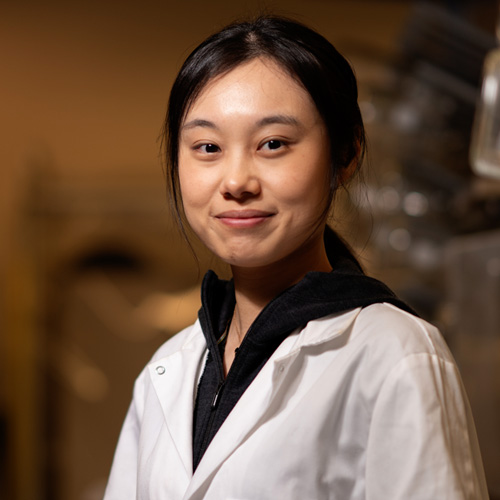
When Elizabeth Ogar was growing up in Nigeria, a weevil infestation hit her family’s corn farm. It was devastating for her family, her neighbors and the entire community.
“I remember the young me just looking up at the moon and wondering ‘Why did this happen?’” Ogar recalls. “That experience made me ask how could farmers be better equipped to respond to issues like that.” Those early questions shaped her academic and professional journey, guiding her decision to pursue agricultural education as a pathway to empower farmers and communities through knowledge. As a first-generation college student, Ogar is especially passionate about motivating young people to see agriculture as an engaging and rewarding career path.
Ogar carried those questions with her through high school and four years of diploma programs in agricultural education that qualified her as an Extension specialist. By the time she finished her bachelor’s and master’s degrees and began applying to PhD programs, she had spent seven years working as an agricultural Extension professional, engaging directly with farmers and rural communities to improve agricultural practices and livelihoods in her home country and beyond. She focused on making agricultural learning more practical and engaging, particularly for young people and emerging farmers. She’d already applied to multiple programs in the U.S. and Canada and was granted admissions, when it came time to interview for Purdue.
“From the day I interviewed with Dr. [Hui-Hui] Wang and Dr. [Neil] Knobloch, I knew I wanted to work with them,” she says. “Afterward, I said to myself, ‘I’m going to hold out for Purdue.’”
She joined the Department of Agricultural Sciences Education and Communication (ASEC) as a doctoral candidate in August 2023.
The research
As an Extension educator, Ogar explored innovative approaches to teaching agriculture, including the use of game-based simulations to make learning more interactive, meaningful and engaging. At Purdue, she studies and uses STEM-based experiential learning to drive student engagement. She brings Purdue Polytechnic high schoolers to campus to visit labs, learn what professors are doing, and engage in hands-on, real-world agricultural experiences that connect STEM concepts to practical applications.
“They work with microbes, they play with insects, they learn about forestry and woodworking, they learn about turning forest products into cash,” she says. For some participating students, these experiences are transformative, shifting their perceptions of agriculture and, in some cases, influencing them to pursue agriculture and related fields as a career path.
“Agriculture becomes meaningful when people experience it, engage it, use it to solve problems, and see themselves as part of its future,” Ogar says.
Ogar’s dissertation extends this work. She’s studying how science and engineering faculty use their disciplinary knowledge and professional identities to frame complex agricultural problems, particularly how individuals from different backgrounds collaborate and navigate tensions when working in interdisciplinary teams.
“I’m interested in how faculty see themselves in the profession,” she says. “How do their professional backgrounds affect how they come together to work in collaborative teams and negotiate challenges?”
Ogar’s project has just received Institutional Review Board approval. She plans to begin data collection this month.
Opportunities
When it comes to mentorship, “Nobody does it like Purdue. Mentorship is at this level,” she says, holding her hand as high above her head as it will reach.
In addition to the support from her advisors, Ogar has sought — and received — advice and guidance from faculty across campus. “Professors I’ve met in classes, I’ve just walked up to them and asked ‘Can you mentor me?’ and they’ve said yes.”
Ogar has done plenty of mentorship of her own. She was president of the Agricultural Sciences Education and Communication Graduate Student Organization and is now vice president. She’s also active in the Nigerian Student Association, MANRRS (Minorities in Agriculture, Natural Resources, and Related Sciences) and with her local church.
She’s a recipient of a Graduate Excellence Fellowship (formerly the Ross Fellowship), a four-year award with salary and tuition coverage aimed at recruiting outstanding PhD-track students to Purdue graduate programs.
Future plans
Ogar expects to graduate in December and plans to look for faculty positions in agricultural education.
“I want to help prepare the next generation of educators and learners to address complex challenges in agriculture, food, and natural resources through interdisciplinary thinking and experiential learning,” she says.
In the meantime, she enjoys volunteering, spending time in nature, chatting with her family in Nigeria and listening to music.
“My colleagues knew from very early on how much I like music,” she says. “Whenever there’s a concert, they say ‘Do you want to go?’”
Overall, she’s thoroughly enjoyed her time in the area. “The College of Ag has been so, so good to me,” she says. “And the Greater Lafayette community too.”
More Graduate Spotlights
“Being at Purdue has changed my thinking entirely,” says Mingyu Zhao, a third-year...
Most parents want to encourage their child’s hobbies, signing them up for chess club,...
As a child in Rio de Janeiro, Mayara dos Santos Rocha loved animals so much she figured...
At 25, Noah Berning has already accomplished a goal held since middle school: he’s going to...

Growing up in lush northern Florida, Natalie Allen spent much of her childhood outdoors, catching...
Luping Xu is proud to be from Ningbo, a port city in eastern China with a long history of...