2023 Farmland and Cash Rent Outlook
January 10, 2023
PAER-2023-08
Todd H. Kuethe, Associate Professor, Schrader Chair in Farmland Economics


Farmland Values
All signs point toward continued growth in Indiana farmland prices through 2023. In 2022, farmland prices across Indiana set a new record high, at $12,808 per acre for top quality land, $10,598 for average quality land, and $8,631 for poor quality land. Perhaps more important, farmland prices grew at a record pace between 2022 and 2023, at just over 30% for all land quality classes. While this pace of growth would be difficult to sustain, current indicators suggest farmland prices are expected to increase at a more modest rate.
The Purdue Farmland Values and Cash Rent survey is conducted in June of each year. The most recent iteration of Iowa State University’s land value survey, released on December 13 2022, found that farmland values across Iowa increased by 17% between November 2021 and November 2022, following a 31% increase the preceding year. In addition, the most recent agricultural banker survey by the Federal Reserve Bank of Chicago found that farmland prices suggest that land values continued to increase across their district, which includes northern portions of Indiana and Illinois, southern Wisconsin, the lower peninsula of Michigan, and all of Iowa. However, the survey suggests that the pace of growth has slowed since the final quarter of 2021.
The growth in farmland prices across the Corn Belt are supported by higher commodity prices, increased demand for conversion to nonagricultural uses, and the overall strength of the farm economy. However, the potential for growth may be limited by fear of a reversal in any of these factors, as well as increasing costs of agricultural production. In addition, the upward pressure on farm mortgage rates places downward pressure on transaction prices.
Cash Rental Rates
Cash rental rates are also expected to increase in 2023. The recent 2023 Purdue Crop Cost & Return Guide suggests that the contribution margin, the difference between market returns and variable costs, is expected to increase in 2023 for both rotation corn and rotation soybeans. Increasing margins generally signals upward pressure on cash rental rates, as farm operators will have additional revenues to allocate to labor, investment, and land. As shown below, the contribution margin for average quality farmland has exceed average cash rentals rates in 2021 and 2022, which also places additional pressure on cash rental rates. However, farmers will no doubt stress the increased costs in other expense categories when trying to negotiate less aggressive cash rent hikes.
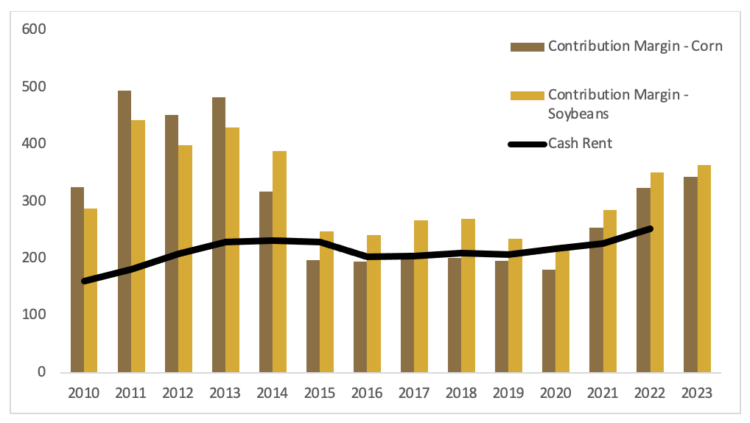
Figure 1: Cash rental rate and contribution margin for rotation corn and soybeans for average quality land, 2010-2023