

Ag Barometer indicates farmer sentiment is at highest level since January
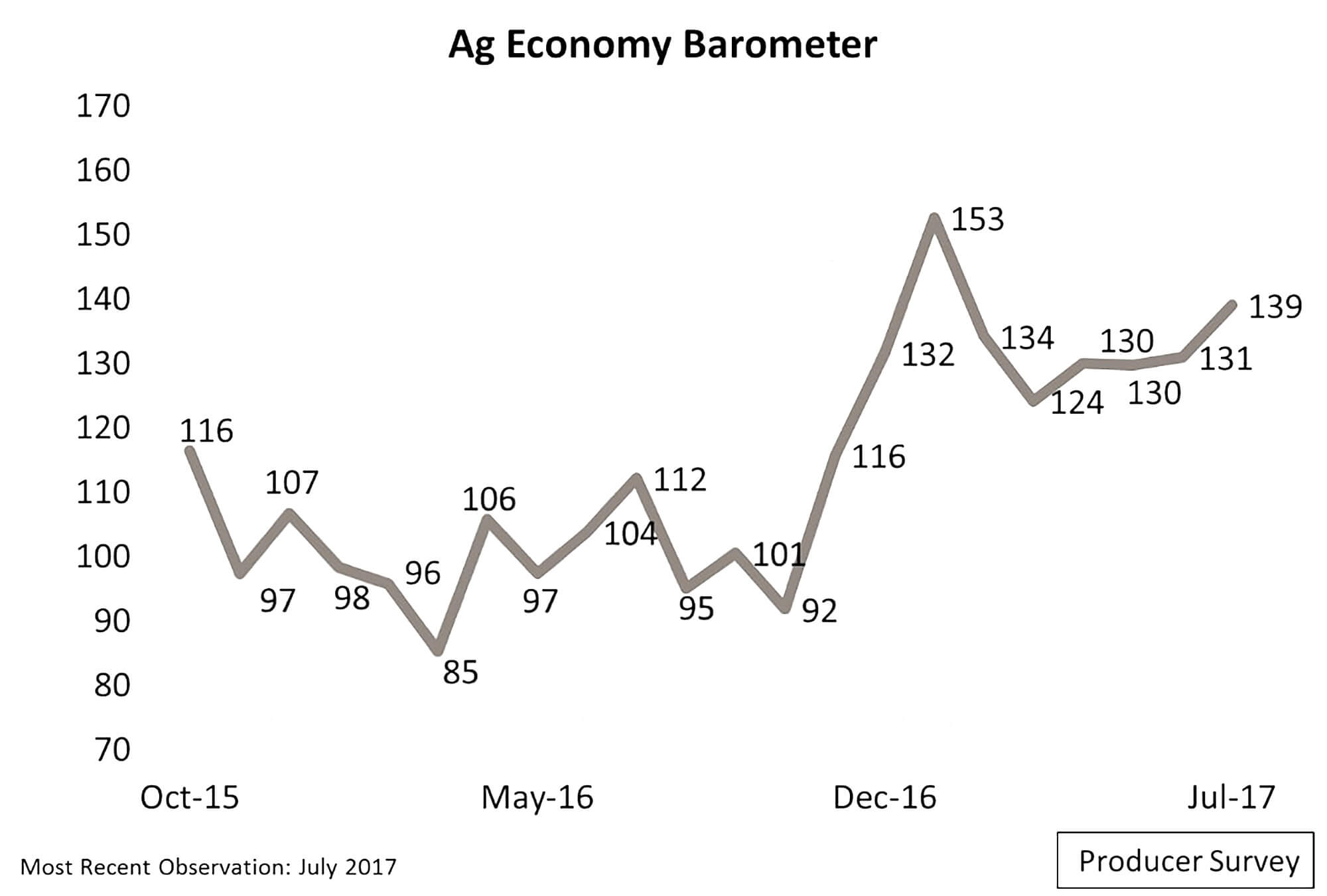 , opens larger image The Purdue/CME Group Ag Economy Barometer climbed to 139 in July as stronger commodity prices led to more optimistic producer sentiment. (Purdue/CME Group Ag Economy Barometer/David Widmar)
 Farmers’ sentiment about the agricultural economy climbed to 139 in July - the highest level recorded in 2017 since January, according to the Purdue University/CME Group Ag Economy Barometer.
The barometer, which is based on a survey of 400 U.S. agricultural producers, exceeded recent barometer readings by 8 to 9 points - breaking out from a range of 130 to 131 during the months of April, May and June.
Overall, farmers’ sentiment this summer has been significantly more positive than it was during the summer of 2016, when the Ag Economy Barometer ranged from the mid-90s to the low 100s, according to Jim Mintert, the barometer’s principal investigator and director of Purdue University’s Center for Commercial Agriculture.
The barometer’s two sub-indices also were higher in July, with the Index of Current Conditions rising from 132 in June to 142 in July, and the Index of Future Expectations climbing from 131 in June to 138 in July.
The July 2017 index also marked the second-highest level for farmers’ sentiment in the history of the barometer, which launched in October 2015.
A key factor contributing to the more positive outlook among agricultural producers includes expectations for higher prices of key commodities. As part of the most recent Ag Economy Barometer survey, producers were asked if they anticipated higher, lower or similar prices for grain, cotton and oilseed in the next 12 months.
Of the 400 respondents, 39 percent said they expected to see higher prices for corn in the coming year. That compares to the 24 percent that was reported in the April 2017 survey and 22 percent in the July 2016 survey. Expectations for increases in soybean and wheat prices were nearly as strong as they were for corn, according to Mintert.
The improvement in producers’ expectations for grain and oilseed prices corresponded with market volatility during the early summer. For example, corn futures prices, based on the December 2017 futures contract, traded down to a low of about $3.75 in late June 2017 to a high of more than $4.15 in early July over a span of just a few trading days. The price increase seems to have helped boost producers’ price expectations, the report indicated.
Read the full July Ag Economy Barometer report at http://purdue.edu/agbarometer.
The Ag Economy Barometer, Index of Current Conditions and Index of Future Expectations are available on the Bloomberg Terminal under the following ticker symbols: AGECBARO, AGECCURC and AGECFTEX.
About the Purdue University Center for Commercial Agriculture
The Center for Commercial Agriculture was founded in 2011 to provide professional development and educational programs for farmers. Housed within Purdue University’s Department of Agricultural Economics, the center’s faculty and staff develop and execute research and educational programs that address the different needs of managing in today’s business environment.
About CME Group
As the world’s leading and most diverse derivatives marketplace, CME Group (www.cmegroup.com) enables clients to trade futures, options, cash and OTC markets, optimize portfolios, and analyze data – empowering market participants worldwide to efficiently manage risk and capture opportunities. CME Group exchanges offer the widest range of global benchmark products across all major asset classes based on interest rates, equity indexes, foreign exchange, energy, agricultural products and metals. The company offers futures and options on futures trading through the CME Globex® platform, fixed income trading via BrokerTec and foreign exchange trading on the EBS platform. In addition, it operates one of the world’s leading central counterparty clearing providers, CME Clearing. With a range of pre- and post-trade products and services underpinning the entire lifecycle of a trade, CME Group also offers optimization and reconciliation services through TriOptima, and trade processing services through Traiana.
CME Group, the Globe logo, CME, Chicago Mercantile Exchange, Globex, and E-mini are trademarks of Chicago Mercantile Exchange Inc. CBOT and Chicago Board of Trade are trademarks of Board of Trade of the City of Chicago, Inc. NYMEX, New York Mercantile Exchange and ClearPort are trademarks of New York Mercantile Exchange, Inc. COMEX is a trademark of Commodity Exchange, Inc. BrokerTec, EBS, TriOptima, and Traiana are trademarks of BrokerTec Europe LTD, EBS Group LTD, TriOptima AB, and Traiana, Inc., respectively. Dow Jones, Dow Jones Industrial Average, S&P 500, and S&P are service and/or trademarks of Dow Jones Trademark Holdings LLC, Standard & Poor’s Financial Services LLC and S&P/Dow Jones Indices LLC, as the case may be, and have been licensed for use by Chicago Mercantile Exchange Inc. All other trademarks are the property of their respective owners.
Featured Stories

Maksym Chepeliev, a leading international scholar recognized prominently for his work in...

In recent years attendees at Purdue Agriculture alumni, donor, and faculty and staff events have...

The Office of Indiana State Chemist (OISC) is warning Indiana residents about an illegal...

A prominent protein on most human cells may be key to unlocking the code that makes humans...

In the September Purdue University/CME Group Ag Economy Barometer survey, 52% of respondents...

Purdue University’s College of Agriculture recognized nine alumni at the Distinguished...