

Applying One Health in the Classroom
Some people lie awake at night worrying about problems that seem overwhelming. Marisol Sepúlveda lies awake thinking about ways she can help students address them. One of those nights, the professor of forestry and natural resources dreamed up a new course for students interested in global health challenges: One Health in the Era of the Anthropocene — the current geological age, during which humans have had a substantial impact on our planet.
“I started thinking of a fun project for the students. I wanted to do something different, not just the typical presentation,” Sepúlveda said.
Purdue University launched its One Health Initiative in 2024. The concept of One World One Health was also introduced at a symposium organized about 20 years ago by the Wildlife Conservation Society and refined with organizations such as the United Nations Food and Agriculture Organization and the US Department of Agriculture (USDA).
Sepúlveda wanted students in her course to explore emerging health threats from both One Health perspectives, tackling complex challenges with real-world impact at the intersection of human, animal and plant health, from a local level to a global perspective.
Over eight weeks, students met twice a week for online lectures and in-person seminars with experts from different fields. They learned about areas such as vector-borne diseases, antimicrobial resistance, human factors that impact how zoonotic diseases are transmitted from animals to humans, and national and international health regulations.
The class culminated in presentations where each student researched a specific case study, such as avian influenza, PFAS forever chemicals, bushfires and antimicrobial-resistant microbes, and then presented a brief that included:
- the timeline and geographic location of their case study;
- an analysis of how the animal, environmental and human health components (the One Health triad) are interconnected;
- root causes;
- a critique of the real-world response;
- and policy recommendations.
 Senior wildlife major Abby Malott presents about her One Health class topic.
 “I hoped for the students to learn how to think about and approach big challenges — or ‘wicked problems,’ as they are sometimes called — that don't have a simple solution and require thinking outside the box,” said Sepúlveda. “I wanted them to realize how complex these issues are and that we require experts like them to solve these problems.”
For the second phase of the presentations, students addressed a panel consisting of Sepúlveda and Amber Smith, wildlife disease biologist with the USDA Animal and Plant Health Inspection Service Wildlife Services program in Indiana. Using what they’d learned from all of their case studies, students each addressed a question from the panel members, such as:
- What are the most frequent, cross-cutting drivers of the health threats explored in the class?
- What are the trade-offs of implementing a practice that’s beneficial to one part of the One Health triad, but risky for another?
- What is the most effective level of intervention, from local to global?
- What metrics would students propose to prove an intervention is working, and how would it include improvements in animal and environmental health?
- How would students, as policymakers, justify or “sell” the economic costs of their policy recommendations?

Students in the course found the One Health approach valuable. Kendall Golan, a senior in aquatic sciences, explained, “I’ve had to think about things in terms of policy before, but on a much smaller scale, like forestry management or aquatic management. I've never had to think about something on a global scale before or think about how economics tie into it a lot more.”
Senior wildlife major Abby Malott gained experience in the professional application of a One Health approach. “Having guest speakers for the lectures was really helpful, because it showed how speakers were using this topic in their actual jobs, applying it to real-world scenarios that could affect us in our future careers,” she said. “I thought that was really interesting, and it definitely put it into a real-world perspective that you sometimes don't get for other classes that are covering topics like this.”
Austin Mygrant, a senior in aquatic sciences, enjoyed the chance to research bush fires in Australia as his case study — a topic outside his major. “Australia has an ecosystem that is isolated from the rest of the world, and I find that interesting. I wanted to see how One Health could be used on an island such as Australia,” he said.
For the panel discussion, Mygrant chose to address the challenges of communicating during a crisis, “because I think communication is the most important and most difficult part of One Health.”
Panelist Amber Smith stayed after class to answer students’ questions. “I’m glad to see students interested in human and animal health, as well as the health of our ecosystems,” she said. “This class provided students with an opportunity to think critically about complex, multifaceted issues and present recommendations through a One Health lens. The ability to think through complex issues and clearly communicate findings will be an important skill as these early career professionals graduate and advance in their careers.”
 Panelist and wildlife disease biologist Amber Smith talks with Professor Marisol Sepúlveda and senior aquatic sciences major Kendall Golan after class.
 The key lesson Mygrant gained from the course was the application of intersecting fields to grand challenges. “The thing that stood out to me the most was that One Health is not being used as much as it should,” he said. “Most fields of study tend to stay in their lane, which means they do not often see the big picture.”
This is exactly what Sepúlveda hoped to achieve. “The students left with a much better understanding of how the One Health triad needs to be examined more on the intersections of animal, human and environmental health,” she said. “When I saw that the students did exactly that in the presentations of their case studies without me asking for it, I knew the message got through.”
Featured Stories
For Brody Cox, preparing for the Indiana State Fair began long before he entered the show...
Carolyn Foley, a long-time member of the Purdue Forestry and Natural Resources (FNR) and...

In the September Purdue University/CME Group Ag Economy Barometer survey, 52% of respondents...
Purdue University’s College of Agriculture recognized nine alumni at the Distinguished...
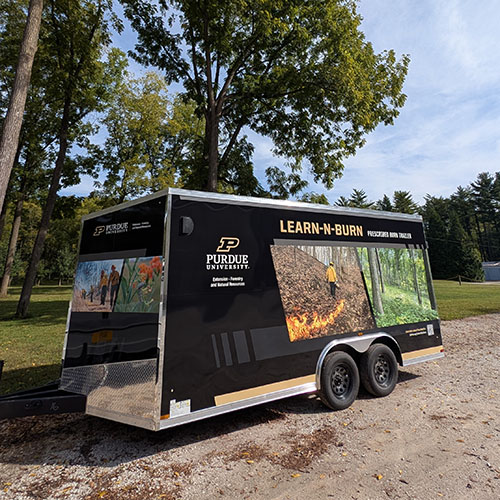
Keep your eyes peeled across Indiana for the newly minted Purdue Forestry and Natural Resources...
“Being at Purdue has changed my thinking entirely,” says Mingyu Zhao, a third-year...