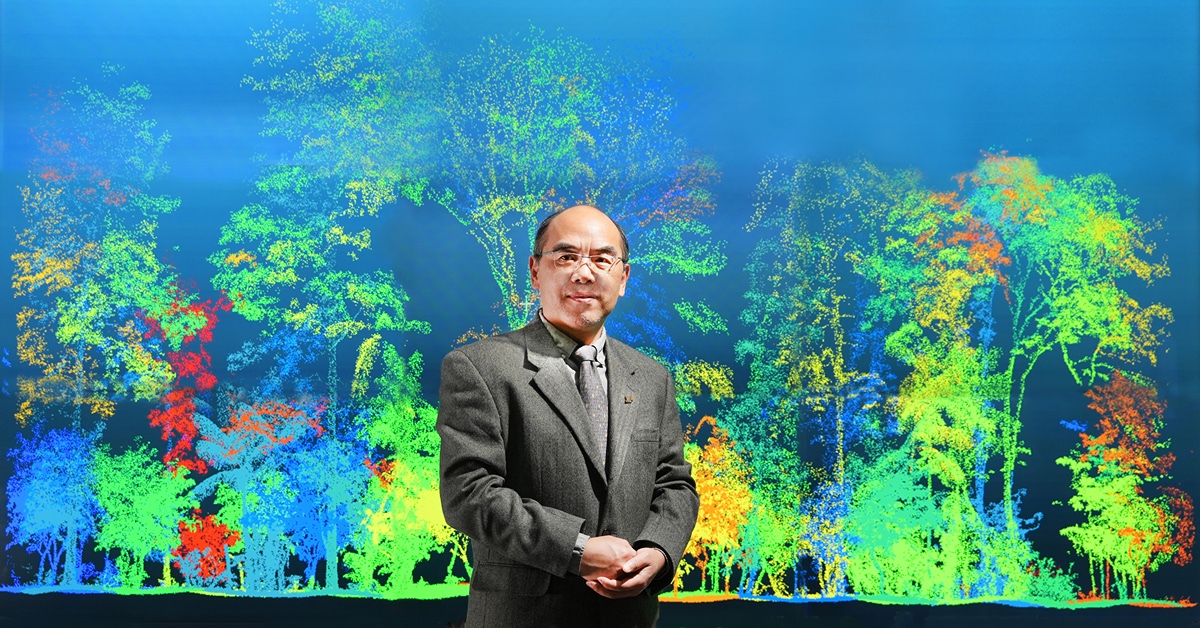
Agricultural researchers generate vast amounts of data. Little of it is shared with peers or accessible to the public. A diverse group of scientists led by Sylvie Brouder, a Purdue University professor of agronomy, is calling for change and proposing the infrastructure to make it happen.

Brouder led the creation of a commentary paper, “Enabling Open-Source Data Networks in Public Agricultural Research,” for the Council for Agricultural Science and Technology with colleagues from the Environmental Defense Fund, the U.S. Department of Agriculture’s Agricultural Research Service, Washington State University, Texas A&M University, and Agriculture and Agri-Food Canada. Brouder presented the paper to lawmakers in a series of events Monday (March 11) on Capitol Hill.
“The next generation of agricultural problem solving will require big science and forging linkages across data sets and disciplines,” the paper says. “Currently, a lack of data sharing and data accessibility is a major barrier for making better decisions in agriculture.”
Solving the world’s grand challenges - feeding nearly 10 billion people by 2050, reducing greenhouse gas emissions that cause climate change and ensuring access to clean water – depends heavily upon agricultural research and advances. Individual studies chip away at these issues, but combining data from multiple efforts offers opportunities to produce global change.
“There are significant opportunities to make advances in so many areas of agricultural research if we share results and make big data out of small data,” Brouder said.
Currently, the lack of a standardized method of organizing agricultural data makes it difficult to combine the data from many small studies to see the bigger picture. Also, many scientific journals put data behind paywalls, keeping it from the public and researchers who cannot afford to access the dozens or even hundreds of journals relevant to their fields.
“There is a case for making data openly available because it democratizes access to science,” Brouder said. “Open data and open access have big implications for how we do science.”
The CAST paper authors argue for developing best practices for data workflow and standards for federally funded projects, offering incentives to making data not presented in peer-reviewed journals available, coordinating among data networks and repositories, and curating and preserving data for use beyond its original intention.
They also call for institutions to bridge gaps between agricultural researchers and data scientists, as well as shift to more of a team science approach that prioritizes data sharing. And, the authors contend that data should inform end-user applications that can address environmental and social challenges.
Building this infrastructure will require coordination amongst researchers, universities, journal publishers and funding agencies. Brouder hopes today’s presentations inspire lawmakers whose support will be vital in making any substantial changes.
“We spend a lot of time as researchers communicating our science,” Brouder said. “Today, we have a chance to take our message to people with the power to make changes that can have true impact on our future.”
To view video of Brouder’s presentation, visit the CAST website at cast-science.org.