Haley Oliver, Associate professor, in food science, was recently honored with Purdue Agriculture’s 2019 Corinne Alexander Spirit of the Land-Grant Mission Award. An expert in retail food safety with an international reputation for her lab’s work on the pathogen Listeria monocytogenes, Oliver is the principle investigator and director of the Feed the Future Innovation Lab for Food Safety (FSIL), established through a $10 million grant from United States Agency for International Development (USAID). FSIL will increase food safety awareness, support local research efforts to improve food safety and disseminate information from the research in Bangladesh, Kenya, Ethiopia, Senegal and Cambodia.
The Corinne Alexander Spirit of the Land-Grant Mission Award, established in 2008, recognizes faculty members in the Colleges of Agriculture, Veterinary Medicine and Health and Human Sciences working across all three land-grant mission areas. The award was named in honor of Corinne Alexander, a professor in the Department of Agricultural Economics, who passed away unexpectedly in 2016.
Karen Plaut, the Glenn W. Sample Dean of the College of Agriculture, presented the award to Oliver. “Dr. Oliver has been an invaluable contributor to the College of Agriculture since coming to Purdue. Her work embodies our land-grant mission and she perfectly exemplifies this award,” Plaut said.
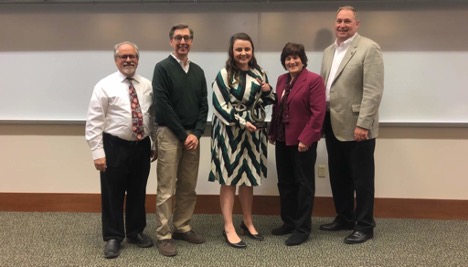
After the receiving the award, Oliver gave a presentation titled “Exercising the Land-Grant Model to Create Resilient Food Systems.” She spoke on the process of applying for the USAID grant for FSIL and the importance of enhancing food safety across the world.
“Many countries struggle with access to clean water, not to mention proper sanitation techniques and equipment,” Oliver says. “With over 600 million people globally falling ill to foodborne illnesses annually, it’s an epidemic. With the expertise and resources contained in this lab, hopefully, we can begin to fight it,” Oliver said.
While Oliver’s work in food safety will impact millions of people around the world, she admits that the role she feels most attached to is mentorship. “I think the area that I value the most is in the mentoring space whether that is in teaching research or mentoring graduate students,” Oliver added. “I am still confused and amazed by the fact that I may be able to help someone with their career or trajectory.”
As for her own trajectory, Oliver and her team in FSIL are beginning to find their role in the food safety realm. “We get to inform the U.S. State Department’s food safety research agenda alongside our partnership with USAID. We also have the opportunity to facilitate research that addresses food safety needs and new partnerships in food safety development and that is a very exciting and powerful place to be.”