

Purdue faculty and staff collaborate on $15 million USAID project in Peru
The Universidad Nacional Agraria La Molina (UNALM) and the U.S. Agency for International Development (USAID), associated with Oklahoma, Utah State and Purdue universities, the Alliance Bioversity International and the International Center for Tropical Agriculture (CIAT), have launched the PERU-Hub project. This $15 million grant-funded effort will improve the economic conditions of farmers in the Huallaga Valley by building a base of knowledge in tropical agriculture and technology transfer.
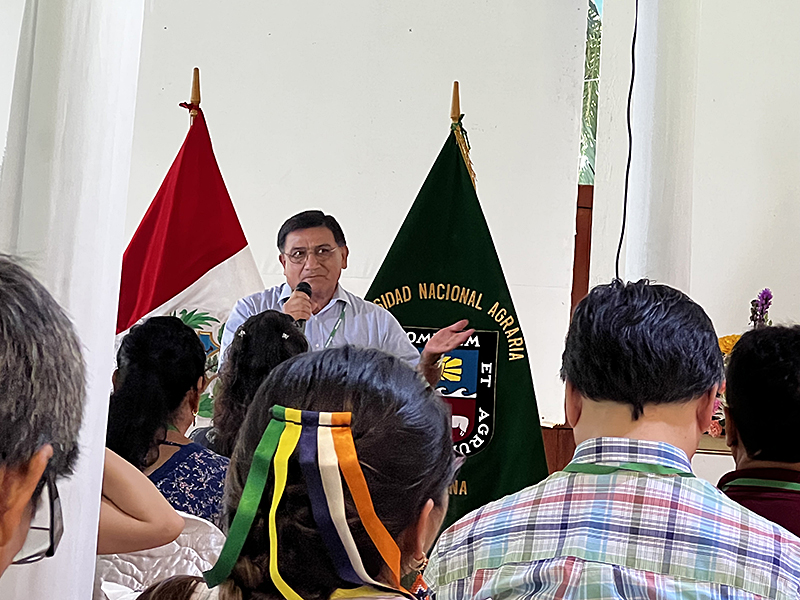 Americo Guevara Perez, Rector of UNALM, welcomes the partners and guests to the launch of PERU-Hub. (Purdue University Agriculture Communications photo)
 Amanda Deering, associate professor of food science in the College of Agriculture, will lead Purdue faculty in contributing to the project, bringing food safety certification, post-harvest practices and policies, food transformation and value chain expertise, and crop suitability technology into the collective. Purdue will use just under $2 million of the grant’s funding.
Loran Parker, associate director and principal evaluation and research scholar at Purdue’s Evaluation and Learning Research Center (ELRC) in Purdue’s College of Education, will serve as the PERU-Hub project’s co-director of learning. With her partner at UNALM, Parker will co-lead the project’s evaluation team and build capacity at UNALM for project monitoring, evaluation and learning. ELRC will support learning and continuous improvement throughout the project’s lifetime. As part of the ELRC/UNALM evaluation team, ELRC Director Willie Burgess will also contribute expertise in participatory evaluation, data collection, analysis, reporting and continuous improvement.
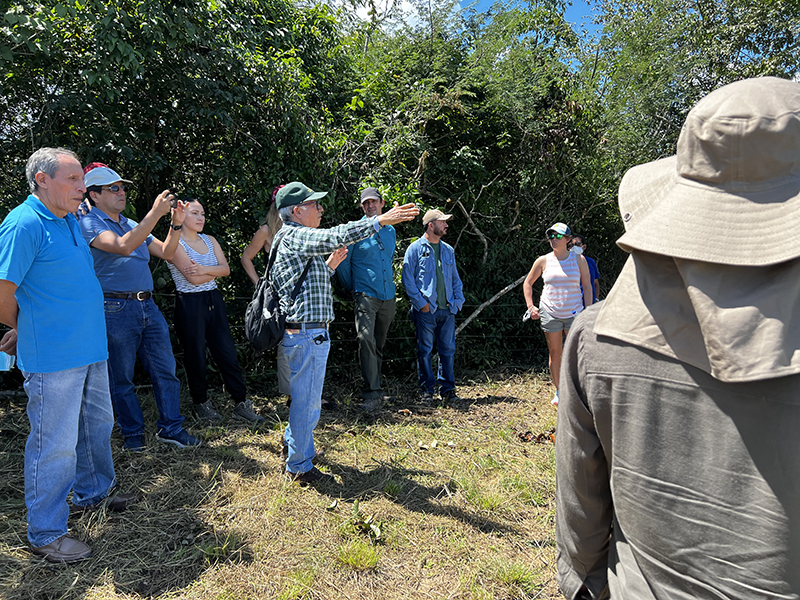 Julio Alegre introduces partners from Purdue University, University of Oklahoma and CIAT to the demonstration farms and pastures at Pucayacu, Peru. (Purdue University Agriculture Communications photo)
 Purdue’s Center for the Environment, which is part of Purdue’s new institute for climate, environment, food security and sustainability, is building on work done through the Nexus Arequipa project.
Deering said part of the grant’s efforts will be to teach farmers how to grow high-value crops to curb and eliminate production of coca, which is linked to illegal drug trade.
“We’re introducing these new crops to farmers, teaching them how to grow alternative crops rather than coca, and focus on value-added products,” Deering said. “For example, in the case of cacao as a replacement for coca, instead of just growing and selling cacao beans, we would also teach them how to make chocolate out of them, which ultimately leads to the ability to make more money.”
Farmers in the Amazon region and San Martin have limited access to improved agricultural techniques, new markets and scarce opportunities for women and indigenous communities. The PERU-Hub project will prioritize the incorporation of women and indigenous community members, with farmers and area entrepreneurs choosing the leaders.
Featured Stories
At Miller Poultry, a broiler production company located in Northern Indiana, Purdue Agriculture...

Sophomore forestry major Katie Schouten spent the summer as an intern with the Lake Maxinkuckee...

Purdue Animal Sciences awarded $96,300 in scholarships to students for the 2026–27 school...

Victoria Uyanga brings expertise in poultry nutrition, physiology and immunology to Purdue Animal...

AI chatbots can provide useful food safety analysis. However, according to an analysis conducted...

Senior wildlife major Andrew Reyes spent his summer as an animal care intern at Brookfield Zoo...