
How the future benefits from the contributions of social scientists
When Zhao Ma hears the term “hard science” used in contrast to “social science,” she internally sighs before making a joke out of it with the hope that will help her colleagues understand the unintended implications of those words.
“I’ll say something like, ‘You know, social science research is also super hard. Have you tried it?’ My colleagues tend to respond, ‘Oh, you know that’s not what I meant,’” Ma, interim assistant dean for research and professor of forestry and natural resources (FNR), said. “I understand they don’t mean it in a bad way, but calling one type of science ‘hard’ implies the other type of science is easier and softer. This is an implicit bias my fellow social science colleagues and I encounter from time to time.”
Ma works with collaborators and students to shed light on the broad and important contributions made by social science research. In her Human Dimensions Lab, Ma analyzes how individuals and organizations make natural resource decisions in the context of social-ecological change.
While fostering stronger communication with biophysical, engineering and technology colleagues across the university, Ma said she emphasizes the importance of calling on a social scientist to collaborate at the beginning of a proposal or project in the planning phase.
“There are times when our biophysical or engineering colleagues will call us after realizing a proposal requires some social science work, but usually by then the main research ideas and the scope of work have been decided,” she said. “I’ve joined a lot of proposals at that stage because I want to be a contributor and team player, but social scientists want to be there from the beginning.”
Linda Prokopy, Horticulture and Landscape Architecture department head and professor, said rather than using terms like “hard and soft” when discussing research, she prefers “biophysical science and social science.” Focusing on what motivates farmers to adopt conservation practices, Prokopy collaborates with professionals who work directly with growers and producers. Together, they refine messaging and program designs to create strategies that lead to greater adoption of conservation practices.
The applied research conducted in Prokopy’s Natural Resources Social Science Lab (NRSS) works to craft conversations through specifically articulated questions that gather effective responses, a skill Prokopy explains is often underappreciated.
“It’s frustrating when biophysical scientists think they can just do a survey, or that it isn’t necessary to bring a social scientist into a project to conduct a survey and they can just do it themselves; it isn’t that easy,” she said. “There is a huge science behind the craft of writing a good survey, getting a good response rate and designing the surveys in a way so that people actually want to take them.”
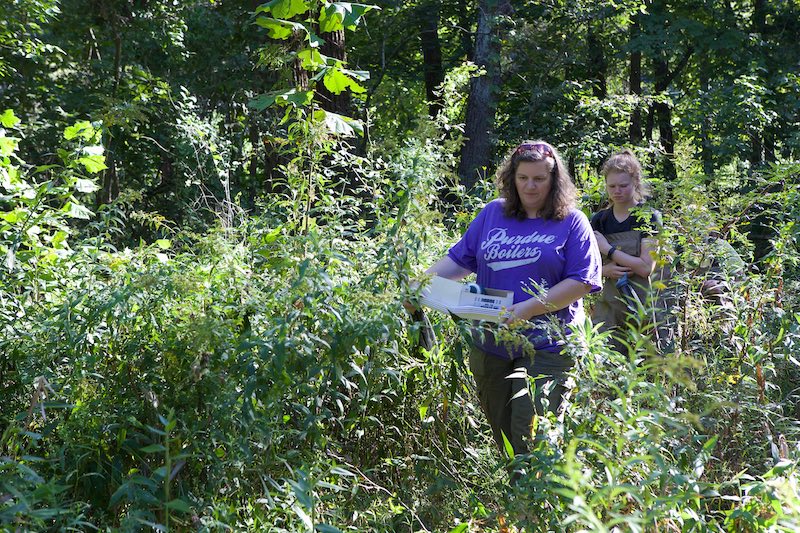 Linda Prokopy walks with a student through Martell Forest during a Natural Resources and Environmental Science leadership skills program.
 A strong example of the collaborative impact social sciences can have on an ecological campaign can be seen through the “Help the Hellbender” campaign, a project led by FNR professor Rod Williams. Funded by the Indiana Department of Natural Resources (IDNR), Prokopy and her team collaborated with Williams’s group to create surveys to understand what people knew about the amphibians. The team then designed an outreach campaign based on survey feedback.
After the success with the hellbender campaign, the ecological team was tapped again by the IDNR for similar projects involving endangered mussels and whooping cranes native to Indiana.
“When I came to Purdue 20 years ago, social sciences were always the tack-on-last-minute type thing, but now social sciences are driving a lot of these larger grants, bringing significant funding into the college,” Prokopy said. “We do impactful research, which all goes hand-in-hand with the impactful work of biophysical scientists.”
With students today being more sustainability-focused, Ma explains, interdisciplinary training and research are key to driving recruitment of the next generation of agricultural, environmental, and natural resource scientists and practitioners.
Featured Stories

The January Consumer Food Insights Report (CFI) sought to determine whether those classified as...
Growing up in LaGrange, Indiana, surrounded by small towns and strong agricultural roots, Conner...

Growing up traveling the world, Abigail Bothwell always wanted to see how agriculture connects...
The Alliance of Crop, Soil and Environmental Science Societies (ACSESS) have acknowledged three...
Farmer sentiment weakened sharply in January, as the Purdue University/CME Group Ag Economy...
Purdue University has grown a thriving forest of more than 2,000 geographic information systems...