

AgSEED grants grow success
For every $1 awarded by the grant program, funded by the Indiana Legislature, Purdue researchers secure an additional $4
The average long-term return on the stock market is about 10 percent. For AgSEED, the Purdue College of Agriculture’s internal competitive grants system, it’s more like 400 percent. It’s an outsized return with outsized impact, benefiting researchers, students, and citizens across the state and beyond.
“The AgSEED program is an investment in ideas that matter,” says Ronald Turco, Associate Dean and Director of Agriculture Research Grad Education at the College of Agriculture. “These grants empower our faculty to take bold steps toward solving the toughest challenges in agriculture.”
Funded by the Indiana Legislature in the Crossroads program, AgSEED (Agricultural Science and Extension for Economic Development) grants are competitively awarded annually to faculty and staff in the colleges of Agriculture, Health and Human Sciences, and Veterinary Medicine. They aren’t huge, typically $50,000 each. But like the ‘seed in their name,’ AgSEED grants grow into something much bigger.
“The program reflects our commitment to innovation and collaboration,” Turco says. “By funding early-stage research, we’re building a pipeline of discoveries that benefit Indiana and the world.”
Since 2014, AgSEED has awarded $10.7 million in grants. This $10.7 million has grown to $44.7 million in additional funding from outside sources. The money has also led to 212 published papers, five patents, and funded 343 graduate students and postdocs.
“AgSEED is also about more than research—it’s about impact,” Turco says. “Every project dollar has the potential to transform agriculture and strengthen rural communities.”
Christian Cruz’s project is a case in point. In 2023, Cruz, an associate professor of botany and plant pathology, was awarded a $75,000 AgSEED grant to study epidemiological surveillance tools for protecting crops from emerging threats like tar spot of corn. He was subsequently able to get an $800,000 USDA National Institute of Food and Agriculture (NIFA) biosecurity grant, as well as an industry grant, all in collaboration with Mohammad Jahanshahi, associate professor of civil and construction engineering.
The total in post-AgSEED grant funding? More than a million dollars. Cruz has used grant money to fund undergrads, scholars, graduate students, technicians, postdocs and consultants. He’s also currently working on a patent application for an algorithm created in collaboration with Jahanshahi.
“Those $75,000 were well-invested!” Cruz says. “It’s been a fantastic experience – we’re grateful these AgSEED grants are available.”
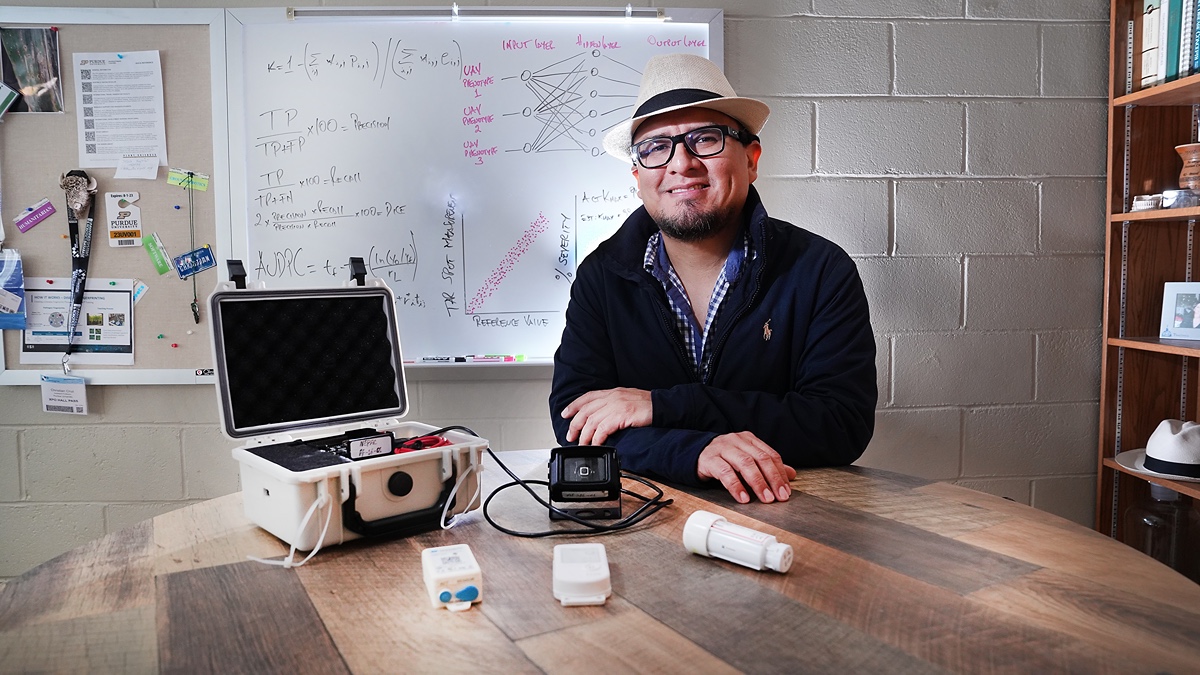 , opens larger image Christian Cruz received an AgSEED grant to help with his research on eliminating tar spot disease on Indiana corn crop.
 Cruz and Jahanshahi have also launched an ongoing collaboration with Solinftec, a global ag-tech leader founded in Brazilia in 2017 that specializes in AI-driven field robotics. The company established its U.S. headquarters at Purdue Research Park in 2018 and later relocated its global headquarters to West Lafayette in 2019, positioning itself close to Purdue’s talent and innovation ecosystem.
“It’s a synergistic partnership we’ve established with them,” Cruz says. “They continue to support Purdue-led projects that validate their robotic platforms.”
AgSEED is designed to support these cross-disciplinary, public-private partnerships, Turco says.
“Many of today’s agricultural challenges require expertise across fields, and this program helps us bring those teams together to deliver real-world solutions,” he says. “AgSEED support allows us to gather critical data and demonstrate feasibility, which is essential for securing larger grants and scaling our work.”
Mohit Verma has also been able to create a real-world solution thanks to an AgSEED grant. In 2020, Verma was PI on a grant was to develop sensors to detect bovine respiratory disease, an infection that can cause fatal pneumonia in calves, leading to almost a billion dollars in losses for the beef industry annually.
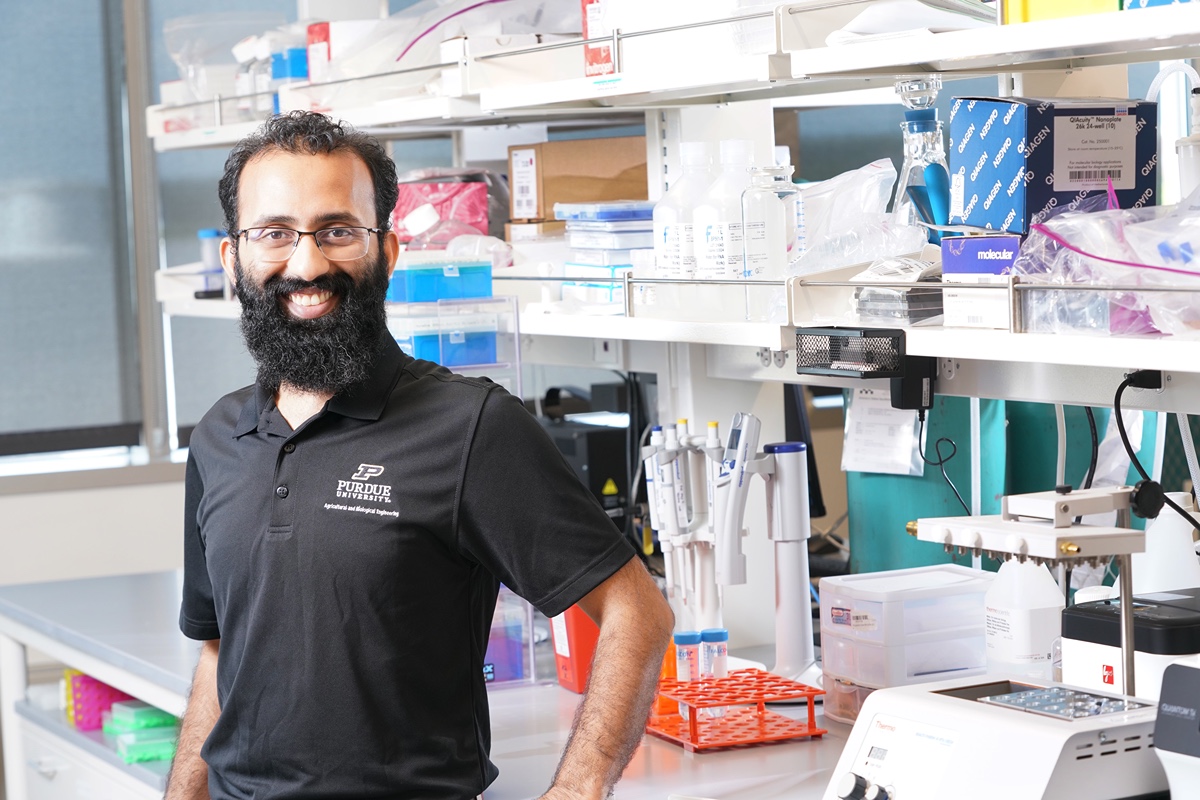 , opens larger image Mohit Verma in his lab in Agricultural and Biological Engineering, working on a nasal swab test for bovine respiratory disease.
 “The idea is to detect which type of pathogen is present and whether there is antibiotic resistance, so vets can make rapid decisions,” Verma explains.
With the AgSEED money, Verma and his team were able to show enough positive preliminary data to secure a $1M NIFA grant through the Inter-Disciplinary Engagement in Animal Systems (IDEAS) program as well as $700k funding (plus matching funds) from the Foundation for Food and Agriculture Research (New Innovator Award and International Consortium for Antimicrobial Stewardship in Agriculture Award). This money has allowed the team to develop a working biosensor and found a startup, Krishi, Inc., for its commercialization. Earlier this year Krishi launched its first product, SherpaTM, currently being tested in the field by veterinarians.
“It’s been really helpful,” Verma says. “It’s much faster than lab-based tests.”
AgSEED, Verma says, is invaluable for early-career professors.
“It supports us to stay focused on a given problem,” he says.
Some AgSEED grants support work involving direct community interaction. In 2022, Cezanne Elias, a clinical associate professor in the Department of Human Development and Family Science, was awarded an AgSEED grant to partner with a local community organization promoting family resilience. Her team worked with community partners to adapt program materials for supporting families facing various hardships. They were able to expand the grant by collaborating with Purdue Extension educators supporting communities recovering from natural disasters, using funding from the USDA/NIFA Smith-Lever Special Needs Competitive Grants Program.
“This grant enabled us to advance our goal of helping families build resilience skills tailored to specific challenge and reduce the negative impacts on children and families,” Elias says.
Many of the problems tackled with AgSEED grants are far-reaching. Jennifer Freeman, a professor of toxicology in the School of Health Sciences, won an AgSEED grant in 2020 for research on how exposure to the herbicide atrazine impacts neurological outcomes throughout life. Atrazine, the second most common herbicide in the US, is known to contaminate drinking water supplies, Freeman says, making understanding its impacts crucial for ordinary citizens nationwide.
 , opens larger image Jennifer Freeman, professor of health sciences, studies the neurotoxicity of PFAS.
 “Our group was extremely appreciative of this award,” Freeman says, explaining that it allowed her team to do an initial study using zebrafish as a model. This initial research generated several publications and presentations, and supported undergraduate and graduate research opportunities, including two national undergraduate research awards from the Society of Toxicology. It also earned Freeman’s team additional funding from the NIH.
Student work is a crucial part of AgSEED’s mission.
“AgSEED opens the doors for students to work on real-world problems,” Turco says. “They gain hands-on experience while contributing to research that shapes the future of agriculture.”
Featured Stories

For Brody Cox, preparing for the Indiana State Fair began long before he entered the show...
Carolyn Foley, a long-time member of the Purdue Forestry and Natural Resources (FNR) and...

In the September Purdue University/CME Group Ag Economy Barometer survey, 52% of respondents...

Purdue University’s College of Agriculture recognized nine alumni at the Distinguished...
Keep your eyes peeled across Indiana for the newly minted Purdue Forestry and Natural Resources...
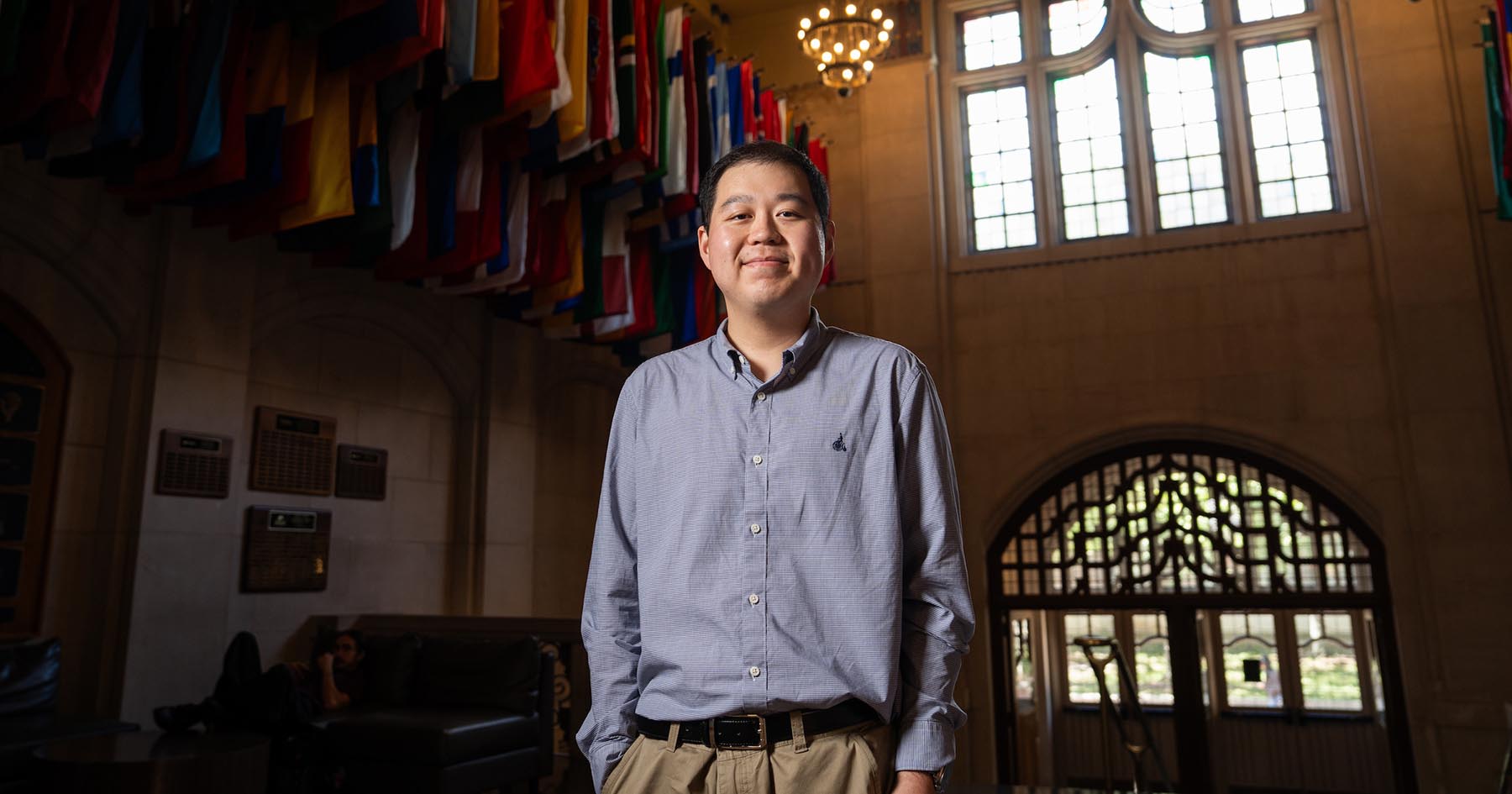
“Being at Purdue has changed my thinking entirely,” says Mingyu Zhao, a third-year...