

Ticks don’t take spring break: Stay protected as the weather warms up
As spring approaches and the days grow warmer, it’s only natural to feel the call of the outdoors. But before you grab the leash and head out for a walk with your pet, remember ticks are ready for spring, too.
According to Catherine Hill, professor and head of the Department of Entomology, tick activity can occur not only in spring and summer but also during winter and autumn months.
“In Indiana and across much of the Midwest and North America, ticks can be active year-round,” Hill said. “With the Lyme disease tick—one of the most significant tick threats in our region—we typically see nymphs active in spring and adults active in the fall and continuing through winter, depending on conditions. On February 28, I removed three adult ticks from my own dog. No matter the time of year, if you and your pets are in tick habitat, be aware that ticks may be active and follow some simple steps to prevent tick bites.”
To understand why ticks can pose a danger year-round, Maria Vittoria Murgia, a research scientist in the Department of Entomology, says it is important to understand their lifecycle.
“Ticks have three life stages. They must feed to molt into each stage,” she said. “To start the female lays eggs, and the eggs hatch into larvae. The larva must feed on a host to molt into the second stage, the nymph. Nymphs have to take another blood meal to become adults. In the third stage, as adults, they mate, the female blood-feeds and then lays eggs. A female will die after she lays eggs. Generally, she will lay 3000-8000 eggs depending on the species.”
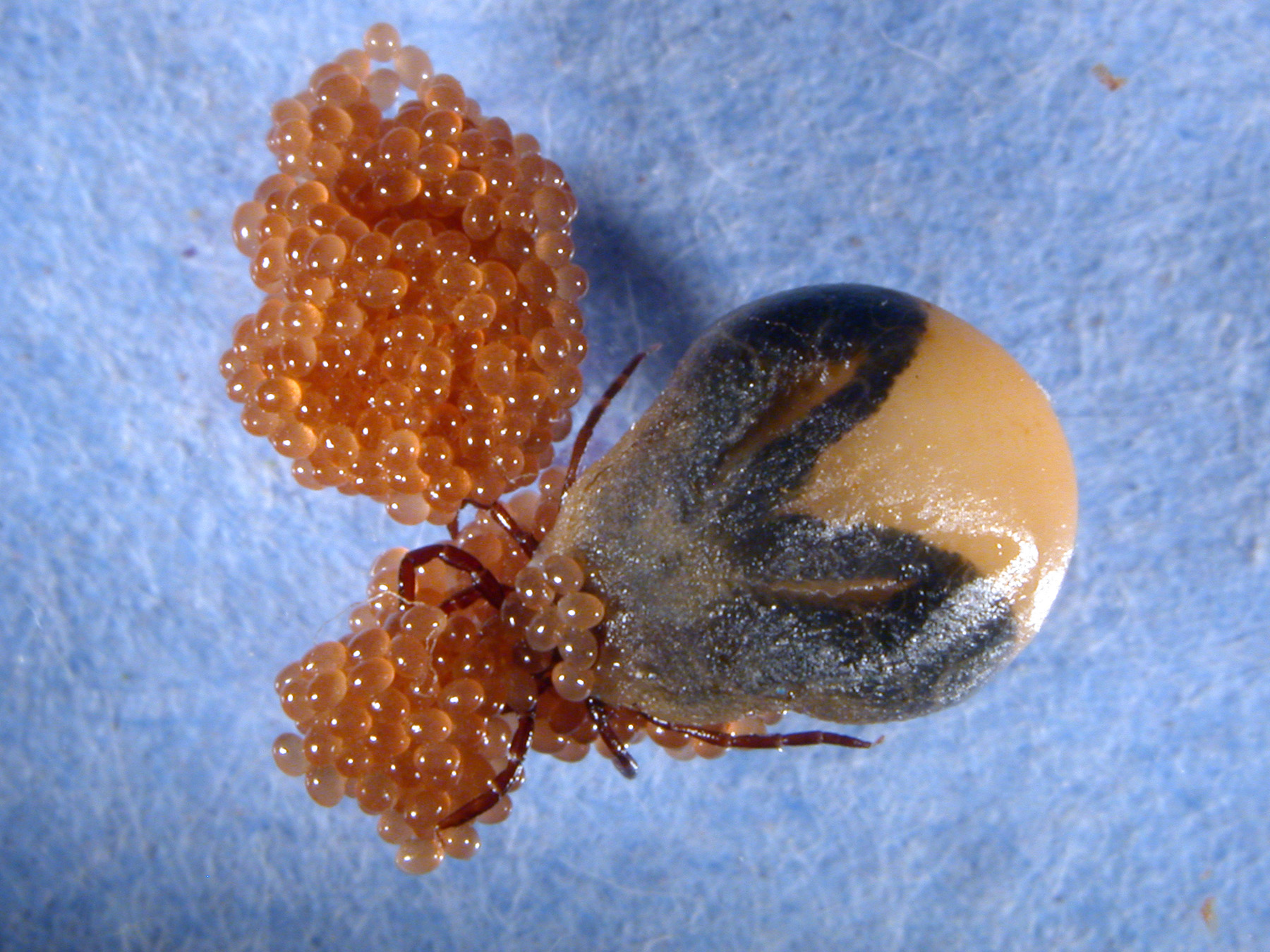 , opens larger image Female tick laying eggs.
 Murgia explains that while ticks are most active in the spring to autumn months, they generally go into a diapause state in the colder months. “A diapause state is a state in which they lower their metabolism. They’re still alive, and they have a lower metabolism because they need to preserve their energy reserves,” she said. Even in the colder months, they could “quest” for a host if the conditions become suitable.
“When they have hatched, they have reserves from the previous stage. Those reserves are needed to survive, so they need to find a host before they exhaust their reserves and die. This is what drives ticks even in colder months to search for a host,” Murgia said.
Various environmental factors can also trigger a feeding opportunity for a tick. “Ticks can sense when conditions are not going to be suitable for them to feed, so they will stay put to preserve their energy and avoid dehydration,” she said. “However, there are conditions such as temperature rises, increase in the number of hours of light in the day and others that are a trigger for “questing.”
Hill notes it is important for the public to be aware that there are many misconceptions about ticks and tick-borne diseases.
“We often think of mosquitoes as the primary arthropod threat to human and animal health, and they certainly are important. However, in the United States, in most years, there are substantially more confirmed cases of tick-borne diseases than mosquito-borne diseases. Ticks are capable of transmitting a wide range of pathogens to both people and animals, including bacteria, viruses, and parasites. These infections can have significant impacts on health and well-being, ranging from acute illness to long-term complications.”
No matter the temperature, Murgia says that it is important to take safety precautions for you, your family and any pets in your home.
How do I protect my family and my pets from ticks when outdoors?
- Wear light-colored clothes
- Cover especially the lower part of your body
- Stay in the middle of the trail
- Remove clothes once indoors and wash and dry on high. Dry for 15 minutes longer than the normal cycle.
- Do tick checks on yourself and your animals that are outdoors. The most common areas to find ticks are behind the ear, the groin area, the armpit and the belly button.
- Take a shower once indoors
- Administer tick and flea medicine to your pets as directed by your veterinarian
- Consider the use of DEET-based products if you are in an area that has been heavily infested

What do I do if I discover a tick on me or my pet?
- If you see a tick crawling on you or your pet, use gloves (optional) and tweezers to remove it, place it in a plastic-sealed bag, and dispose of it in the garbage. You can also flush it down the toilet.
- It is important not to squash the tick, as it can release bodily fluids that may be infected with a pathogen.
- If a tick is attached, do not use any irritant or burn the tick. The best way to remove the tick is with tweezers. Place the tweezers close to the skin at the mouth part of the tick and pull gently and steadily upward. Ensure all mouthparts are removed, to avoid irritation and chance of secondary infection.
- Once you remove the tick, always wash the wound with soapy water.
- If you experience a fever redness, burning or itching around the bite site, it is important to be evaluated by a doctor.
With tick-borne diseases, prevention is better than treatment.
“The good news is that we have effective tools to reduce risk. By understanding where ticks are found, when they are active, and how to prevent tick attachment and feeding, we can better protect ourselves and our pets. Avoiding tick habitat when possible, wearing protective clothing, using an EPA-approved repellent, keeping pets on veterinarian-recommended tick prevention products, and performing regular tick checks are all proven strategies,” Hill said.
Staying vigilant and practicing these simple precautions means you can enjoy every sunny day with peace of mind—while keeping your family and pets safe from unwanted hitchhikers.
Featured Stories

For Brody Cox, preparing for the Indiana State Fair began long before he entered the show...

Carolyn Foley, a long-time member of the Purdue Forestry and Natural Resources (FNR) and...

In the September Purdue University/CME Group Ag Economy Barometer survey, 52% of respondents...

Purdue University’s College of Agriculture recognized nine alumni at the Distinguished...
Keep your eyes peeled across Indiana for the newly minted Purdue Forestry and Natural Resources...

“Being at Purdue has changed my thinking entirely,” says Mingyu Zhao, a third-year...