Agricultural Economics
Many consumers view processed foods as unhealthy but convenient

WEST LAFAYETTE, Ind. — When it comes to highly or ultra-processed foods, consumers display a disparity between what they say is important to them and what they typically buy from the grocery store, according to the March issue of the Consumer Food Insights Report (CFI).
The survey-based report from Purdue University’s Center for Food Demand Analysis and Sustainability (CFDAS) assesses food spending, consumer satisfaction and values, support of agricultural and food policies, and trust in information sources. Purdue experts conducted and evaluated the survey, which included 1,200 consumers across the U.S.
“There’s been a lot of attention on highly or ultra-processed foods in recent years, including new U.S. Department of Agriculture dietary guidelines that have called out highly processed foods as a contributing factor in chronic disease,” said the report’s lead author, Joseph Balagtas, professor of agricultural economics at Purdue and director of CFDAS. “But highly or ultra-processed foods are not clearly defined, and so we set out to document consumers’ understanding of what these foods are.”
The March edition of CFI gauges consumers’ familiarity with the term “processed foods,” opinions on their healthfulness, and the reasons why consumers think they might choose processed foods over unprocessed or minimally processed foods. The responses are broken out by region: Midwest, Northeast, South and West.
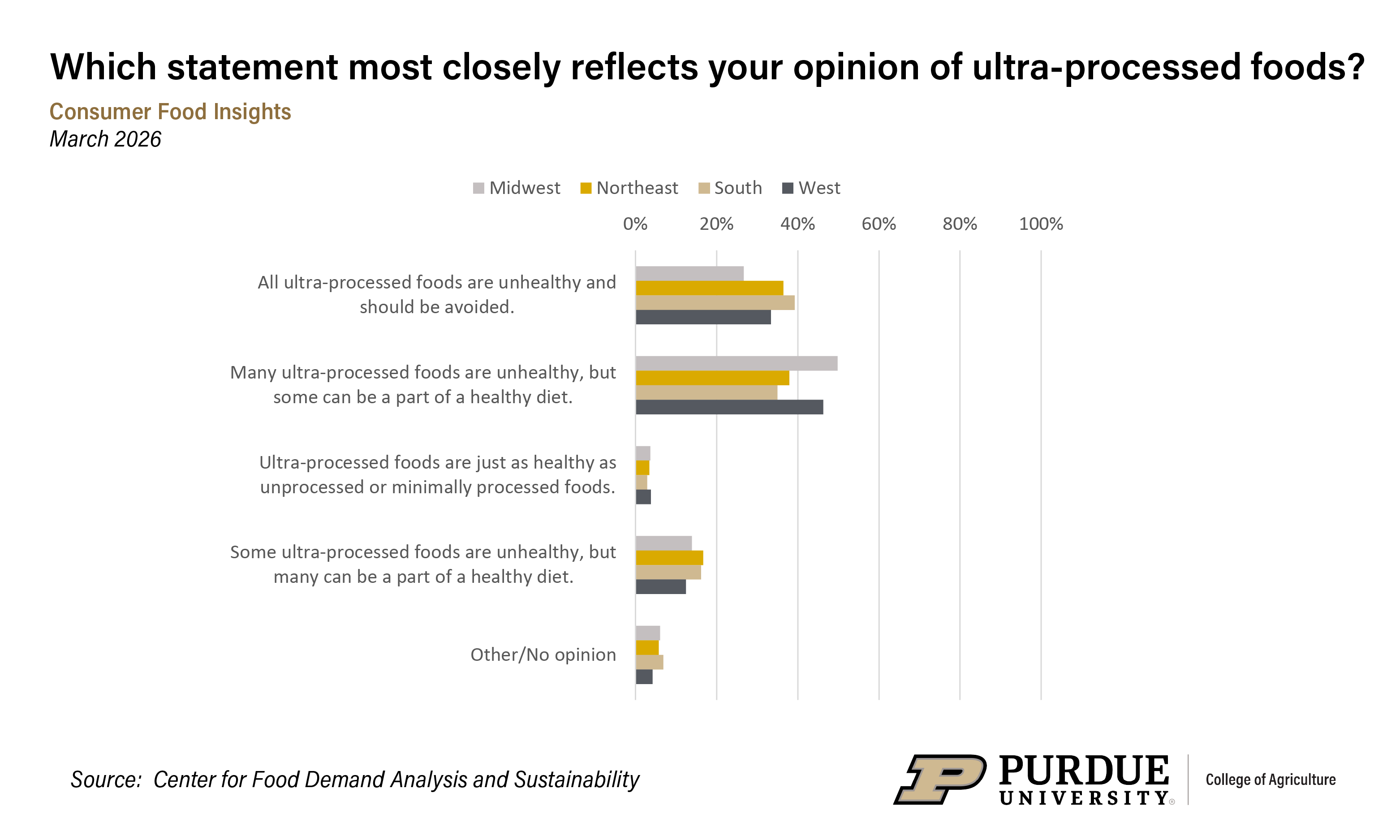 , opens larger image Figure 4. "Which statement most closely reflects your opinion of ultra-processed foods?" March 2026
 Last month’s CFI survey screened respondents to see what kinds of common grocery items make it into their typical grocery baskets before asking them to rate their concern about the potential health impacts of processed and ultra-processed foods on a scale from “not at all concerned” (0) to “very concerned” (10).
“The responses show an average rating of 7.1, indicating that, on average, Americans are indeed concerned about the healthfulness of these foods,” Balagtas said. “Approximately a third of Americans tell us all ultra-processed foods should be avoided, while 57% agree that some ultra-processed foods can be part of a healthy diet.”
As for why consumers prefer processed or ultra-processed foods over unprocessed or minimally processed alternatives, 58% selected convenience and time savings as the top reasons. Affordability, taste preferences and shelf life were the next most selected reasons.
“With many processed foods being ready to eat, they can be an important part of many household diets, especially when there is limited time or knowledge to prepare meals,” Balagtas noted.
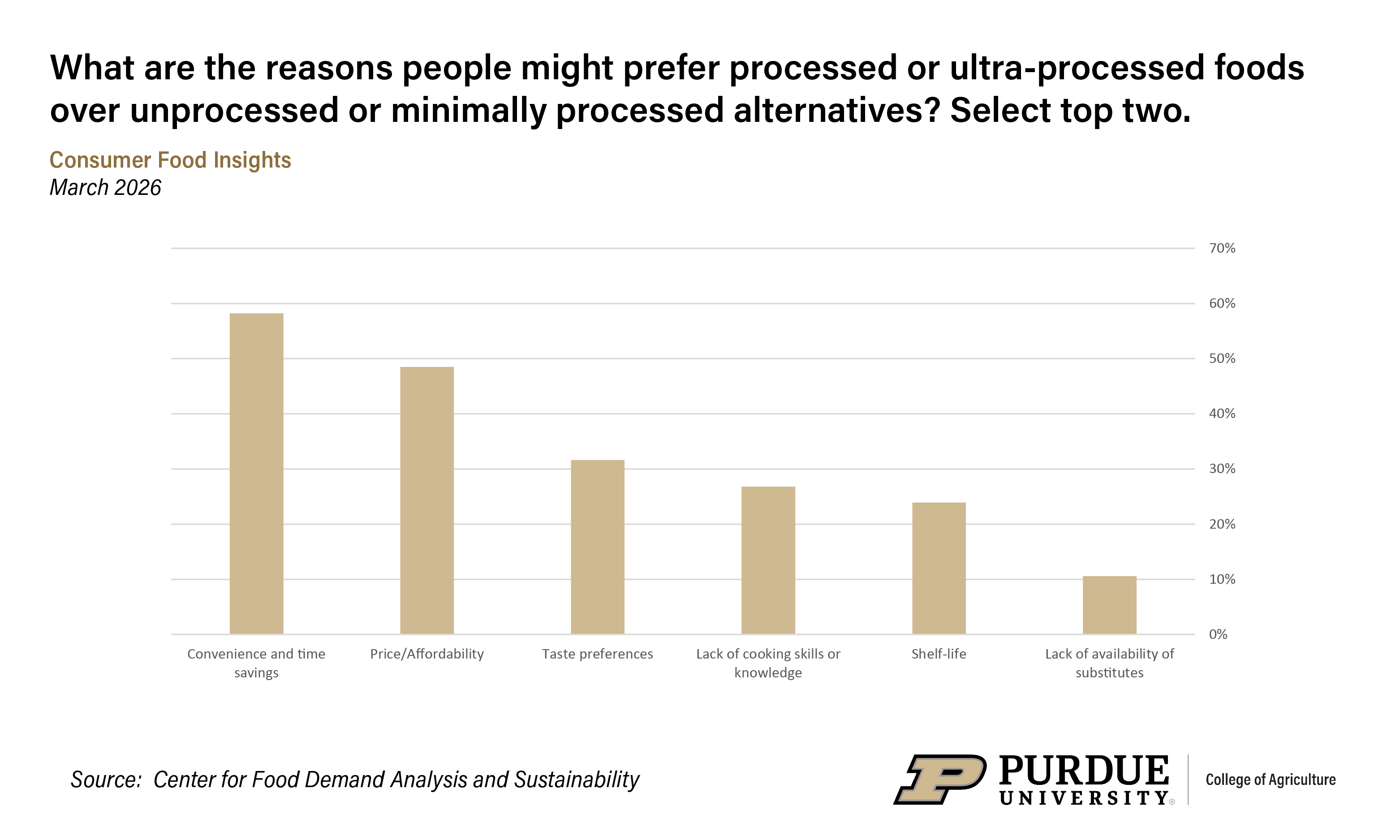 , opens larger image Figure 5. What are the reasons people might prefer processed or ultra-processed foods over unprocessed or minimally processed alternatives. Select top 2. March 2026
 National food insecurity stood at 11% in March, representing a significant 2% improvement from February, said Caitlinn Hubbell, a market research analyst at CFDAS and a report co-author. Food insecurity in the West is about 7.5 percentage points lower than in the South.
Meanwhile, Americans’ self-reported diet quality remains intermediate, with an average Mini-EAT score of 62.2, well below the healthy threshold of 69. Diet quality scores in the West are about two points higher than in the Midwest.
Consumer food purchasing remains driven by taste, safety and affordability, according to the latest sustainable food purchasing (SFP) index, which holds steady at an average score of 71 out of 100. “Consistently, purchasing behaviors tied to environmental and social responsibility are less common,” Hubbell said.
When looking at total SFP score by region, the West ranked about 6 points higher than the Northeast. As for taste specifically, the Midwest and the West both scored 87, followed by the South at 80 and the Northeast at 77.
Consumer food spending declined this month, with households reporting an average of $122 per week on groceries and $68 on dining out in March. “While consumer estimates of food inflation are stable, they remain higher than official consumer price index (CPI) figures, suggesting a persistent perception gap,” Hubbell said. “Still, consumers appear to be tracking inflation trends more closely, with their expectations aligning directionally with CPI changes.” The CPI for food inflation was up slightly, 0.2%, from February.
The Center for Food Demand Analysis and Sustainability is part of Purdue’s Next Moves in Plant Sciences 2.0 and uses innovative data analysis shared through user-friendly platforms to improve the food system. In addition to the Consumer Food Insights Report, the center offers a portfolio of online dashboards.
About Purdue Agriculture
Purdue University’s College of Agriculture is one of the world’s leading colleges of agricultural, food, life and natural resource sciences. The college is committed to preparing students to make a difference in whatever careers they pursue; stretching the frontiers of science to discover solutions to some of our most pressing global, regional and local challenges; and, through Purdue Extension and other engagement programs, educating the people of Indiana, the nation and the world to improve their lives and livelihoods. To learn more about Purdue Agriculture, visit this site.
About Purdue University
Purdue University is a research institution ranked among the top 10 public universities in the United States. More than 111,000 students study at Purdue across multiple campuses, including more than 57,000 at our main campus locations in West Lafayette and Indianapolis. As a land-grant university committed to affordability and accessibility, Purdue’s main campus has frozen tuition 14 years in a row, enabling more students than ever to graduate debt-free.
Writer: Steve Koppes
Media contact: Devyn Ashlea Raver, draver@purdue.edu
Sources: Joseph Balagtas, balagtas@purdue.edu
Agricultural Communications: Maureen Manier, mmanier@purdue.edu, 765-494-8415
Journalist Assets: Publication quality charts and images can be obtained at this link.