

Worth the investment: Purdue research quantifies the ROI of agricultural outreach
Measuring the impact of education is never straightforward. A farmer who learns a better grain storage technique from an instructional video might increase her income by 19 percent. However, for organizations investing in global-scale agricultural learning, showing returns in a funding report has long been a problem—a problem that Barry Pittendrigh and Julia Bello-Bravo are working to solve.
Pittendrigh, Purdue’s John V. Osmun Endowed Chair in Urban Entomology, and Bello-Bravo, assistant professor of agricultural sciences education and communication, are coauthors of a new study published in PLOS One. Written with international collaborators, the paper introduces a framework that gives funders a concrete, quantitative way to evaluate the return on investment of digital agricultural learning initiatives.

The research centers on Scientific Animations Without Borders (SAWBO), which produces free multilingual instructional animations for audiences in low-literacy and non-English-speaking communities. Available online as well as through the new SAWBO app, the videos reach viewers speaking languages ranging from Arabic and Swahili to those used by fewer than 10,000 people globally.
“We wanted to measure the economic impact of delivering content in local languages,” said Bello-Bravo. “What is the value of giving someone who doesn’t speak a mainstream language like English or Spanish access to educational materials they can understand and use?”
The concept for the paper grew out of an earlier collaboration between Purdue and the Food and Agriculture Organization (FAO) of the United Nations, in which economists worked alongside the SAWBO team on a field experiment in Uganda.
“After that, we kept exchanging ideas,” said coauthor Rebecca Pietrelli, economist in the Agrifood Economics and Policy Division at the FAO. “It became clear we didn’t want to stop at a single case study, but instead try to step back and ask, ‘How do these kinds of digital learning experiences make sense economically, and under what conditions can they really scale?’”
The team developed a systems-modeling framework that tracks a learning initiative through four stages: production, deployment, adoption and returns. The output is an internal rate of return – a standard measure of investment performance – that funders can use to evaluate economic viability.
The model simulates how information spreads through a population, starting with a small group of informed farmers and diffusing outward through peer-to-peer knowledge sharing and targeted outreach. Sensitivity analysis revealed that returns were most impacted by campaign spending, adoption rates and income gains.
 , opens larger image Figure 7 from “Investment modeling for scalable agricultural learning,” showing the number of farmers required for investments to break even.
 The study’s findings highlight how scale and longevity shape returns. For a new animation, built from scratch, peer-reviewed and produced in 20 languages at a base cost of $30,000, the break-even point is 7,593 farmers over three years, or just 113 farmers if the content remains in active use for 30 years.
By comparison, it can cost as little as $500 to translate an existing animation into a new language, an investment that breaks even at 130 farmers in three years or just seven over 30 years.
“Because this content lives on well beyond a three-year funding mechanism, you don’t need to impact that many people in order to have a positive return on investment in the long term,” said Pittendrigh.
While the paper uses SAWBO’s animations as a case study, the framework can be adapted to evaluate the impact of any scalable agricultural learning mechanism, such as farmer field schools, printed materials and mobile applications.
For organizations deciding where to direct limited resources, this research offers a offers a replicable way to model outcomes before, during or after a campaign.
“In a context where resources are increasingly constrained and demands on development funding continue to grow, this kind of analysis helps highlight which approaches offer strong value, which ones are worth expanding, and where changes may be needed,” explained Máximo Torero, the FAO’s chief economist and another coauthor.
Pittendrigh compares the trajectory of agricultural education to technologies like the automobile or telephone, which evolved from expensive, specialized tools into widely accessible resources.
“Our study demonstrates that placing content into even rare languages makes economic sense. This is a game changer for reaching remote communities, as traditional extension systems often do not have educational content available to them.”
Featured Stories

The Office of Indiana State Chemist (OISC) is warning Indiana residents about an illegal...

A prominent protein on most human cells may be key to unlocking the code that makes humans...
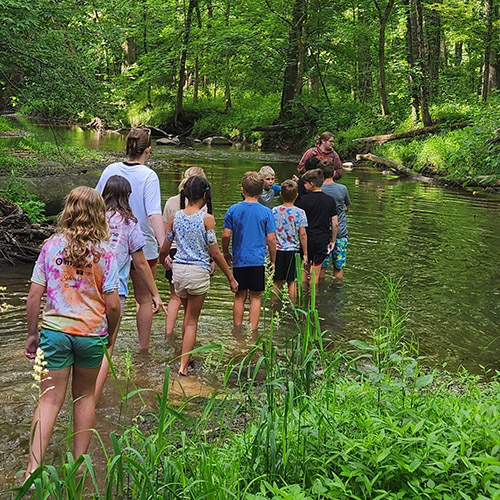
Ava Hoskins, a double major in aquatic sciences (fisheries concentration) and natural resources...
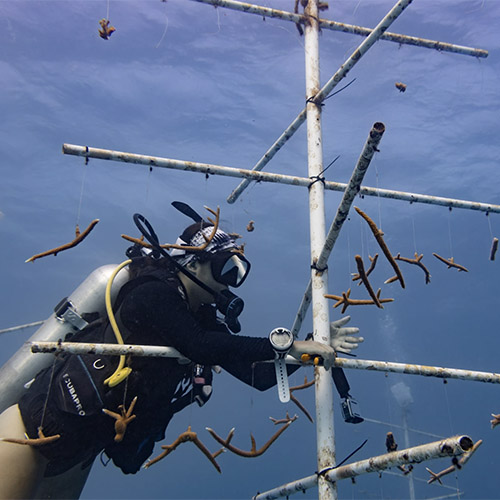
Ashlynn McLaughlin, a senior aquatic sciences major with a concentration in marine and freshwater...

For Brody Cox, preparing for the Indiana State Fair began long before he entered the show...
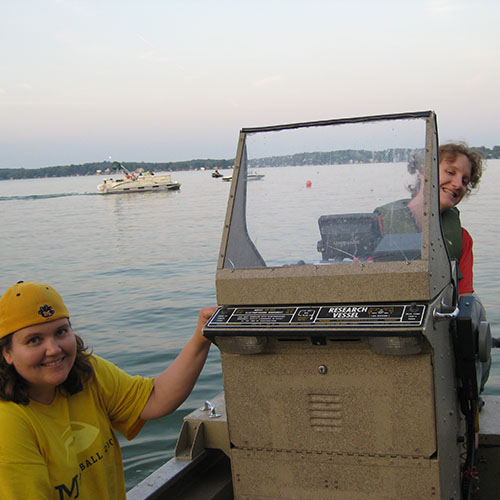
Carolyn Foley, a long-time member of the Purdue Forestry and Natural Resources (FNR) and...