

Layton Rosen - Graduate Ag Research Spotlight
We had a lab full of rotting onions with maggots in them, and you’d have to scoop them out, It’s exactly as gross as you imagine. I got to write up and present my results. I came back here and was like ‘yeah, I am definitely doing grad school.’
- Layton Rosen, Recent Master’s Graduate, Entomology
The student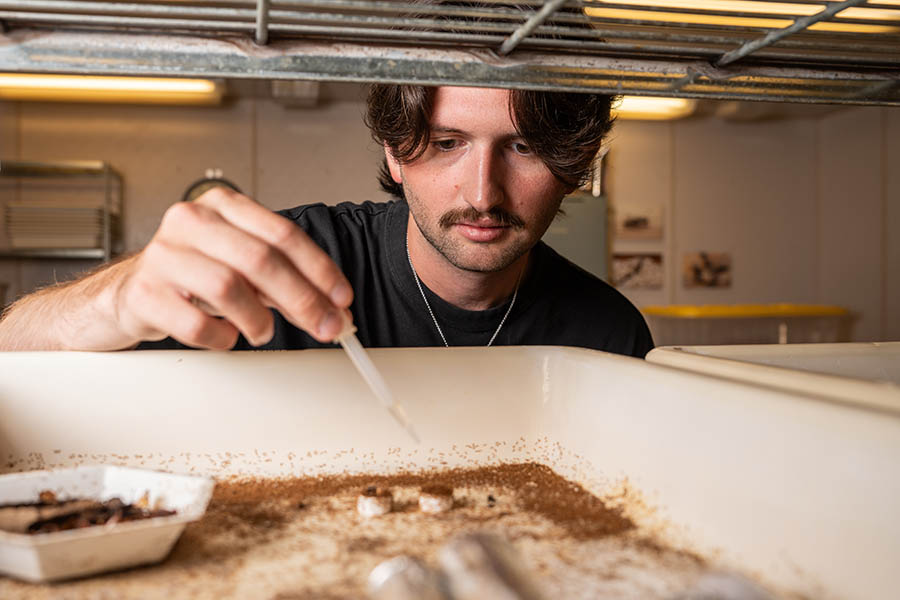
Most parents want to encourage their child’s hobbies, signing them up for chess club, shuttling them to soccer practice, paying for paint and canvas. But what about when that hobby is insect husbandry?
Luckily for Layton Rosen, his parents tolerated — if not exactly embraced — his childhood love of insects, allowing him to fill his room with ant colonies, millipedes, mantids and even cockroaches.
“They hated it,” he says, laughing.
Rosen, who moved frequently as a child but attended high school in Ohio, had always been an outdoorsy kid, spending afternoons rambling around, looking for lizards. His sophomore year of high school, he saw a YouTube video about keeping ant colonies.
“I got really interested in how to catch a queen,” Rosen says. “I read all these materials, learned about their nuptial flights. I’d go around at night, catching carpenter ants.”Still, Rosen expected to pursue his first love — music — at college. He planned to attend the University of Washington but deferred because of Covid. During that year, he changed course, remembering how much he’d liked touring the entomology labs at Ohio State University. He decided to apply to Purdue instead.
The research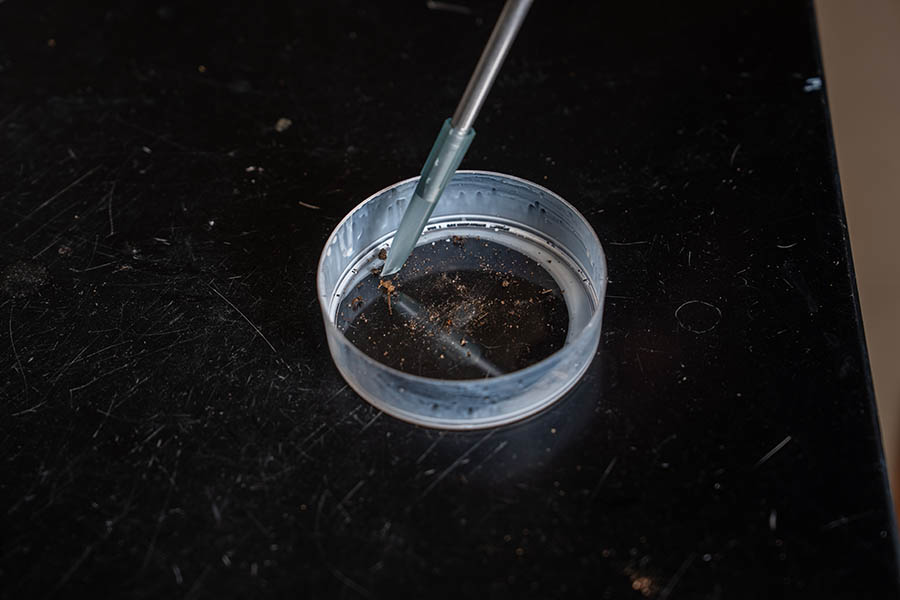
As an undergrad, Rosen immediately got involved in research, working first as a lab tech for entomology professor Douglas Richmond.
“I was digging up Japanese beetle grubs at the soil center,” he says. “I got paid and got hands-on experience.”
Ultimately, he worked in four or five labs, “getting a taste of every discipline,” he says.
The summer after his junior year, he did a summer research internship at Cornell University, studying the charmingly named onion maggot.
“We had a lab full of rotting onions with maggots in them, and you’d have to scoop them out,” he says. “It’s exactly as gross as you imagine. I got to write up and present my results. I came back here and was like ‘yeah, I am definitely doing grad school.’”
He decided to stay at Purdue for a master’s, working with entomology research professor Grzegorz Buczkowski, an ant expert.
“I wanted to do more ecologically focused work and work with ants,” Rosen says.
His master’s work involved applying principles of island biogeography — the ways in which geographical isolation affects species richness and diversity — to isolated habitats in Indiana. He studied stands of isolated trees within corn or soybean fields, examining the level of biodiversity among the trees and in the surrounding fields.
“Largely I found that the stands do behave much like islands, and the ants just do not go in the fields at all,” he says.
This is largely because of tilling, which destroys the ants’ ability to nest in the ground. Since ants can be useful for aerating the soil and preying on certain agricultural pests, this research could be helpful for farmers looking for greener growing strategies.
The work became Rosen’s master’s thesis, which he defended this summer. He’ll stay at Purdue for the next year, working as a lab tech for new faculty member Lindsay Miles and continuing to care for his ant colonies. He hopes to pursue a PhD, though he’s also interested in industry opportunities.
Opportunities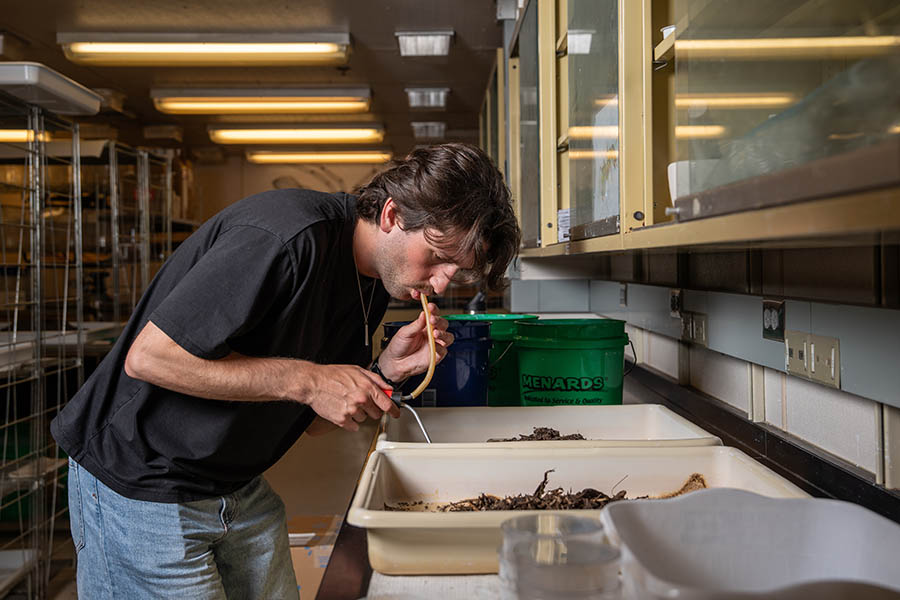
“Most entomology programs don’t even have their own building,” Rosen says, gesturing around his office in Smith Hall. On his desk is a stuffed ant, a water bottle covered in ant stickers, a painting of an ant made by his girlfriend, and a cast aluminum ant colony his parents had made for him. “We’ve got lots of space and resources.”
These resources include the eight Purdue Agricultural Centers, where researchers study real-world land and soil conditions. Rosen also cites Purdue’s Center for Urban and Industrial Pest Management as well as Purdue’s annual pest management conference, which is “really good for getting connected with employers.”
Other resources are less, well, formal.
“I used to test carpenter ants I collected off trees by the police station at night,” Rosen says. “I’d definitely get stopped and asked.”
More Graduate Spotlights
“Being at Purdue has changed my thinking entirely,” says Mingyu Zhao, a third-year...
As a child in Rio de Janeiro, Mayara dos Santos Rocha loved animals so much she figured...
At 25, Noah Berning has already accomplished a goal held since middle school: he’s going to...

Growing up in lush northern Florida, Natalie Allen spent much of her childhood outdoors, catching...
When Elizabeth Ogar was growing up in Nigeria, a weevil infestation hit her family’s corn...

Luping Xu is proud to be from Ningbo, a port city in eastern China with a long history of...