

Hayley Sutherland - Graduate Ag Research Spotlight
Two hens can be standing right next to each other, and one might have 10,000 mites while the other has fewer than 100. We are trying to understand why.
- Hayley Sutherland, Animal Sciences
The student
Hayley Sutherland has always loved taking care of animals. As a child, she adored her Alaskan malamute, Roz, born just three days after her. In high school, she joined the zoology club, raising exotic pets like bearded dragons, rats, iguanas and rabbits. And from an early age, Sutherland had Purdue in her sights.
“I’m from the south suburbs of Chicago, and growing up, when you’d take your dog to the vet, you’d notice that all the vets went to Purdue,” she says. “And my mom did her PhD in animal psychology at Purdue. So, it was a pretty linear path.”
Sutherland earned her bachelor’s and master’s degrees in animal sciences at Purdue and stayed on for her PhD. She expects to graduate next spring.
The Research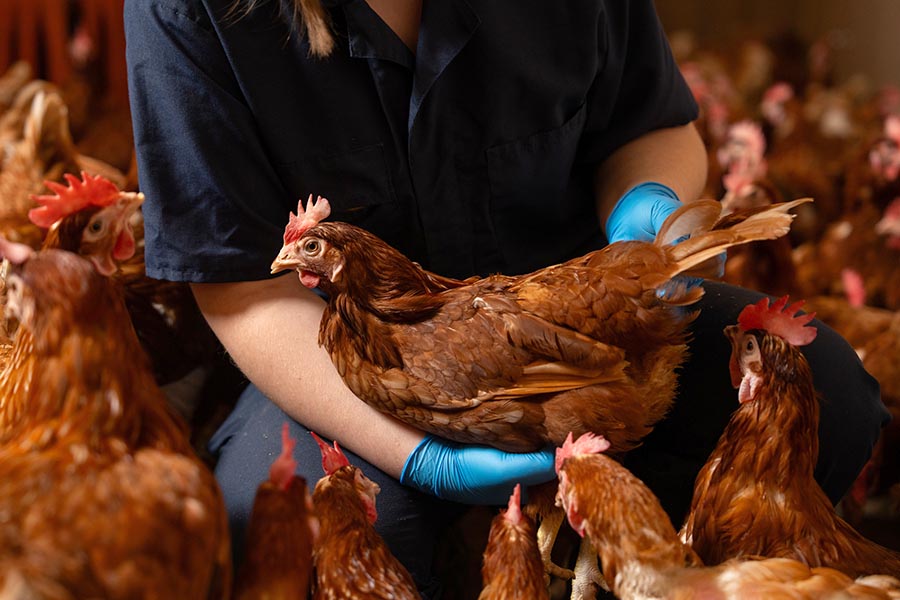
Sutherland studies an ectoparasite called the northern fowl mite, a scourge on egg farms in temperate regions worldwide.
“They’re a really big problem in the U.S.,” Sutherland says. “When a chicken is infested, maybe she’s itchy, maybe her immune system is involved, she’s not very comfortable, her egg production may drop. It causes a lot of production issues.”
Sutherland investigates why some hens are especially vulnerable to mite infestations.
“There’s something called the 80/20 rule of parasitology,” she says. “Twenty percent of animals carry 80 percent of parasites. Two hens can be standing right next to each other, and one might have 10,000 mites while the other has fewer than 100. We are trying to understand why.”
One hypothesis is that mite susceptibility has a genetic link. If this is the case, then discovering the responsible genes could make it possible to breed parasite-resistant chickens. This could provide an enormous benefit over traditional methods of treatment — pesticide sprays or oral medications. As the poultry industry has shifted toward cage-free production, these methods have become increasingly impractical.
“You treat one hen, and she runs around the hen house. It’s really hard to keep track,” Sutherland says. “So, if we could get a preventative effect going, it would really help producers — and hens, too.”
Opportunities
“I think part of the reason I’ve stayed so long at Purdue was that I felt really supported here,” Sutherland says. “I feel like I can contribute to the direction our department is shifting to as we move toward One Health and a welfare-centric approach.”
Sutherland says she’s been lucky to have known her advisor, Marisa Erasmus, associate professor of animal sciences, since she was an undergraduate.
“A good advisor will make sure you get experience outside your department, and I’ve been lucky enough to have that in Dr. Erasmus,” she says.
Sutherland has traveled for national and international conferences and recently attended an applied ethology conference in the Netherlands. She’s also presented in front of industry representatives and other nonacademics. “I’ve been able to go in front of lots of different audiences and learn to tailor my approach,” she says.
She competes on a team in an annual animal welfare assessment contest sponsored by the American Veterinary Medical Association. The contests involve deciding which scenario — such as bearded dragons in pet stores, cats in cat cafes and octopi in aquariums — offers better welfare.
“You have to understand how to apply animal welfare tools to species you’re not learning about in the classroom,” she says. “It’s cool to see how your knowledge can be applied.”
Sutherland is finishing her term as president of the Animal Sciences Graduate Student Association.
“I already do animal welfare. This is about grad student welfare,” she says, laughing.
Future Plans
Sutherland hopes to go into industry after graduation.
“I’m one of the few graduate students working on northern fowl mites,” she says. “So, I hope I can help other people out.”
For now, her favorite nonwork activity is watching Chicago Bears football games with her fiancé and five guinea pigs.
“Guinea pigs are a really good college pet,” she says. “They’re pretty content to hang out in their houses. I feed them, and that’s as much relationship as they want from me.”
Sutherland has advice for anyone considering graduate school.
“Give it everything you’ve got while you’re in it,” she says. “It’s OK if you can’t give it 100 percent every day, but this is your degree and years of your life. Give it your best effort.”
More Graduate Spotlights
“Being at Purdue has changed my thinking entirely,” says Mingyu Zhao, a third-year...
Most parents want to encourage their child’s hobbies, signing them up for chess club,...
As a child in Rio de Janeiro, Mayara dos Santos Rocha loved animals so much she figured...
At 25, Noah Berning has already accomplished a goal held since middle school: he’s going to...

Growing up in lush northern Florida, Natalie Allen spent much of her childhood outdoors, catching...
When Elizabeth Ogar was growing up in Nigeria, a weevil infestation hit her family’s corn...