

Behind the Research: Jada Powlen
Jada Powlen Ph.D., Lead Research Scholar, Turfgrass Ecology and Management
- Addressing challenges faced by turfgrass managers and helping them come up with the best possible management approaches
- Sharing practical research with turfgrass industry professionals and other stakeholders through publications, field days, workshops and conferences
- Teaching and mentoring undergraduates and seeing their success after graduation
People think grass is simple. Lawns, right? Mow regularly and add some water and fertilizer. What could be complicated about that?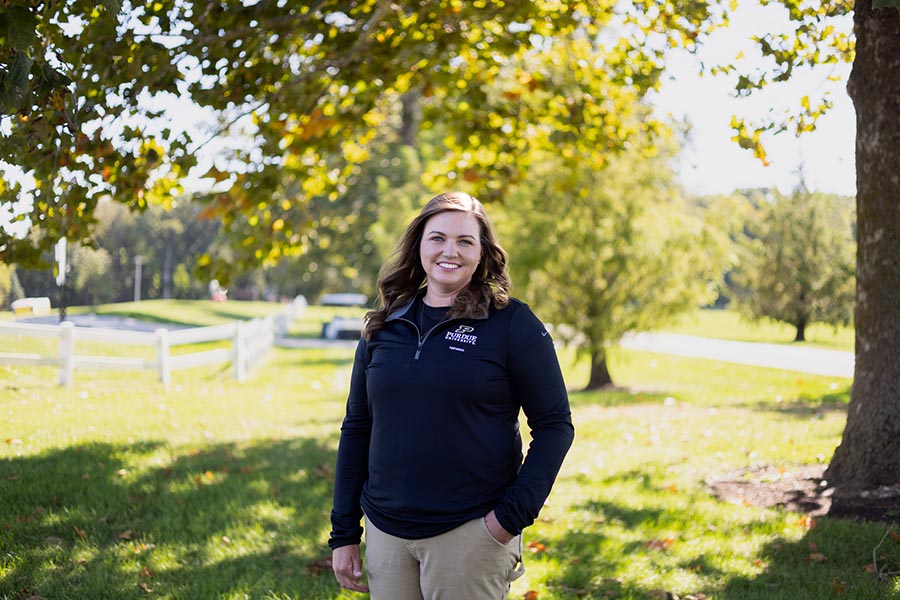
Jada Powlen, lead research scholar in turfgrass ecology and management, has an answer.
“There’s much more involved in turfgrass science that many people don’t realize: plant ecology, soil science, plant physiology and nutrition, entomology, pathology, weed science,” she says. “And unlike row crops like corn or soybeans, which are replanted yearly, you may be managing the same plant for 20-plus years. This limits the options to continuously plant new genetics, and something you did several years ago may have an impact on how it’s growing today.”
Powlen, who has a PhD from Purdue in turfgrass ecology and management, spends her days researching more sustainable turfgrass management systems, helping turfgrass professionals, teaching future turfgrass managers and much more.
Turfgrass, Powlen says, is about much more than just lawns. Turfgrass is central to many sports — baseball’s lush green outfields, Wimbledon’s fastidiously mowed ryegrass court, a deliberately compacted cricket pitch. You can play soccer or football on artificial turf, sure, but the stiffer surface can be hard on the joints, and increased surface temperature can cause concerns with heat stress and athlete safety. Then there are golf courses, an entirely different management system, with turfgrasses maintained at less than 0.1 inch to unmown naturalized areas. Turfgrass is also essential in the urban built environment for erosion control, to reduce runoff, and to moderate temperature.
“Most people don’t understand how complicated a system it is,” she says.
Deep Roots in Agriculture
Powlen grew up in Kewanna, Indiana, a small, rural town about an hour northeast of West Lafayette. Her family raises beef cattle (previously dairy cows) and grows row crops — corn, soybeans, wheat, alfalfa. Both sets of grandparents farm, and the family goes back in Indiana agriculture for several generations.
“I didn’t really know anything else besides agriculture, because that was my life,” she says.
She came to Purdue knowing she wanted to study plants and quickly gravitated toward turfgrass, thinking she would start a lawn and landscaping business one day. Then, one summer, a research assistant job opened a new possibility.
“That job introduced me to research,” she says. “Asking questions, figuring out how and why certain things happen, trying to answer the questions that people have out in the field.”
Hooked, she decided to come back to Purdue for a master’s and PhD; her advisor was professor of horticulture Cale Bigelow. Her dissertation looked at management approaches for reducing brown patch, a common summer fungal disease, in tall fescue, which is often used for home lawns and recreation facilities. She graduated in 2023 and was hired in her current role as a lead research scholar.
No Typical Day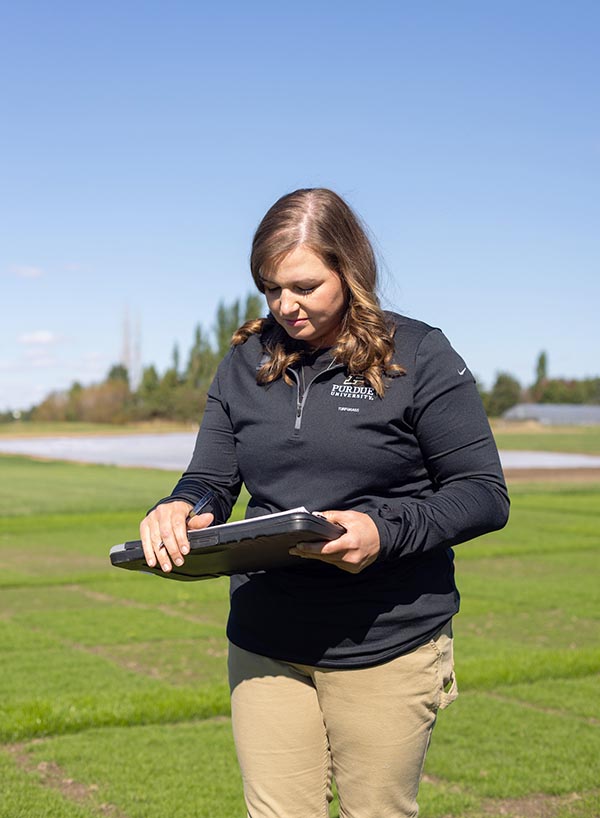
Working with principal investigator Bigelow, Powlen coordinates field research — up to 40 trials at a time — managing all of them from start to finish, from the planning and initiation phase, treatment application, data collection and analysis, through to writing and submitting reports to collaborators. She also writes grants, submits manuscripts for publication in peer-reviewed journals, and presents at field days and conferences.
“It’s kind of ‘which fires are the biggest’ — that’s where my attention goes,” she says.
Right now, since it’s fall, Powlen is focused on seeding new species and cultivar trials at the William H. Daniel Turfgrass Research and Diagnostic Center. The center’s 20-plus acres of managed turfgrass range from putting green to lawn height. Powlen typically spends most days at the center during the warmer season, roughly April through, along with the four turfgrass faculty members, their staff and graduate students who use the facility for trials.
“As an example, we conduct research on irrigation scheduling and soil moisture management to reduce overall water consumption in turfgrass areas,” she says. “We evaluate various turfgrass species and cultivars, and work with groups like the National Turfgrass Evaluation Program, Alliance for Low Input Sustainable Turf, and the Turfgrass Water Conservation Alliance.”
Powlen’s own research focuses on integrated systems for sustainable turfgrass management. This includes evaluating turfgrass species and cultivars and identifying which management practices help reduce the use of fertilizer, pesticides and water. She’s published several papers since finishing her PhD three years ago.
Once winter starts, Powlen is usually found in the Horticulture Building or the Horticulture Plant Growth Facility. In spring, she teaches an undergraduate course on turf pest management. She also helps advise the student Turf Club, which competes in an annual Turf Bowl.
“I’m very fortunate to have a lot of opportunities to work with undergraduate students,” she says. “I started as a teaching assistant in grad school, and that experience led me to really enjoy teaching.”
“It’s always a good day to come to work,” she says. “It’s never boring.”
Using Expertise to Help Others
The most challenging part of the job is “trying to keep everything managed and making sure all the boxes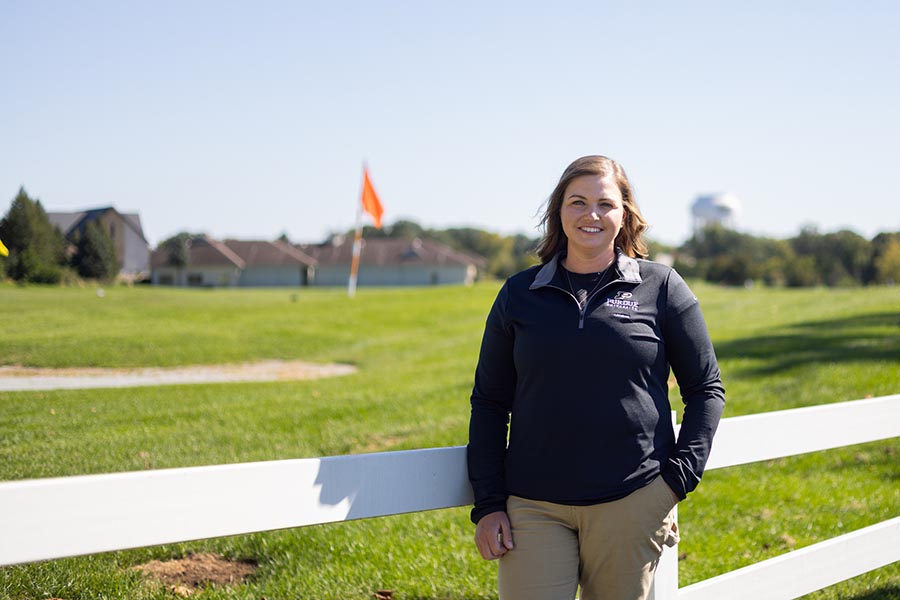 are checked,” Powlen says. She relies heavily on her (stuffed) weekly planner.
“If I don’t keep up with things, it can easily fall through the cracks.”
As for the best parts of the job – there are many, Powlen says.
“I get to work outside, collaborate with some really good people, I get to teach. I really enjoy helping others.”
Powlen frequently gets questions from turfgrass, such as lawncare business owners, athletic managers and golf course superintendents, asking her opinion on particular choices or practices.
“That’s pretty rewarding, for them to reach out to me and ask for help,” she says.
She enjoys working with undergraduate students in Turf Club. Some compete at national Turf Bowl contests of turf-related knowledge and skills.
“It could be anything from calculations to turf and pest identification to putting together different parts of an irrigation system,” she says. “For them, it’s not just a competition, but a networking opportunity. I’m proud to work with them, then seeing them graduate and be successful in their careers.”
Outside of the Research
Powlen enjoys walking with her miniature schnauzer, baking breads and desserts, and tries to go home to help on the family farm as often as possible. Certain weekends might find her moving cattle, driving a tractor or helping to make hay.
“I feel fortunate that my role at Purdue allows me to manage turfgrass while conducting field research, collaborating with others, teaching, and hopefully making a difference by using what I know to help others,” she says.
About the Feature
Many people are involved in the remarkable range of programs, services and facilities that undergird research in the College of Agriculture. Collectively they’re integral to the college fulfilling its research mission. “Behind the Research” explores their individual roles. Each academic year, we profile six people whose work supports the College of Agriculture’s global reputation for developing innovative, multidisciplinary solutions to challenges and then putting those solutions into action.
More Behind the Research
Weed scientist Julie Young’s workweeks are sometimes chaotic — but never dull. On any...
Jackie Getson, project manager for Purdue’s Institute for Digital Forestry, has built a...

The Department of Food Science’s Pilot Plant is a 9,500-square-foot facility with millions...
It’s winter, so right now the Southwest Purdue Agricultural Center (SWPAC) office is quiet....
It all started with 9th grade biology class. Growing up in Michigan, Laura Esman was lucky enough...
In 2015, Emily DeaKyne was a recent college graduate with a degree in applied ecology,...