

Niraj Rayamajhi - Postdoc Scholar Feature
Everybody knows about AI because of ChatGPT and Claude, right? This same technology that learns the patterns of human language can be applied to learn the language of DNA to understand what makes genes switch on and off.
- Niraj Rayamajhi, Purdue Institute for Physical Artificial Intelligence and Department of Horticulture and Landscape Architecture
As a computational biologist, Niraj Rayamajhi is interested in finding the “switches” that turn genes on and off, causing organisms to express different traits. He’s studied everything from endangered cacti to Antarctic fish to monkeys to — his current subject — plants in the Solanaceae family, which includes tomatoes, peppers and petunias, among some 2,500 species.
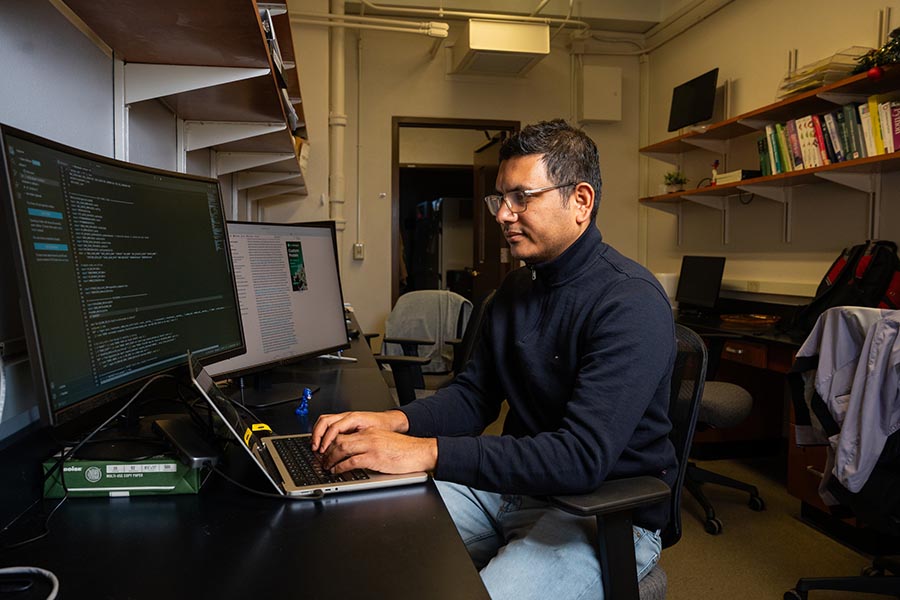
“I care about the big questions — what are the genomic bases of adaptations for the traits that are useful for plants or animals?” Rayamajhi says. “And what are the evolutionary forces that shape those traits?”
Rayamajhi joined Purdue’s Institute for Physical Artificial Intelligence (IPAI) and the Department of Horticulture and Landscape Architecture (HLA) as a postdoc in 2025. He’s studying how AI can be used to more quickly and easily identify genetic switches.
“Everybody knows about AI because of ChatGPT and Claude, right?” he says. “This same technology that learns the patterns of human language can be applied to learn the language of DNA to understand what makes genes switch on and off. The traits that we see — such as the fruit ripening of a tomato — are often shaped by when, where and how much genes are being switched on and off. Those switches are written in our DNA. We’re trying to find them in crops.”
From wild cacti and fish to domesticated crops
Originally from the city of Biratnagar in eastern Nepal, Rayamajhi grew up with parents who worked in government office jobs. But his grandmother still farmed wheat and other crops in a more rural area nearby, which piqued his interest.
“I used to visit my grandmother's home very often, and I saw how people do agriculture,” he says. “I went to the agricultural institute at Tribhuvan University, where I trained in plant breeding and genetics.”
After finishing his bachelor’s degree, Rayamajhi did a master’s at Texas Tech University, where his work on a rare succulent commonly known as the Tobusch fishhook cactus uncovered higher than-previously understood levels of genetic diversity. This helped the U.S. Fish and Wildlife Service determine that the plant should be moved from the “endangered” category to the less-dire “threatened” category.
For his PhD at the University of Illinois Urbana-Champaign, Rayamajhi switched his focus from hot weather plants to cold weather fish. He studied Antarctic notothenioid fish, a group of teleost fish mostly found in the frigid Southern Ocean.
“If you put other fish in this water, they freeze and die instantly,” Rayamajhi says. “But the notothenioid fish are able to survive because of the antifreeze glycoprotein in their blood.”
Over time, a few lineages of notothenioid fish transitioned to warmer climates, where such adaptations were not needed. Rayamajhi looked at genetic changes that potentially enabled the transition of notothenioid fish to non-Antarctic waters through comparative and population genomics approaches. His work and collaborations have yielded several papers in journals, including “G3: Genes/Genomes/Genetics,” “Molecular Biology and Evolution,” and “Genes.”
Rayamajhi switched subjects yet again as a postdoc at Arizona State University, focusing on nonhuman primates, including monkeys. He worked on building computational pipelines for identifying differences in DNA, attempting to understand whether specific variations might be associated with disease.
Using AI to understand the language of plant DNA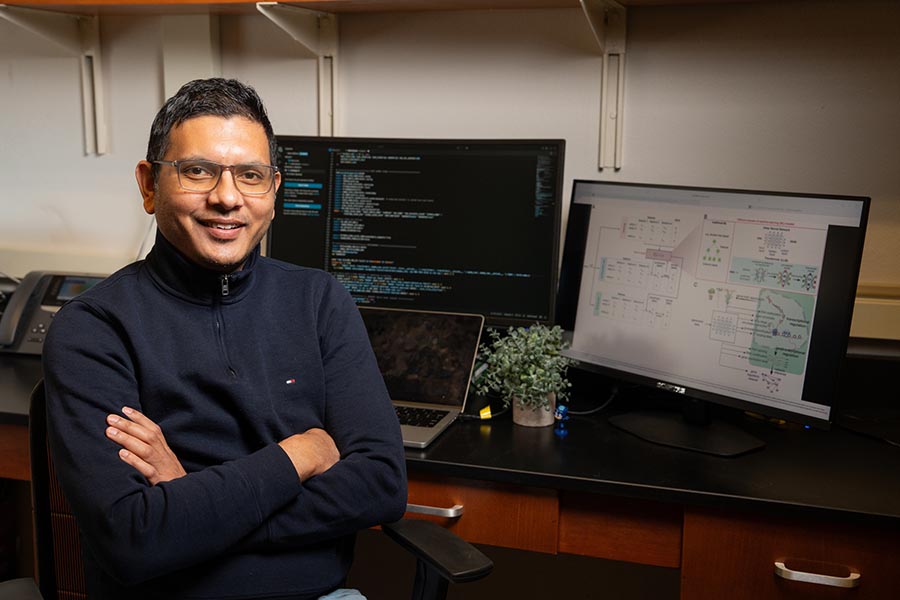
After his first postdoc, Rayamajhi set his sights on a new learning experience: using AI to identify switches hidden in the genomes.
“I needed to think about how we adapt to this growing technology called AI, and wanted to get my hands on AI technology,” he says. “So I decided to be in a place where I can get this technology plus biology infrastructure and expertise. I get that opportunity here, working with Ying Li, who’s an expert in plant system biology, and with Jing Gao. They work together, and I can learn from both of them.” Li is an associate professor of horticulture and landscape architecture; Gao is a professor of electrical and computer engineering.
AI makes it possible to identify changes in DNA much more quickly and efficiently, Rayamajhi says.
“Large genomes have lots of repeats,” he explains. “When you have a very repetitive sequence, it’s hard to identify switches buried in them. With AI, it can identify the patterns of those buried switches in large repetitive sequences even though the switches are very small.”
Many plants in the Solanaceae family, the current target of Rayamajhi’s work, are economically important food crops — think tomatoes, potatoes, peppers, eggplant — while others, such as petunias and flowering tobacco, are valuable nursery flowers. Using AI to understand how their genetic traits are expressed could help farmers improve their crops, he says.
More broadly, Rayamajhi’s research could provide a blueprint for other scholars interested in using AI to fast-track crop changes.
“It will give direction to other people interested in applying AI to plant genomics to improve their crop of interest,” he says.
“Not only a trainee but a collaborator”
Rayamajhi’s postdoc will continue until 2029, after which he hopes to pursue academia. When he’s not working, he enjoys spending time with his children, ages 6 and 2.
Purdue has been an ideal place to grow as a scholar, Rayamajhi says.
“Drs. Li and Gao give me the opportunity to be not only a trainee but a collaborator,” he says. “That means a lot. They also give me opportunities to present my work and push me to think about it critically. It’s been a great environment for me.”
More Postdoctoral Scholars
It wasn’t until she was actually in a veterinary hospital, attempting to give an injection...

Jingxian An has always been interested in the science of what people eat and drink, whether...
At an age when most kids are still learning long division, Caroline Rose Alukkal was already...
Terry Torres Cruz’s path to mycology — the study of fungi — has been guided by...
When Zeus Mateos-Fierro arrived in Indiana, he’d never seen a watermelon field in his life....

Many of us remember our high school lessons in genetics – drawing Punnett squares,...