

Researchers Study Competitive Behaviors Between Black Vultures, Turkey Vultures
Aristotle Onassis once said I have no friends and no enemies – only competitors. A well-known proverb also says that birds of a feather flock together. So, which is it? Just how true are those statements in the natural world where competition determines who gets to eat, and possibly even survive?
Researchers answer those questions in a new article “Competitive Behaviors Between Black Vultures and Turkey Vultures During Scavenging” in the Journal of Raptor Research, co-authored by Amanda Herbert (B.S. Wildlife 2023) as well as Dr. Pat Zollner, Landon Jones, Marian L. Wahl and Brandon Quinby (PhD 2022) from Purdue Forestry and Natural Resources.
Black vultures (Coragyps atratus) and turkey vultures (Cathartes aura) coexist throughout much of their ranges and often share feeding sites when scavenging, but the interactions between the two species while actively scavenging are not well understood. As black vultures expand their range northward, knowledge about such behaviors of both species is vital to helping predict their competitive and social interactions in new areas of overlap.
In order to assess these interactions, researchers used remote motion-activated cameras to observe black vulture and turkey vulture behaviors while actively scavenging stillborn domestic cattle carcasses. Specifically, cameras documented the duration of any aggression, scavenging and vigilance behaviors within flocks of each vulture species by itself and flocks consisting of both species. Acts of aggression included displacement from the carcass through pecking, pushing or fighting; scavenging behaviors included active foraging and consumption of a carcass; and vigilance behaviors included alert assessment of the vulture’s surroundings such as scanning to detect threats.
The study found that aggressive behaviors, which are often the most reported, were rare, accounting for just three percent of each species’ interactions. Results also showed both species of vulture were more aggressive in single-species flocks than in mixed-species flocks. Although aggression was limited, video showed that black vultures are dominant at carcasses by spending more time scavenging in mixed species flocks, especially when black vultures outnumber turkey vultures at a carcass. Meanwhile, turkey vultures spent more time on the periphery observing their surroundings.
“Based on previous research, we expected the duration of aggression to differ based solely on species, however, our results suggested that aggression was dependent on the combined effect of species and flock composition, and not species alone,” lead author Amanda Herbert said. “Our study helps to emphasize that competitive dominance between the species is more complex than aggression alone. It also highlights other forms of competition used to outcompete individuals of a different species.”
While competition is alive and well among species of scavengers, it seems Aristotle Onassis may have been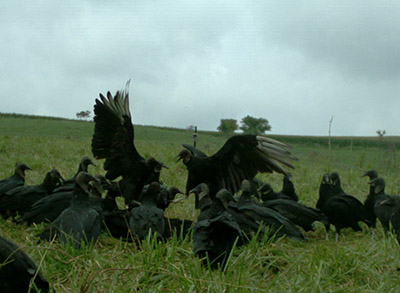 right. Alas, the birds of a feather may face more competition from their own species than bullying from their dinner companions of the other species.
“This paper has interesting implications for researchers, primarily that the conventional preconception of black vultures always bullying turkey vultures may not be accurate,” Zollner said. “Scientists might need to reconsider their thoughts on how these two species compete for carrion. More broadly, beyond vultures, studies like Amanda’s that directly compare the influence of exploitative vs. interference competition are rare and certainly not common for large birds like raptors. This paper provides a rare and valuable example of a study contrasting these approaches in an understudied system.”
Additional Research and Next Steps
Herbert’s paper is the second from the Zollner lab to be published in 2024, following Marian Wahl’s paper on “Taphonomic Signatures of Early Scavenging by Black and Turkey Vultures” in PLOS One over the summer, which established control measurements from scavenged calves for use in future comparison.
A third article “Drivers of Agricultural Producers’ Tolerance Towards Less-Charismatic Avian Species,” exploring the interactions between livestock producers and black vultures in Indiana and Kentucky, co-authored by Brooke McWherter (PhD 2022), Dr. Zhao Ma from the Human Dimensions Lab and the Zollner lab, will be published in the January issue of Biological Conservation. 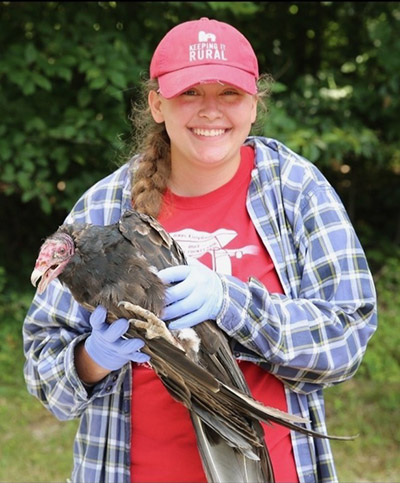
Future publications also include Alex Dudley (BS Wildlife, Forestry 2024)’s research using GPS movement data from 12 black vultures to show how they change their movement patterns in response to deer hunting season. This article will be published in The Wildlife Society Bulletin in 2025.
Wahl also will be publishing two more chapters of her dissertation based on GPS telemetry data from 24 black vultures gathered over a three-year span. The first will quantify habitat selection by black vultures in agricultural landscapes in Indiana and Kentucky. The second will look at how black vultures change their movement patterns when their roosts are disrupted as a mitigation measure to ameliorate their impacts on people in local communities impacted by them.
Landon Jones, former postdoctoral researcher in the Zollner lab, has been involved in several of the black vulture/turkey vulture projects assisting with the utilization of the same data sets for multiple projects and publications.
“For Marian's project on understanding what scavenged calves look like to compare to predated calves by black vultures, we needed cameras on the calves to know when and how vultures were scavenging them,” Jones explains. “Thus, we knew the camera footage would be available for use later to tease out behavioral interactions between black and turkey vultures. Amanda was then able to go through the camera footage, score the behaviors, and write the second paper as a way to double our productivity from that same field effort.
“For my part on the project, all I did was put out some calf carcasses, remove them at the right moments, and help our veterinarian (Grant Burcham) with the necropsies a bit during my first postdoc in the lab. However, while doing that, I enjoyed near constant thinking about how to use that data for extra papers, what ideas to test, hypotheses about how the black and turkey Vultures found, consumed, and competed over the carcasses, etc. Most we couldn't test or didn't have data for, but it was still fun and led to some extra efforts or discussion topics that went into one or both papers that we wouldn't have had otherwise. Some of these ideas connected with a current study I'm finishing on adaptations of bill shape in vultures and carrion feeding raptors for their respective diets.”
The possibilities for future black and turkey vulture projects from the Zollner lab are endless, but, with help from additional grant proposals and funding, projects could include a deeper dive into the interactions of these two species while scavenging. Specifically, that could include gathering data for longer exposures and at other times of year.
Featured Stories

Maksym Chepeliev, a leading international scholar recognized prominently for his work in...

In recent years attendees at Purdue Agriculture alumni, donor, and faculty and staff events have...

People think grass is simple. Lawns, right? Mow regularly and add some water and fertilizer. What...

The Office of Indiana State Chemist (OISC) is warning Indiana residents about an illegal...

A prominent protein on most human cells may be key to unlocking the code that makes humans...
Ava Hoskins, a double major in aquatic sciences (fisheries concentration) and natural resources...