

Meet Kristin Floress: 2025 Distinguished Alumni Award Recipient
If you can let go of passion and follow your curiosity, your curiosity just might lead you to your passion." – Elizabeth Gilbert
Dr. Kristin Floress, who earned her PhD from Purdue Forestry and Natural Resources in 2008, has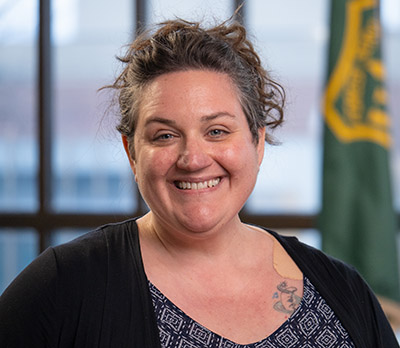 capitalized on her constant curiosity and evolving interests to mold a successful career in natural resources social science. The 2025 FNR Distinguished Alumni Award recipient credits her unsatiated desire to learn with guiding her although her path was not linear.
“One of the things that is really defining about a lot of folks with ADHD or neurodivergence in general, is an innate interest in a ton of things,” Floress explained. “As a kid I liked to read and learn about a lot of different things, although not in a formal setting. I wasn’t a very good student. I was undiagnosed ADHD and felt a little bit dumb growing up. But, I am a late Gen X/early millennial, so I was free range. I grew up in the suburbs of Chicago on a couple of acres, which is really lucky. We had a little pond and my parents let us do what we wanted, so I was outside a lot of the time, but I never related to that as a formative experience or career trajectory.”
As a first-generation college student at Southern Illinois University Carbondale, Floress, a double major in English and philosophy, ended up becoming best friends with people who were “very into outdoor recreation.” She began hiking, rock climbing, mountain biking and backpacking at nearby Giant City State Park and in the Shawnee National Forest.
“I was blown away by the beauty of the unglaciated topography that I had never experienced before having grown up in the suburbs of Chicago and not having gone beyond to southern Illinois,” Floress recalled. “I joined the Outdoor Adventure Club and they had gear to lend out and a structure to teach you how to do the activities. And that’s when I realized that there was a whole other world of professions, interests and opportunities in life that had nothing to do with going to an office or building.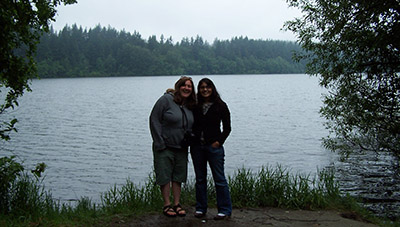
“By my senior year, I was taking environmental education classes and forest ecology with the same attitude that I had always had of just wanting to learn what I could about things of interest. I took whatever classes I wanted, which was super fun, but then they told me I had to have an actual plan of study to graduate. That is how I ended up with a general studies degree, because I had a broad swath of classes and interests.”
As she approached graduation in 2002, Floress realized that she had not “positioned herself to get a job in anything” so she looked for opportunities in graduate school.
“I really had no idea what grad school was except that it was more school and I really loved learning, so I ended up applying to different schools and programs and projects,” she continued. “While I had originally been into outdoor recreation, I can get excited about almost anything. If there is something interesting, there is going to be a way for me to find a nugget of it that I am passionate about.”
Her curiosity and desire to keep learning eventually led Floress to work on a master’s degree under Dr. Jean Mangun at her alma mater.
“I didn’t know what I was going to study. I didn’t know that you go to grad school and do research and publish papers. I had no idea,” Floress admitted. “But, for some reason Dr. Mangun saw the potential in me to do that. I had only taken a couple of classes in the forestry program - forest ecology, environmental interpretation and environmental education - but through a series of happy accidents, Dr. Mangun had an opportunity available. I studied hard, read a lot and learned as I went along.
“I wanted to learn about a lot of different natural resource topics because I didn’t have that opportunity as an undergrad. I used my graduate programs to do that. I took a broad array of classes in things of interest at SIU and Purdue. One of the benefits of that was that I was never strictly aligned with one discipline, so I could be conversant with a lot of people, which is vital for a social scientist within the context of natural resources and on-the-ground management.”
Floress completed her master’s degree in forestry with a concentration in the human dimensions of natural resource management from SIU in 2004. As she looked to continue her education, Mangun, a two-time alumnus of Purdue FNR (MS 1985, PhD 1991) encouraged Kristin to apply for a PhD project at Purdue working on developing a social indicator system related to watershed management with Dr. Linda Prokopy and former FNR professor Dr. Shorna Broussard Allred.
Floress began working with Prokopy and Allred as a research assistant in the summer of 2005 and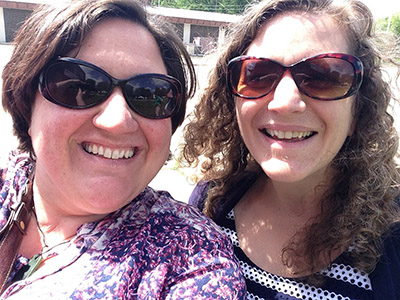 completed her PhD and dissertation titled “Exploring Relationships: Social Capital, Leadership and Behavior in Three Indiana Watersheds” in August 2008.
“My first semester I took a regional planning class that Linda taught and that was one of the most impactful classes for me,” Floress recalled. “We learned about stakeholder involvement and how to do collaborations. We did a service-learning project where we worked with an organization to provide them some sort of deliverable. We had an amazing experience running the Wabash River Vision and ended up publishing a paper. We got money, advertised on the radio and ran a facilitated visioning session with more than 100 people from West Lafayette and Lafayette. Linda and the department provided a lot of opportunities and grad students had the freedom to explore things.
“I also took a class in fragmentation ecology with Carol Rizkalla (PhD 2009), who was a graduate student in wildlife under Dr. Swihart at the time. She was amazing and I learned about landscape-level, systems-level thinking. I finally had a name for the concepts that I had been thinking about from other classes, talking about wildlife and conservation biology and how they had been doing landscape-level work for a really long time. That was formative in how I started to view the world and the landscapes around me.”
Floress began her career as a faculty member and extension specialist at the University of Wisconsin-Stevens Point. The position, an assistant professorship in natural resources policy and communication, was a “perfect fit” for Kristin, who had dreamed of working at the school someday after finding a job listing there while taking a break from studying for her prelims just a few months earlier.
“The job listing was basically a list of my courses and experiences,” Floress shared. “It felt like I created that job for myself. I applied and got it. It was amazing. I didn’t have a word written of my dissertation yet, so I basically didn’t sleep for several months and finished it so I could take the job that was offered to me. I loved UW-Stevens Point. It was a great place to be and live and work.”
While Floress was teaching Stakeholder Involvement in Natural Resources, Conflict Resolution, Research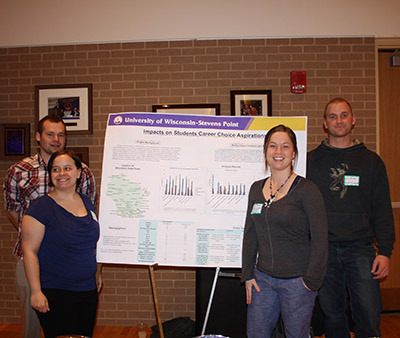 Methods, Integrated Resources Management, Policy and the Legislative Process, Natural Resources Social Science and Public Relations and Social Marketing courses at UW-Stevens Point, Prokopy sent Floress a job announcement for a position as a research social scientist with the U.S. Forest Service.
“Linda sent me the announcement and I thought, ‘oh my gosh, this seems so amazing,’” Floress said. “Never in a million years did I think I would ever get the job. I could not believe it when I got an interview. Of course, it was a federal job so it was months later - I had forgotten that I had even applied when they called me for an interview. I was super nervous for the interview because it was like working with rock stars in the field. The office was full of people whose work I had read, the Mick Jaggers of social sciences. But, you have to go for it, right? So, I went for it and I got it.”
The Long Grove, Ill., native has spent the last 11 years as a research social scientist at the Northern Research Station in Evanston, working on projects related to landowner engagement for oak conservation, cross-boundary adaptive management strategies for forest restoration, wildfire crisis planning in communities, agricultural diversification in the Midwest and more.
One of the first projects she was involved with was an outshoot of the Chicago Region Trees Initiative based out of the Morton Arboretum.
“They had an oak recovery plan for the Chicago Wilderness Region, but didn’t have anything going on with private lands,” Floress explained. “The majority of land is privately owned, especially in an urban-suburban area. So, I came down and started working closely with Lake County Conservation at Home, which is now run through Open Lands, as well as the Lake County Forest Preserves and the Chicago Region Trees Initiative on some of their private landowner engagement strategies. Now, they have an established way to do their outreach, and I can see my impact in how it and related programs are run in the region.”
Another effort saw Floress collaborate with Allison Frederick, a fellow Purdue alumna (BS 2003), who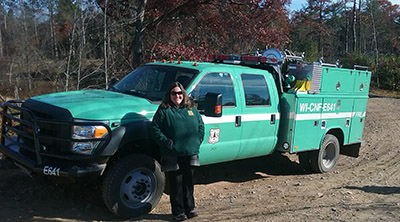 worked at the Lake County Forest Preserves. The two worked closely to design programs working with private landowners out in concentric circles from public lands where buckthorn had been completely eradicated to expand the removal efforts.
“We started peer learning and the residents put together neighborhood groups and incentives and we helped provide them options and costs for removal,” Floress said. “It is a well-known project that nobody would ever relate back to me, but Allison eventually developed a beautiful brochure called Healthy Hedges, which is ubiquitous across the Chicagoland area now.”
Floress acts as the socio-economic working group lead for the Ohio Interagency Forestry Network and has been engaged with the team since 2018. What started out as a short consultation with managers to help solve problems has resulted in a multi-year project and collaborative interagency plan utilized by the network. The goal is collaborative cross boundary oak conservation and forest management across southeastern Ohio, namely in the 17 counties occupied by the Wayne National Forest, including federal, state, county and private lands.
“We collaboratively developed a set of indicators, metrics and outcomes to work towards as well as logic models that have really guided the work of this team over the past eight years,” Floress noted. “Every December agency leaders come together and we report out what we have done that year. I monitor everything that is happening across all of the social and partnership outcomes and we have ecologists who monitor those outcomes, etc. It is all part of this integrated system that we adapt in real time. We call it adaptive doing rather than adaptive management, which is often experimental in nature.”
Community planning regarding the Forest Service’s wildfire crisis strategy also has been part of Floress’ job description. After the National Forest Foundation conducted focus groups about the Forest Service and fire and suggested changes in 2022, Floress and her colleagues began working alongside Emily Silver at Michigan State University to develop a national survey to assess the social acceptance of wildfire.
Floress also is collaborating with Dr. Sarah Church, a former postdoc in Prokopy’s lab who is now an associate professor in Montana State University’s Department of Geography and director of its Institute on Ecosystems, on a project assessing the type of information needed by community planners and others across disciplinary boundaries when it comes to day-to-day decision making and community planning regarding wildfire.
A project with Laurie Yung at the University of Montana has Floress working with communities to develop shared visions for fire-adapted communities.
A landscape restoration project on the Chequamegon-Nicolet National Forest in Wisconsin with silviculturist John Lampereur has allowed Floress to utilize her skills to gauge community response to landscape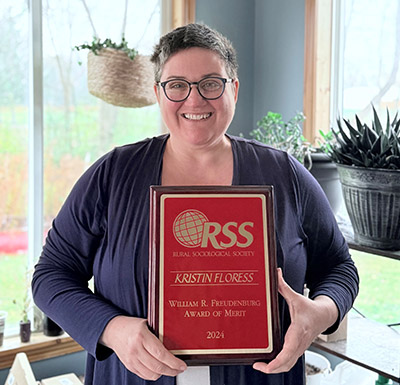 change. The project has sought feedback from residents regarding changes from closed canopy forest to a barrens, which was directed by Lampereur. It also seeks to measure residents’ willingness to manage their nearby private lands or simply support the efforts on the national forest.
Floress also served as an editor in chief for Society and Natural Resources journal for four years.
In 2024, Floress received the William R. Freudenburg Award of Merit from the natural resources working group within the Rural Sociological Society in recognition of her “exceptional contributions to the sociology of natural resources and the environment.” In particular, the award is meant to recognize those who have substantively affected the trajectory of thinking within natural resources and environmental sociology.
The award notice stated that “In a year of competitive submissions, the awards committee felt that you best exemplified this change in thinking through not only your impressive body of publications and external research support, but also your unique record of informing, directing and impacting the on-the-ground governance and actions of those working in forest management across the country. Your ability to foster real change informed by rigorous social science is truly impressive and we are thrilled to be able to give you this award.”
Floress also has been recognized by the Forest Service with several performance awards, including the Chief’s Award in 2019 for her work with the Family Forest Research Center in strengthening the stewardship of private lands through technology and research. However, nothing prepared her for the honor of being recognized by her alma mater in April.
“Receiving this award is a tremendous honor, as was attending Purdue under the mentorship of my advisor Linda Prokopy,” Floress said. “I have had a number of amazing mentors who I credit with training me well, providing opportunities for me to learn and supporting collaborative, community-based work that makes a real difference in natural resources management.
“When I received the text from Linda that I had been selected as FNR’s Distinguished Alumni Award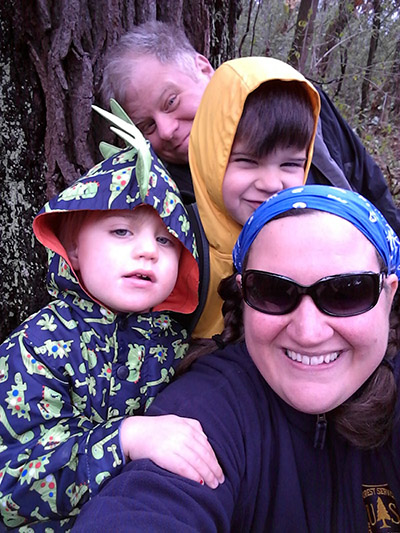 recipient, I was on furlough. I cried. It was a nice feeling, validating both my work as an individual and also showing this type of work is valued by others. A lot of people think of Purdue as an Ivy League university and the honor of receiving an award like this from Purdue gives me chills. And for Linda to think that I deserved it and the awards committee to think that the work I do deserves it is really validating. Sometimes you have days where you are not feeling like you are making a difference. This feels like one of those things I can go back to on those days as proof that I am making a difference.”
That is quite a statement for a first-generation college graduate who simply followed her interests and never stopped learning all the way to a PhD and beyond.
“We are in a system globally where you can make you own path and make your own future,” the mother of two shares with current and future students. “Don’t limit yourself by disciplinary boundaries or what you think a person in X position should be doing or learning. If you have an interest in painting but you’re a wildlife biologist, there are jobs for that. I know someone who is a fisheries biologist who illustrates textbooks.
“Also, if you have an idea of a job you may want to do when you’ve graduated, go look at those types of job postings now, while you are an undergrad or in grad school. Start gaining those experiences now and make sure you are competitive for those jobs. Be proactive.”
Featured Stories
Alisa Tilson (BS '96, Natural Resources and Environmental Science) works for CDOT’s...
Behind every jar of honey is a fascinating story of pollination, research, and hands-on learning....
Maksym Chepeliev, a leading international scholar recognized prominently for his work in...
In recent years attendees at Purdue Agriculture alumni, donor, and faculty and staff events have...
People think grass is simple. Lawns, right? Mow regularly and add some water and fertilizer. What...
The Office of Indiana State Chemist (OISC) is warning Indiana residents about an illegal...