From Assets to Well-being: A Conceptual Framework for Community Vitality
March 23, 2026
PAER-2026-01
Authors: Michael Wilcox, Community and Regional Economics Specialist, Assistant Director Community Development; Jeffrey Walker, Community Vitality Specialist; Zuzana Bednarik, Research and Extension Specialist; DeAndre Malone, Graduate Research Assistant


Introduction
At the advent of the new year, many Americans decide to make positive changes in their lives, focusing on individual or family-related factors. Similarly, active community members take stock of their quality of life and the changes they face due to internal and external influences, some of which lie beyond local control.
Both contexts require a baseline from which to measure progress or success. For the individual, this may come in the form of a starting weight or bank account level, for example. Communities, however, are far more complex, and building consensus on the appropriate baseline is more challenging. To assist in this effort, the North Central Regional Center for Rural Development, hosted by Purdue Agriculture and the Department of Agricultural Economics, has developed NCR-Stat, a survey-based effort to collect representative data from across the North Central Region to assist decision-makers and professionals from land-grant institutions with pursuing burgeoning opportunities and addressing pressing challenges throughout the region (Bednarik, et al., 2025). But, before a meaningful baseline can be created, there must be a robust conceptual framework to undergird and guide the effort.
Purdue Extension provides the perfect conduit. For over a century, Purdue Extension has been enriching Indiana communities through comprehensive programs in Agriculture and Natural Resources, promoting sustainable practices; Health and Human Sciences, enhancing well-being; Community Development, fostering economic growth; and 4-H and Youth Development, empowering the next generation.
By delivering practical, research-based information that enhances lives and livelihoods, Purdue Extension catalyzes positive change and promotes what researchers and practitioners alike have coined ‘community vitality’ and ‘community well-being.’ In fact, the Department of Agricultural Economics and Purdue Extension’s Community Development and Health and Human Sciences programs have been working in these spaces for decades. Now, these important (but historically parallel) efforts are converging in exciting initiatives that have and will impact the entire state.
Conceptual Framework
First, we introduce the key concepts that generally frame community vitality and well-being extension work (and our baseline analysis of Indiana’s community vitality and well‑being in Wilcox et al., 2026).
Among many approaches to fostering community vitality and well‑being, an asset‑based approach remains essential for helping communities achieve their goals (Kretzmann & McKnight, 1993). Purdue Extension Community Development has long promoted asset-based approaches to strengthen the capacity of local leaders, residents, businesses, and organizations to build resilient, vibrant, and sustainable communities through research-based resources and processes. The Community Capitals Framework (CCF) undergirds asset‑based community development (Beaulieu, 2014). Introduced by Flora et al. (2004), CCF brought together prominent ‘capital’ concepts (e.g., human, social, etc.) into a conceptual framework that provides researchers and practitioners with an intuitive and robust way to assist communities in achieving their goals. CCF identifies seven interconnected forms of community assets (natural, cultural, human, social, political, financial, and built capital) that, when strategically invested, interact to create sustainable community development across economic, environmental, and social dimensions (commonly known as the ‘triple bottom line’).
Concurrently, Purdue Extension Health and Human Sciences has based its approach to educating people, families, and communities on strengthening relationships, eating smart, improving health, and achieving financial well-being within a CCF-adjacent framework. The guiding force is the Socio-Ecological Model of public health (SEM), which suggests that health behaviors arise from interactions across multiple levels: individual (knowledge, skills), interpersonal (family, peers), organizational (schools, workplaces), community (local networks, norms), and public policy (laws, regulations) (McLeroy et al., 1988). To operationalize SEM and promote positive public health, Purdue Extension has embraced the Policy, Systems, and Environment (PSE) framework. PSE is an approach that focuses on changes involving policy (laws/regulations), systems (networks/infrastructure/organizations), and the environment (physical/economic/social aspects of the community) (Centers for Disease Control and Prevention & American Cancer Society, 2025; Washburn et al., 2021).
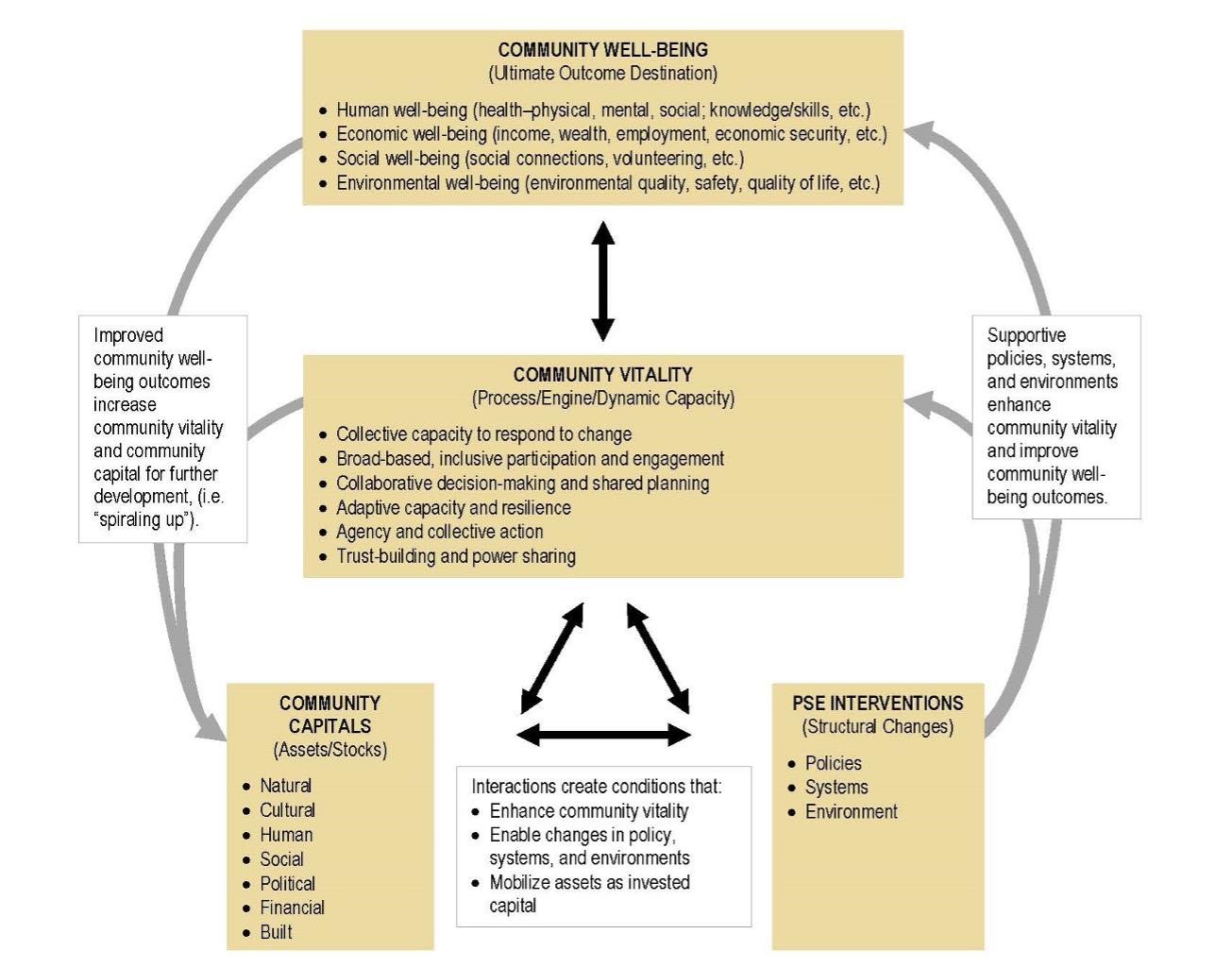
In practice, CCF and PSE have traditionally worked side by side, but not always synergistically. Purdue Extension is moving toward a synchronized model in which CCF assets and PSE shifts reinforce one another to enable/enhance community vitality (see Figure 1).
Figure 1
From Assets to Well-being: A Conceptual Framework
Note: Figure 1 is collectively based on the following: Beaulieu (2014); Centers for Disease Control and Prevention & American Cancer Society (2025); Emery & Flora (2006); Etuk & Acock (2017); Flora et al. (2004); Grigsby (2001); Kretzmann & McKnight (1993); McLeroy et al. (1988); NIFA (2026.); OECD (2020); Rong et al. (2023); Scott (2010); Sung & Phillips (2016); University of Wisconsin–Madison Extension (n.d.); Washburn et al. (2021).
Community Vitality
Community vitality represents the dynamic process through which communities pursue shared aspirations. The UW Extension Community Vitality & Placemaking framework defines community vitality as “community’s collective capacity to respond to change with an enhanced level of participation (process or pursuit of) with aspirations for a healthy and productive community (an outcome or shared vision of success)” (University of Wisconsin–Madison Division of Extension, n.d.) and summarizes it as “people’s pursuit of a shared vision of place.” Scott (2010) describes vital communities as those with “strong, active and inclusive relationships between residents, private sector, public sector and civil society organizations that work to foster individual and collective well-being.” Etuk & Acock (2017) consider community vitality a dynamic process built on collaboration, adaptability, and active participation. And, Rong et al. (2023) find that trust, inclusive participation, and shared power enable community vitality. Ultimately, community vitality is rooted in asset-based community development, involving the buy-in and active engagement of residents, organizations, and institutions as they plan, make decisions, and act together, building the agency necessary to adapt and thrive in changing circumstances (Grigsby, 2001; NIFA, 2026). Therefore, community vitality can be thought of as the process, engine, and dynamic capacity needed to produce community well-being (see Figure 1).
Community Well-being
In this model, our goal is community well-being. As the ‘ultimate outcome’, community well-being is useful if it can be measured and positively impacted through the capitalization of assets (CCF), structural changes (PSE), and community vitality initiatives. That community well-being refers to the overall quality of life within a community is reasonably intuitive. From an academic perspective, Sung and Phillips (2016) frame this concept along four dimensions, while the OECD (2020) adds practical insight by identifying measurable outcomes. Taken together, community well-being combines human well-being (health: physical, mental, and social; knowledge/skills), with economic well-being (income, wealth, employment, economic security), alongside social well-being (social connections, volunteering, etc.) and environmental well-being (environmental quality, safety, quality of life) (see Figure 1).
The Interconnected Model
All of the model elements are interconnected. As described above and highlighted in Figure 1, the Community Capitals interact with the PSE framework to enhance community vitality. In turn, the PSE framework leverages community vitality enhancements to improve community well-being outcomes. And, in a process called ‘spiraling up,’ improved community well-being can have a positive effect on community vitality and strengthen the community capital foundation, which positions a community for further community well-being gains (Emery & Flora, 2006). As such, ‘spiraling up’ is a key driver of the dynamic nature of community vitality.
A Way Forward
While this may all seem intuitive in theory, the utility derived from such a construct can only be attained if it is put into practice in a useful way. In a companion article, “How is Indiana Doing? Community Vitality and Well-being in the North Central Region” (Wilcox et al., 2026), we apply this framework using data from the 2024 NCR-Stat: Baseline Survey to create a baseline for Indiana. For the purposes of this article, we apply the conceptual framework to a thought experiment focused on what a ‘21st Century’ Cooperative Extension could look like within the context of thematic areas and Extension programming (Table 1).
A little history first.
Since celebrating its centennial in 2014, the Cooperative Extension System has been taking stock of its history and exploring ways to sustain its relevance and excellence (Atiles & Eubanks, 2014; Beaulieu & Cordes, 2014; Borden et al., 2014; Gould et al., 2014). In these ‘Commentaries’, the authors identify common themes, including diversifying Extension’s reach, embracing new technologies and delivery methods, strengthening measurement and evaluation, addressing workforce development needs, and respecting tradition while continuing to evolve as a proactive institution.
Given the program area focus, it is not surprising that cross-programmatic (interdisciplinary) efforts were not emphasized. However, in a capstone piece by Henning et al. (2014), the authors argue that Extension must be integral to community vitality and “seen as a constant resource in a changing landscape of NGOs, non-profits, for-profits, etc. Extension continues to be a national, dynamic network able to mobilize people, resources, and ideas driven by the local needs, while supported by state, regional, and national frameworks. All of the mission areas of Extension must contribute to the economic and social well-being of their local communities.” And while this message was relayed over a decade ago, USDA-NIFA continues to emphasize the importance of community vitality, recognizing the need to focus on the “socio-economic potential of rural/urban interdependence and…the critical needs of people and places, while also highlighting the critical role that the Regional Rural Development Centers serve as the “primary vehicle to organize multi-disciplinary teams” around community vitality (NIFA, 2026). And, directly related to well-being, Martinez (2024) emphasizes the need for all program areas in Extension to recognize their integral role in health extension through application of the PSE framework.
Given this context, we can start with the end in mind. In this thought experiment, community vitality and all four dimensions of well-being are supported by the six thematic areas (Table 1). While arguments can be made for alternate groupings, these represent the most significant and explicit relationships. Accordingly, each thematic area is supported by combinations of community capitals and examples that fit in the policy, systems, and environment framework. Perhaps surprising to some, there are numerous examples of Extension programs that build capacity, offer technical assistance, and/or blend process and knowledge to help individuals and communities achieve their goals across all thematic areas.
An archetype is Purdue Extension’s Enhancing the Value of Public Spaces: Creating Healthy Communities, which explicitly relies on CCF and PSE-based strategies to promote community vitality and well-being (Salazar et al., 2019). This program draws on knowledge from all four Cooperative Extension program area disciplines and integrates that research-based information into a strategy matrix that directly accounts for the intersection between CCF and PSE (explicitly leveraging available community capitals as the building blocks of structural change) while building community capacity through community vitality initiatives and measuring positive impact through measures of well-being.
Table 1
Cooperative Extension and the Community Vitality/Well-being Framework
| Thematic Area[1] | Extension Programs (Examples)[2] | CCF Connection | PSE Connection (Examples) | Well-being Outcome |
|---|---|---|---|---|
| Leadership and Organizational Development | Leadership development, civic engagement, grant writing, board management, volunteer development, community coaching | Social, Political, Human Capital | Policy (governance), Systems (networks, organizations), Environment (collaborative spaces) | Community Vitality, Social Well-being |
| Economic Resilience and Financial Well-being | Local government/public finance, housing, personal finance, succession planning, workforce development, community economics | Financial, Human, Built Capital | Policy (public finance, regulations), Systems (workforce infrastructure), Environment (water infrastructure) | Economic Well-being |
| Health and Wellness | Individual health, community health, workplace wellness, mental health, substance use prevention/recovery | Human, Social Capital | Policy (workplace policies), Systems (healthcare networks), Environment (community health conditions) | Human Well-being |
| Human Development and Family Well-being | Childcare, parenting, aging, family dynamics, youth development | Human, Social, Cultural Capital | Policy (childcare regulations), Systems (family support networks), Environment (safe spaces) | Human Well-being, Social Well-being |
| Community Planning and Natural Resource Management | Regional planning, conservation, disaster preparedness, renewable energy, public spaces, aquatic/wildlife/forest management | Natural, Built, Political Capital | Policy (zoning, conservation), Systems (regional planning), Environment (physical spaces, infrastructure) | Environmental Well-being |
| Food & Agricultural Systems | Field crops, horticulture, livestock, food access, food safety, diversified farming systems, farm management | Natural, Financial, Built, Cultural Capital | Policy (food safety, farm policy), Systems (food distribution networks), Environment (food access, land use) | Economic Well-being, Environmental Well-being |
[1] These thematic areas are a product of many discussions with Cooperative Extension professionals and Cooperative Extension leaders and are based on the thematic areas adopted by the Purdue Extension Community Vitality program funded by the Downing Family Charitable Trust; see: https://extension.purdue.edu/vitality/index.html
[2] The Extension program examples are derived from an inventory of Purdue Extension programs assembled from https://extension.purdue.edu/
Conclusion
The conceptual model presented in this paper connects community assets, policies, systems, and environments to the dynamic process of community vitality and to the community well-being outcomes linked to quality of life. This model offers a framework for Cooperative Extension and its partners to consider as they seek to achieve community goals.
Intentionally integrating the Community Capitals and the Policy, Systems, and Environment frameworks affords Extension professionals not only the opportunity to consider interdisciplinary approaches, but it also provides a tangible pathway where all program areas and community partners can see themselves as part of the process and solution, and where social, economic, environmental, and human well-being outcomes are mutually achieved.
Lastly, this paper proposes a new approach to aligning Extension programming with community assets and needs, in which cross-program collaboration is expected, a shared language for community vitality and well-being is adopted, and robust metrics of success are developed, measured, and shared.
References
Atiles, J. H., & Eubanks, G. E. (2014). Family & Consumer Sciences and Cooperative Extension in a Diverse World. Journal of Extension, 52(3), Article 28. https://doi.org/10.34068/joe.52.03.28
Beaulieu, L. J. (2014). Promoting community vitality and sustainability: The community capitals framework. Purdue University Center for Regional Development. https://pcrd.purdue.edu/wp-content/uploads/2020/09/Community-Capitals-Framework-Writeup-Oct-2014.pdf
Beaulieu, L. J., & Cordes, S. (2014). Extension Community Development: Building Strong, Vibrant Communities. Journal of Extension, 52(5), Article 23. https://doi.org/10.34068/joe.52.05.23
Bednarik, Z., Green, J. J., Marshall, M. I., Russell, K. J., Wiatt, R. D., & Wilcox, M. D. (2025). North Central Region Household Data. NCR-Stat: Baseline Survey 2024. Purdue University Research Repository. https://doi.org/10.4231/NQG5-5V79
Borden, L. M., Perkins, D. F., & Hawkey, K. (2014). 4-H Youth Development: The Past, the Present, and the Future. Journal of Extension, 52(4), Article 35. https://commons.joe.org/joe/vol52/iss4/35
Centers for Disease Control and Prevention & American Cancer Society. (2025). PSE change guide: Policy, systems, and environmental change in comprehensive cancer control. https://acs4ccc.org/acs-ccc-resources/policy-systems-and-environmental-change/
Emery, M., & Flora, C. (2006). Spiraling-Up: Mapping Community Transformation with Community Capitals Framework. Community Development, 37(1), 19–35. https://doi.org/10.1080/15575330609490152
Etuk, L. E., & Acock, A. (2017). Toward a rural community vitality measurement practice. Community Development, 48(1), 141–153. https://doi.org/10.1080/15575330.2016.1251480
Flora, C. B., Flora, J. L., & Fey, S. (2004). Rural communities: Legacy and change (2nd ed.). Westview Press.
Gould, F. I., Steele, D., & Woodrum, W. J. (2014). Cooperative Extension: A Century of Innovation. Journal of Extension, 52(1), Article 3. https://doi.org/10.34068/joe.52.01.03
Grigsby, W. J. (2001). Community vitality: Some conceptual considerations (Rural Development Paper No. 6). Northeast Regional Center for Rural Development, The Pennsylvania State University. http://aese.psu.edu/nercrd/publications/rdp/rdp6.pdf
Henning, J., Buchholz, D., Steele, D., & Ramaswamy, S. (2014). Milestones and the future for Cooperative Extension. Journal of Extension, 52(6), Article 6COM1. Available at: https://web.archive.org/web/20200816011835/https://joe.org/joe/2014december/comm1.php
Kretzmann, J. P., & McKnight, J. L. (1993). Building communities from the inside out: A path toward finding and mobilizing a community’s assets. Center for Urban Affairs and Policy Research, Northwestern University.
Martinez, E. L. (2024). The transformation of Extension family and consumer science programs to Health Extension. In C. L. Eschbach, E. H. Weybright, & J. W. Dwyer (Eds.), Health Extension: Community-based healthcare and the future of Cooperative Extension (pp. 121–140). Michigan State University Press.
McLeroy, K. R., Bibeau, D., Steckler, A., & Glanz, K. (1988). An ecological perspective on health promotion programs. Health Education Quarterly, 15(4), 351–377. https://doi.org/10.1177/109019818801500401
National Institute of Food and Agriculture (NIFA). (2026). Community vitality. U.S. Department of Agriculture. https://nifa.usda.gov/topics/community-vitality
Organisation for Economic Co-operation and Development. (2020). How’s life? 2020: Measuring well-being. OECD Publishing. https://doi.org/10.1787/9870c393-en
Rong, T., Ristevski, E., & Carroll, M. (2023). Exploring community engagement in place-based approaches in areas of poor health and disadvantage: A scoping review. Health & Place, 81, 103026. https://doi.org/10.1016/j.healthplace.2023.103026
Salazar, K., Connolly, B., Graves, L., Walker, D., & Wilcox, M. D. (Eds.). (2019). Enhancing the value of public spaces: Creating healthy communities (Purdue Extension Curriculum, 305 pp.). Purdue Extension. https://www.cdext.purdue.edu/signature-programs/quality-places/evps-health/
Scott, K. (2010). Community vitality: A report of the Canadian Index of Well-being. Canadian Index of Well-being and University of Waterloo. https://uwaterloo.ca/canadian-index-wellbeing/sites/default/files/uploads/documents/communityvitality-a_report_of_the_canadian_index_of_wellbeing.pdf
Sung, H., & Phillips, R. (2016). Conceptualizing a community well-being and theory construct. In Y. Kee, S. Lee, & R. Phillips (Eds.), Social factors and community well-being (pp. 1–38). Springer. https://doi.org/10.1007/978-3-319-29942-6_1
University of Wisconsin–Madison Division of Extension. (n.d.). Defining community vitality. Community Vitality & Placemaking. https://blogs.extension.wisc.edu/community/defining-community-vitality/
Washburn, L. T., Norman-Burgdolf, H., Franck, K. L., Kennedy, L. E., & Sneed, C. T. (2021). Integrating policies, systems, and environments (PSE) work into FCS extension programming: Lessons learned from a multi-state training. Journal of Human Sciences and Extension, 9(1), 194–213. https://doi.org/10.54718/HYHE1105
Wilcox, M., Malone, D., Bednarik, Z., & Walker, J. (in press). How is Indiana Doing? Community Vitality and Well-being in the North Central Region. Purdue Agricultural Economics Report.