State-Led Land Acquisition and Farmland Prices: Evidence from Indiana
May 13, 2026
PAER-2026-19
Binayak Kunwar, PhD Student and Graduate Research Assistant; Chad Fiechter, Assistant Professor, Agricultural Finance; Guy Tchuente, Assistant Professor, Quantitative Methods in Spatial Analysis; and Aaron Shew, Chief Technology Officer at Acres


Introduction
State and local governments increasingly rely on direct land acquisition to facilitate large-scale economic development projects. By purchasing land in advance of firm location decisions, public agencies aim to attract high-tech investment, expand employment opportunities, and accelerate regional growth.
Indiana offers a recent and prominent example of this approach. Beginning in late 2021, the Indiana Economic Development Corporation (IEDC) began purchasing farmland in Boone County to establish the LEAP (Limitless Exploration/Advanced Pace) Innovation and Research District. The project was formally announced in Q2 2022 and has been promoted as an innovation hub along the I-65 corridor. Reported purchase prices for farmland in the LEAP District were substantially higher than prevailing agricultural values, drawing attention from landowners, local officials, and policymakers.
While the development motivations for such public land acquisitions are often emphasized, less is known about how such interventions affect farmland prices. Farmland values are shaped not only by agricultural fundamentals but also by expectations about future land use, bargaining conditions, and observed transaction prices (Borchers et al., 2014; Kunwar, 2024; Plantinga et al., 2002; Shi et al., 1997). As a result, state entry into farmland markets may influence prices well beyond the parcels directly acquired.
This report examines how IEDC’s land acquisitions affected farmland prices in Boone County and whether those effects extended to neighboring counties. Understanding these impacts is important for evaluating the broader consequences of state-led development strategies for land markets, farmers, and rural communities.
Data
This study uses transaction-level farmland sales data for Indiana from 2016 to 2024. These sales data were obtained through Acres.com. This data includes arm’s-length transactions with information on sale price, acreage, transaction year, and county location.
Boone County is a treated county as IEDC’s land purchases for the LEAP District. To assess broader market impacts, two comparison groups are used: counties adjacent to Boone County and the remainder of Indiana, which serve as control groups. This structure allows us to distinguish localized price effects from spillover effects that may arise in nearby areas.
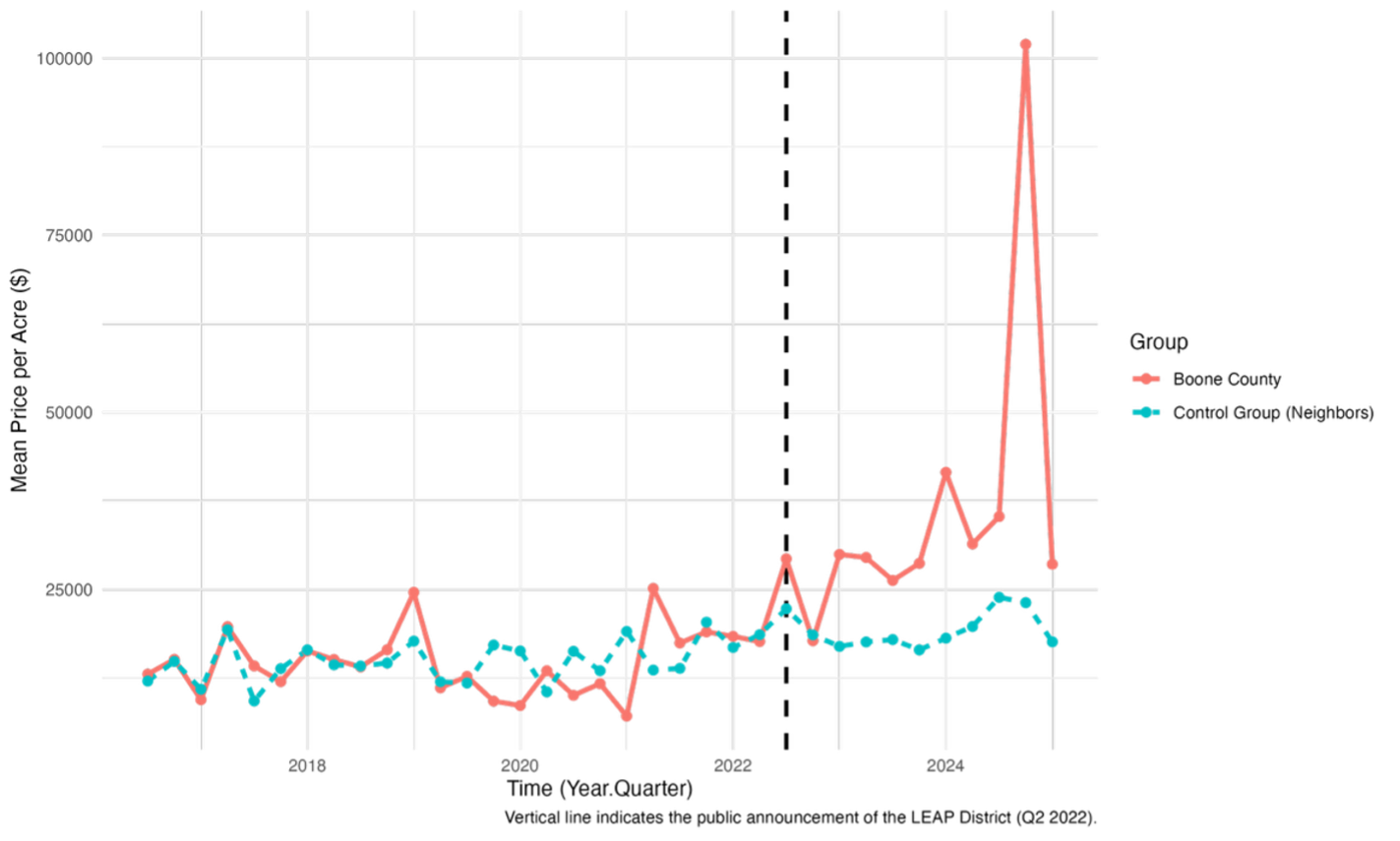
Figure 1 presents average farmland prices per acre in Boone County and its neighboring counties over time. Prior to the LEAP District announcement in 2022, the farmland price trend is similar in Boone County and its bordering counties, with no systematic divergence between the two series. This similarity in pre-announcement trends provides visual support for the parallel trends assumption underlying the empirical analysis (Angrist & Pischke, 2009). Following the LEAP announcement, farmland prices in Boone County diverge sharply upward, while prices in neighboring counties continue to follow a more gradual trend.
Figure 1
Parallel Trends in Farmland Prices of Boone and Neighboring Counties
Empirical Approach
To estimate the localized and spillover effects of state-led land acquisition on farmland prices, we employ a difference-in-differences (DiD) framework. This approach compares changes in farmland prices in Boone County after the LEAP District announcement to contemporaneous changes in prices in counties not directly affected by the acquisitions. Multiple model specifications are estimated using alternative control groups and the inclusion of county and year fixed effects.
While the baseline DiD model provides an average treatment effect on the treated (ATT) county, it masks potential dynamics in farmland prices surrounding the IEDC acquisitions. To evaluate the validity of the parallel trends assumption and to track how treatment effects change over time, we estimate an event-study specification.
Results
Table 1 reports the estimates of the effect of state-led land acquisition on farmland prices across several different-in-differences specifications[1]. Across all models, farmland prices in Boone County increased substantially following the IEDC’s entry into the land market.
Table 1
Difference-in-Differences Regression Results
|
Variable |
Model 1 |
Model 2 |
Model 3 |
Model 4 |
|
Main Coefficients |
||||
|
Intercept |
11.035*** |
9.514*** |
9.232*** |
9.229*** |
|
|
(0.159) |
(0.275) |
(0.024) |
(0.206) |
|
|
||||
|
Treated |
-0.054 |
— |
0.226*** |
— |
|
|
(0.051) |
|
(0.041) |
|
|
|
||||
|
Neighbors |
— |
— |
0.216*** |
— |
|
|
|
|
(0.023) |
|
|
|
||||
|
Post |
0.293*** |
— |
0.167*** |
— |
|
|
(0.043) |
|
(0.009) |
|
|
Interaction Effects |
||||
|
Localized Effect (Treated × Post) |
0.338*** |
0.358*** |
0.458*** |
0.438*** |
|
|
(0.093) |
(0.094) |
(0.078) |
(0.075) |
|
|
||||
|
Spillover Effect (Neighbors × Post) |
— |
— |
0.067* |
0.074* |
|
|
|
|
(0.041) |
(0.040) |
|
Model Specifications |
||||
|
Controls |
Neighbor |
Neighbor |
Rest |
Rest |
|
Year Fixed Effects |
No |
Yes |
No |
Yes |
|
County Fixed Effects |
No |
Yes |
No |
Yes |
Note: *p<0.1; **p<0.05; ***p<0.01
Standard errors are in parentheses.
Standard errors clustered at the county level.
Our results show that state-led land acquisitions in treated counties create positive and statistically significant localized effects. Farmland in Boone County increased by roughly 40 percent across specifications relative to counterfactual trends following IEDC’s land purchases, as would be expected with land being repriced because it now has some non-agricultural land use as an anchor. These estimates are robust to alternative comparison groups and to the inclusion of county and year fixed effects.
The magnitude of this localized price increase is consistent with how farmland markets respond when a large, state-backed, resourceful buyer enters at prices well above prevailing agricultural values. Highly visible transactions at elevated prices establish new reference points, leading sellers to revise reservation prices upward even in private transactions that do not involve the state directly (Cotteleer et al., 2008). At the same time, public announcements, infrastructure commitments, and site planning associated with the LEAP District appear to have altered expectations about future land use, causing farmland values to capitalize anticipated development potential rather than agricultural returns alone (Capozza & Helsley, 2003).
The results also show that the impact of these economic development initiatives not only has a localized effect, but the effect also spreads out to neighboring counties. We observe spillover effects of about 7 percent in neighboring counties, compared to the rest of Indiana, due to IEDC land acquisition in Boone County. Although smaller in magnitude, these spillovers suggest that changes in price benchmarks and development expectations extended beyond the county where land was directly acquired.
Dynamic patterns reinforce this interpretation. Event-study results show no evidence of differential price trends prior to the LEAP District announcement. Farmland prices in Boone County begin to diverge within a few quarters after the announcement and remain persistently higher thereafter. In contrast, spillover effects in neighboring counties emerge with a lag and gradually dissipate over time, consistent with the gradual adjustment of expectations and bargaining conditions.
Conclusions
This report examines how state-led farmland acquisition for economic development affects farmland prices, using the special case of IEDC’s creation of the LEAP District in Boone County, Indiana. We find large and persistent increases in farmland prices in Boone County and smaller, temporary spillover effects in neighboring counties. These results indicate that public land acquisition can substantially reprice farmland by altering demand conditions, establishing new price benchmarks through highly visible elevated transactions, and shifting expectations about future land use away from purely agricultural returns.
These findings have several implications. Rising farmland prices may increase barriers for farmers seeking to expand or enter agriculture and raise the cost of future land acquisition, while spillover effects suggest that market impacts extend beyond targeted areas, complicating regional land-use planning. As state-led development initiatives continue to expand, understanding these land market consequences, alongside the intended economic benefits, is essential for informed policy design.
References
Angrist, J. D., & Pischke, J.-S. (2009). Mostly Harmless Econometrics: An Empiricist’s Companion. Princeton University Press.
Borchers, A., Ifft, J., & Kuethe, T. (2014). Linking the Price of Agricultural Land to Use Values and Amenities. American Journal of Agricultural Economics, 96(5), 1307–1320. https://doi.org/10.1093/ajae/aau041
Capozza, D. R., & Helsley, R. W. (2003). The Fundamentals of Land Prices and Urban Growth*. In The Economics of Land Use. Routledge.
Cotteleer, G., Gardebroek, C., & Luijt, J. (2008). Market Power in a GIS-Based Hedonic Price Model of Local Farmland Markets. Land Economics, 84(4), 573–592. https://doi.org/10.3368/le.84.4.573
Kunwar, B. (2024). IMPACT OF COMMERCIAL AND UTILITY-SCALE SOLAR ENERGY ON FARMLAND PRICE [Thesis, Purdue University Graduate School]. https://doi.org/10.25394/PGS.26076679.v1
Plantinga, A. J., Lubowski, R. N., & Stavins, R. N. (2002). The effects of potential land development on agricultural land prices. Journal of Urban Economics, 52(3), 561–581. https://doi.org/10.1016/S0094-1190(02)00503-X
Shi, Y. J., Phipps, T. T., & Colyer, D. (1997). Agricultural Land Values under Urbanizing Influences. Land Economics, 73(1), 90–100. https://doi.org/10.2307/3147079
[1] Models 1–2 use neighboring counties as the control group (Model 2 includes year and county fixed effects). Models 3-4 expand the control group to the remainder of Indiana; Model 4 additionally includes year and county fixed effects.