Indiana Pasture Land, Irrigated Farmland, Hay Ground, and On-Farm Grain Storage Rent

August 8, 2015

PAER-2015-09

Craig L. Dobbins, Professor of Agricultural Economics and Kim Cook, Research Associate

Estimates for the rental value of irrigated farmland, pasture land, hay ground, and on-farm grain storage in Indiana are often difficult to find. For the past several years, questions about these items have been included in the Purdue Farmland Value Survey. The values from the June 2015 survey are reported here. Because the number of responses for some items is small, the number of responses is also reported.

Averages for pasture rent, the market value of and cash rent for irrigated farmland, and the rental of on-farm grain storage are presented in Tables 1, 2, and 3, respectively. The rental rate for grain bins includes two situations; one for just the bin and a second for the bin and utilities. Table 4 (page 11) provides information about the rental rate for established alfalfa-grass and grass hay ground.

Information from prior years’ surveys can be found in the Purdue Agricultural Economics Report archive.​​​

This information can be found in the August issue beginning in 2006.
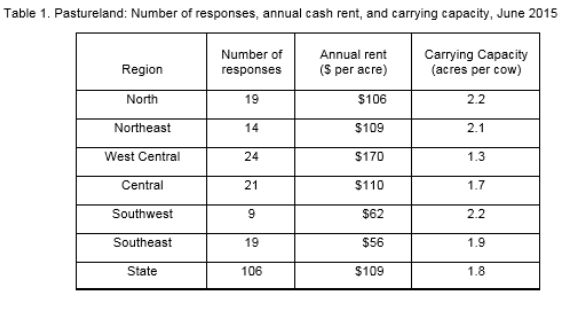
Table 1: Pastureland: Number of responses, annual cash rent, and carrying capacity, June 2015
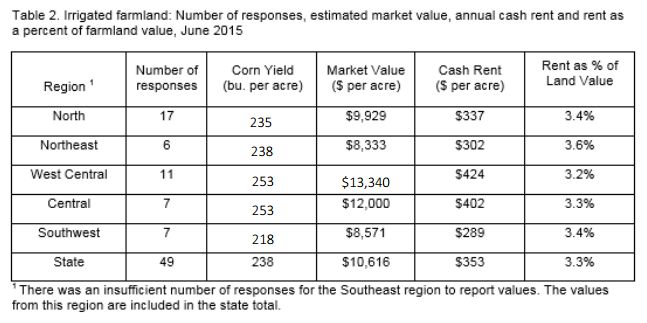
Table 1: Pastureland: Number of responses, annual cash rent, and carrying capacity, June 2015


Table 2. Irrigated farmland: Number of responses, estimated market value, annual cash rent and rent as a percent of farmland value, June 2015
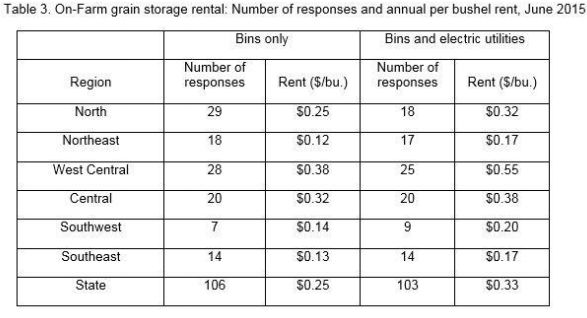
Table 2. Irrigated farmland: Number of responses, estimated market value, annual cash rent and rent as a percent of farmland value, June 2015


Table 3. On-Farm grain storage rental: Number of responses and annual per bushel rent, June 2015

Table 3. On-Farm grain storage rental: Number of responses and annual per bushel rent, June 2015
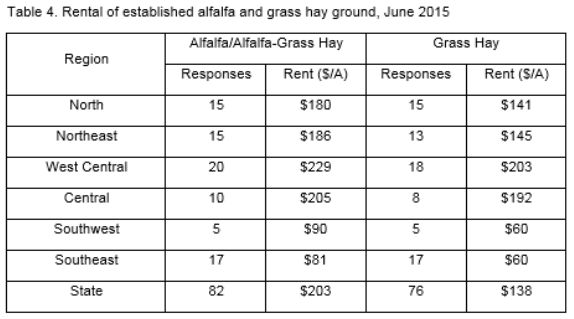
 

Table 4. Rental of established alfalfa and grass hay ground, June 2015
Table 4. Rental of established alfalfa and grass hay ground, June 2015


Publication Appeared Within:

Latest Articles:

The Iran Conflict and Global Food Security: Why the Burden Falls Hardest on the World’s Most Vulnerable

March 31, 2026

When an energy shock ripples out from the Persian Gulf, the headlines focus on oil prices, gasoline costs, implications for value chains and the profit margins of U.S. producers.

READ MORE

The Iran Conflict and Consumer Food Prices: A Broad but Lagged and Sticky Shock

March 31, 2026

The initial public reaction to an oil price shock reaching $110 per barrel is often to project near-immediate, dramatic increases in grocery prices. This instinct overstates the direct farm-to-retail transmission channel in a straightforward and measurable way. The USDA Economic Research Service tracks how each dollar of consumer food spending is distributed across the supply chain in its Food Dollar Series. The picture it reveals is sobering for those who expect large and rapid retail food price responses driven purely by higher farm input costs.

READ MORE

The Iran Conflict, Energy Prices, and U.S. Farm Profitability: A Balanced Assessment

March 31, 2026

The conflict that began on February 28, 2026, with U.S.-Israeli airstrikes on Iran triggered the closure of the Strait of Hormuz — the narrow chokepoint through which approximately 20 percent of the world’s traded oil and significant volumes of liquefied natural gas (LNG) flow. Within days, Brent crude oil surged from roughly $70 per barrel to over $110, the highest level since Russia’s 2022 invasion of Ukraine. Gasoline prices at the pump rose roughly 17 percent in the first two weeks of the conflict, and diesel — the lifeblood of farming operations — followed closely.

READ MORE