January 11, 2024

Corn & Soybean Basis Continue to Strengthen

by Nathanael Thompson

After starting the year with weaker than normal basis levels, corn and soybean basis are improving. The improvement in corn basis occurred much later than normal due to slow harvest progress from wet corn in many locations. For example, corn basis in Central Indiana did not reach its low until the third week of November. Since then, corn basis in Central Indiana has improved $0.43/bu. and is now $0.26/bu. under March ’24 corn futures (Figure 1). This is still about $0.19/bu. weaker than the 3-year historical average in Central Indiana. Corn basis at Indiana ethanol plants (Figure 2) and river terminals in southern Ohio, Indiana, and Illinois (Figure 3) have followed a similar pattern.
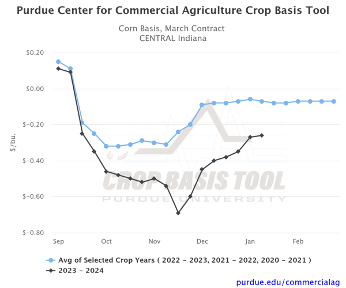
Figure 1. Central Indiana Corn Basis
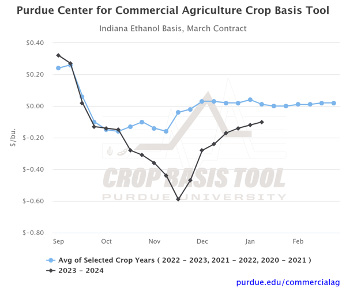
Figure 1. Central Indiana Corn Basis


Figure 2. Indiana Ethanol Plant Basis
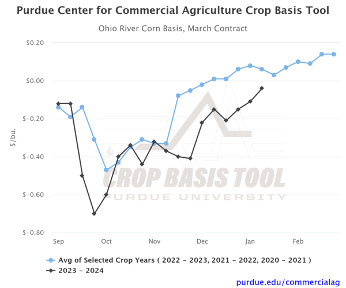
Figure 2. Indiana Ethanol Plant Basis


Figure 3. Ohio River Corn Basis

Figure 3. Ohio River Corn Basis

Soybean basis also started the year weaker than normal. However, strengthening of soybean basis happened earlier than corn given timelier harvest. For example, soybean basis in Central Indiana has been strengthening since early October and is currently $0.24/bu. under March ’24 soybean futures (Figure 4). This is just $0.05/bu. weaker than the 2-year historical average soybean basis in Central Indiana. Soybean basis at Indiana processors (Figure 5) and river terminals in southern Ohio, Indiana, and Illinois (Figure 6) have seen a similar recovery. As always, be sure to visit the Purdue Center for Commercial Agriculture Crop Basis Tool to check current corn and soybean basis levels and historical basis trends in your local area.
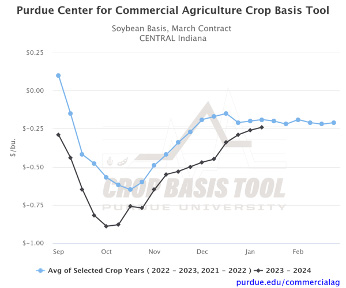
Figure 4. Central Indiana Soybean Basis
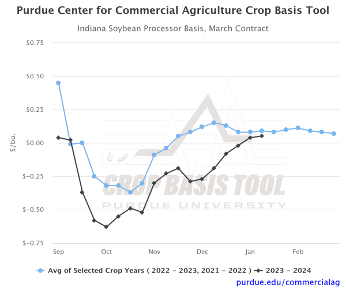
Figure 4. Central Indiana Soybean Basis


Figure 5. Indiana Soybean Processor Basis
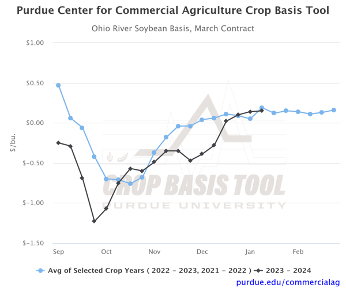
Figure 5. Indiana Soybean Processor Basis


Figure 6. Ohio River Soybean Basis

Figure 6. Ohio River Soybean Basis

TAGS:

TEAM LINKS:

RELATED RESOURCES

Indiana and Ohio Set the Benchmark for Soybean and Corn Basis, Respectively

March 13, 2026

Corn basis across the Eastern Corn Belt has remained relatively stable compared to last month, but regional differences remain significant. Ohio currently sets the benchmark for corn basis, with positive levels in parts of the state, while Iowa continues to post the weakest levels. Soybean basis has been more volatile, with strengthening through late February followed by recent declines across most districts. Indiana continues to lead the region with the strongest soybean basis levels. While historical patterns suggest basis should strengthen into spring, recent week-to-week volatility highlights the importance of monitoring local markets closely. Producers can track conditions using Purdue’s Crop Basis Tool.

READ MORE

Corn Basis is Stable Across the Eastern Corn Belt, but Soybean Basis Varies

February 20, 2026

Corn basis remains steady across much of the Eastern Corn Belt as markets transition to May futures contracts, with particularly strong local basis levels in central Ohio and northern Indiana. Meanwhile, soybean basis shows significantly more volatility, with widening spreads across districts and notable weakness in Iowa. Ethanol plants continue to offer firm premiums relative to local delivery points, while soybean crush plant basis has softened in several states. Producers can use the Purdue Center for Commercial Agriculture’s Crop Basis Tool to compare local ethanol and crush plant basis levels and evaluate current pricing opportunities against historical averages.

READ MORE

Crop Basis Trends Up Across the Eastern Corn Belt, but Regional Variance is Significant

January 16, 2026

Corn and soybean basis levels have improved across much of the Eastern Corn Belt in early 2026, though large regional differences remain. Learn what’s driving basis strength—and how to track your local opportunities using Purdue’s Crop Basis Tool.

READ MORE

UPCOMING EVENTS

We are taking a short break, but please plan to join us at one of our future programs that is a little farther in the future.

2026 Crop Cost and Return Guide

September 16, 2025

The 2026 Purdue Crop Cost and Return Guide provides estimated costs and net returns for planting, growing, and harvesting corn, soybeans, and wheat in the upcoming year. Cost and return information presents information for low, average, and high productivity soils. Early projections point to slightly higher breakeven prices.

READ MORE

2025 Farmland Values & Market Trends

September 9, 2025

Purdue ag economists Todd Kuethe and Michael Langemeier as they discuss Indiana farmland values on this, the first of two episodes reviewing the 2025 Purdue Farmland Values and Cash Rental Rates survey results. The survey shows Indiana land prices continue to rise and are anticipated to continue a modest increase for the rest of 2025 for most of the state.

READ MORE

Farmland Prices Increase Despite Downward Pressure, Purdue Ag Econ Report August 2025

August 19, 2025

Indiana farmland prices have continued the trend of record highs in 2025, according to the latest Purdue Farmland Value and Cash Rents Survey results. The average price of top-quality farmland reached $14,826 per acre, a 3.0% increase from June 2024. Statewide, cash rents increased from 1.5 to 1.7% for poor-, average-, and top-quality land.

READ MORE