

New report provides insight on consumer food spending, satisfaction, sustainability
The Sustainable Food Purchasing Index (SFP). The score reflects consumer food purchasing that aligns with a set of key recommendations for healthy diets from sustainable food systems. The SFP is part of the Purdue Consumer Food Insights Report, a new monthly report identifying trends and changes in consumer food purchases and preferences. (Purdue University image/Courtesy of the Center for Food Demand Analysis and Sustainability)
The Consumer Food Insights Report, a new monthly report identifying trends and changes in consumer food purchases and preferences, has been released.
The survey-based report out of Purdue University’s Center for Food Demand Analysis and Sustainability assesses food security and spending, consumer satisfaction and values, support of agricultural and food policies and trust in information sources.
Purdue experts conducted and evaluated the first survey, which included 1,200 consumers across the U.S., in January.
Key results include:
- 25% of respondents were unable to find a specific food product at the grocery store.
- 32% of respondents are waiting for their next paycheck to buy groceries.
- 16% of respondents face food insecurity.
- 51% of respondents blame COVID-related shutdowns for the rise in meat prices.
- A Sustainable Food Purchasing (SFP) Index of 67/100.
“We are taking the pulse of consumers to help guide farmers and retailers along the food supply chain as we all adapt to changing circumstances,” said Jayson Lusk, the head and Distinguished Professor of Agricultural Economics at Purdue, who leads the center. “Consumers significantly influence the direction of food and agricultural systems, and we need a timely way to track trends in what people are buying and eating, and how this is affected by events like inflation, climate change and COVID-19.”
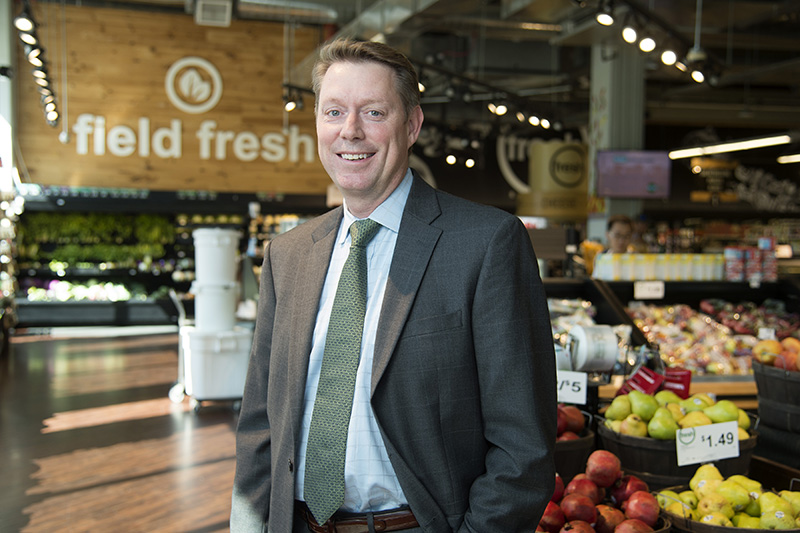 Jayson Lusk
 Sam Polzin, a food and agriculture survey scientist for the center and co-author of the report, said the goal is to create a useful public resource.
“Informed decisions are one way we can build a better and more sustainable food system,” he said. “We are sort of democratizing food data that previously was limited by resources and access.”
Larger corporations have the resources to conduct consumer surveys themselves, but the data isn’t shared; and some of the data is publicly available, but over longer periods of time and in difficult-to-understand government or academic reports, he said.
“We also are covering new territory, like examining sustainability as a factor in food purchases, and establishing baselines in certain areas,” he said.
The Consumer Food Insights Report includes a new Sustainable Food Purchasing Index that offers insight into how sustainability and health relate to consumer behaviors. It is a self-reported assessment of how consumer shopping habits correspond with healthy diets from sustainable food systems.
“We’re looking at whether or not people are purchasing foods that align with different areas of sustainability,” Polzin said. “We want to gauge consumer interest in this, as well as track changes over time and in response to outside factors, like climate change-related events. The January report is our first, so it is a baseline. We’ll see what increases, decreases and remains steady over time.”
The Sustainable Food Purchasing Index value for January is 67/100. The score reflects consumer food purchasing that aligns with a set of key recommendations for healthy diets from sustainable food systems. The index includes six components correlating with different strategies for achieving food system transformation: nutrition, environment, social, economic, security and taste.
“For example, purchasing a diversity of foods with many different micro and macronutrients is central to supporting nutritional health, but a family must also be able to buy this food while staying within their budget,” Polzin sad. “Meeting the nutritional goals of a sustainable food system is moot if the system is not also providing affordable options that meet our economic goals.”
The survey is flexible and has an “Ad Hoc” question section that can be tailored to current events. In January, the question was “Why are retail meat prices rising?” The results showed 51% of consumers blamed COVID-related shutdowns for the dramatic increase in meat prices, and less than 10% attributed the increase to concentration in the meat packing sector.
“Stock-outs also continue to affect consumers,” Lusk said. “About a quarter of the respondents mentioned being unable to find certain items in the grocery store. The most commonly mentioned missing items were chicken, beef and dairy products.”
The report offers data that the team hopes will lead to further research, guide strategic pivots from producers and retailers, and inform policymakers, he said.
The Center for Food Demand Analysis and Sustainability is part of Purdue’s Next Moves in agriculture and food systems, and it aims to use innovative data analysis shared through user-friendly platforms to improve the food system. In addition to the Consumer Food Insights Report, the center offers a portfolio of online dashboards.
Featured Stories

For Brody Cox, preparing for the Indiana State Fair began long before he entered the show...

Carolyn Foley, a long-time member of the Purdue Forestry and Natural Resources (FNR) and...

In the September Purdue University/CME Group Ag Economy Barometer survey, 52% of respondents...

Purdue University’s College of Agriculture recognized nine alumni at the Distinguished...

Keep your eyes peeled across Indiana for the newly minted Purdue Forestry and Natural Resources...

“Being at Purdue has changed my thinking entirely,” says Mingyu Zhao, a third-year...