

The luck of the Irish in your lawn
St. Patrick’s Day gets us thinking about all things green — from shamrock decorations to our lawns, which we hope will soon show signs of life.
The word shamrock describes a three-leaf clover and comes from the Irish seamróg, which means “young clover.” It’s the rare four-leaf clover that’s considered lucky, but your chances of finding one are estimated between one in 5,000 to one in 10,000, thanks to genetics. Unlike humans, whose chromosomes come in pairs, clovers have four chromosomes per cell. Since the gene for four leaves is a recessive one, all four chromosomes must have this recessive gene for the trait to appear.
A four-leaf clover in your hand feels lucky, but what about clover in your lawn? Whether that’s a good or bad thing depends on your perspective, says Cale Bigelow, professor of horticulture, because “There is no perfect lawn.”
Historically, say 100 to 150 years ago, we had a lot of clover in our grass mixes, explains Aaron Patton, professor and interim head of the Department of Horticulture and Landscape Architecture. “People were going out in their pasture and harvesting whatever seed was there. With the advent of herbicides, those growing grass for seed production were able to clean those weeds up so that they could harvest just the grass seed itself.”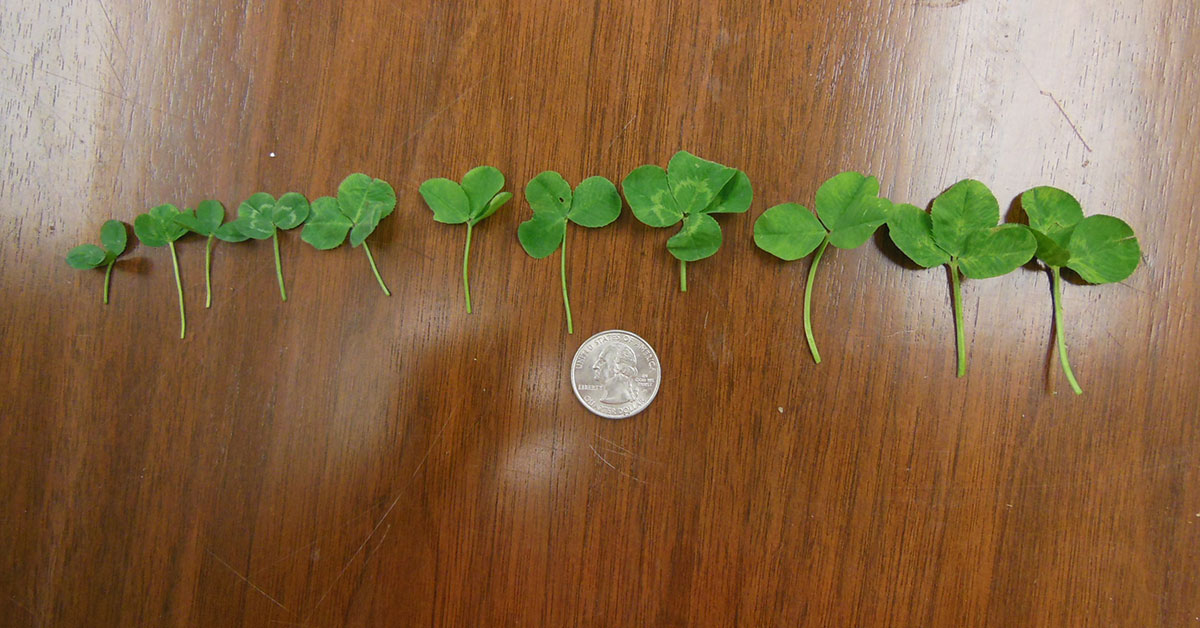 Clover comes in many sizes, but the grass-legume mix Cale Bigelow and his team tested contained microclover.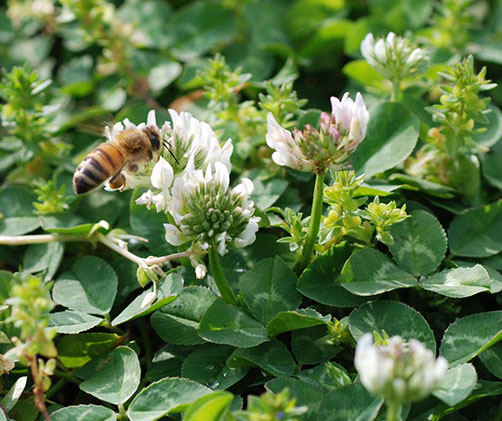
A grass-clover mixture can also promote species biodiversity — and boost your flower or veggie garden by attracting pollinators. However, not all homeowners’ associations will like lawns they consider too weedy, and those same pollinators can create risk for pets or kids allergic to stinging insects.
Maintaining a lawn with a clover mix can also be challenging if you or your lawn care company decide to apply nitrogen to give your grass mixture a boost. “If you establish this and then you start to feed it, you’re shifting the species dynamics to favor the grass because you have more nitrogen available to it,” Bigelow says. This reduces clover’s competitive advantage of fixing its own nitrogen.
Post-emergence herbicides also work to reduce clover if you prefer a lawn without it. “The challenge is the best time to make the applications to remove clover is going to be in the fall, but most people aren’t really thinking about their lawns in the fall. Herbicides will work in the spring to control clover, but they often don’t work as well as the homeowner might want them to.”
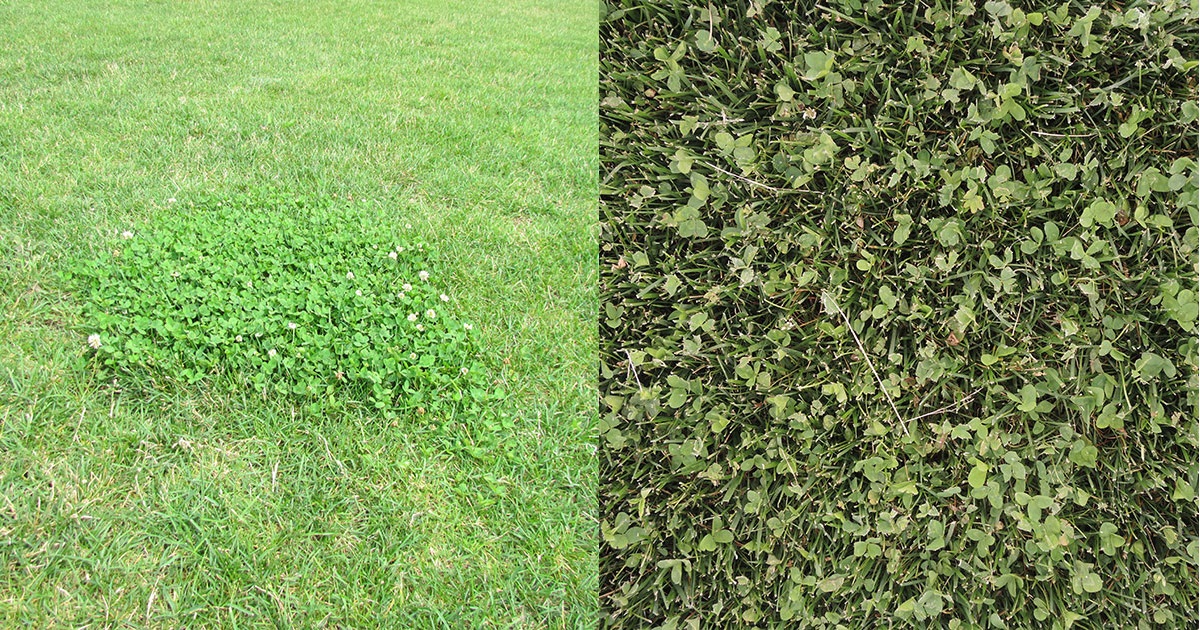 Clover shown as a weed in a clump versus in a uniform grass-clover mix.
 Bigelow says another disadvantage of clover he discovered in research trials is that clover is more succulent than grass. “We would actually get a lot of clumping of the clippings because of all the moisture in that leaf. If somebody’s not mowing frequently enough, they would potentially get some clippings that would sit on the surface, which may not be aesthetically what they want.”
The best lawn management requires weighing the pros and cons of different materials and strategies for your circumstances. “I think the more people understand that there’s no right or wrong in these situations, and that it comes down to personal preference, that could be helpful,” Patton says.
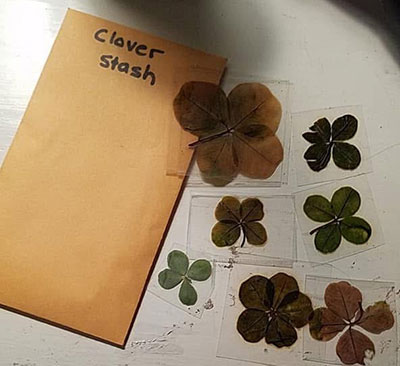 However, if you’d like a little Irish luck, Bigelow and Patton say that Geoff Schortgen, Wabash County Agriculture and Natural Resources Extension Educator, is the best at finding four-leaf clovers. Schortgen suggests getting close to the ground to look for big clover patches and notes that three-leaf clovers create a triangle shape, whereas four-leaf clovers look more like a square. Look for the squares, he says, and when you find one four-leaf clover, there are often others nearby.
“For me, it’s free therapy,” Schortgen says. “You can’t buy luck, but you can always find it.”
Featured Stories

For Brody Cox, preparing for the Indiana State Fair began long before he entered the show...

Carolyn Foley, a long-time member of the Purdue Forestry and Natural Resources (FNR) and...

In the September Purdue University/CME Group Ag Economy Barometer survey, 52% of respondents...

Purdue University’s College of Agriculture recognized nine alumni at the Distinguished...
Keep your eyes peeled across Indiana for the newly minted Purdue Forestry and Natural Resources...

“Being at Purdue has changed my thinking entirely,” says Mingyu Zhao, a third-year...