

Using process-based modeling and high-throughput phenotyping data to predict how plants will grow
While the houseplant sitting on your windowsill doesn’t seem to do a lot, it is turning sunlight and water into new leaves and longer stems. Plants may seem stationary in comparison to our fast-paced lifestyle, but a myriad of hidden, complex processes occur that keep plants growing — many of which we still haven’t discovered.
Predicting how plants will grow under different environments and circumstances is crucial to securing the global food supply. Shifting weather patterns, spreading diseases and pests put plants at risk, and plant breeders must continuously create new varieties of staple crops that survive challenging conditions.
To-Chia Ting, a postdoctoral scholar in agronomy, studies new approaches to predict plant behavior and growth using process-based modeling. Unlike statistical models, which use patterns in data to predict the probability of a particular event, process-based models rely on mathematical equations that describe the physical and biomechanical laws of Earth or the physiological mechanisms of organisms as humans understand them, such as knowing how much energy one needs to heat water to a boil and produce water vapor.
“We want to use process-based modeling to understand plant growth and how genotypes, or different genetic varieties of plants, interact with their environment,” Ting said. “But the challenge of using these process-based models is that they need a lot of data to start functioning and to be checked for accuracy. If we rely on humans to collect data, it may not be realistic, especially if you want to examine thousands of genotypes.”
Purdue’s Ag Alumni Seed Phenotyping Facility (AAPF) gathers large datasets both routinely and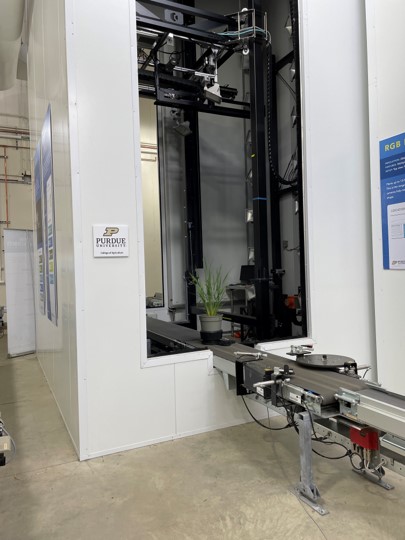 automatically. The plants are pulled by a conveyor belt into imaging booths where, with the touch of a button, pictures are taken under different wavelengths of light. Those images can then be used to estimate their physical and physiological characteristics, see if they have indicators of stress and even generate x-ray scans of their root system.
The AAPF is especially useful to research projects like that of Ting because measurements are taken without harming the plant. Scientists can collect data continuously throughout any plant’s lifetime.
To make phenotyping and process-based modeling more accessible to other researchers, Ting and her collaborators have published a thorough literature review in New Phytologist. In it, they draw deeper connections between data collected using high-throughput phenotyping methods from previous studies and the process-based modeling linking that data to biological traits and responses.
 , opens larger image The data from high-throughput phenotyping facilities (blue circles on the left) include images from different cameras. Using statistical approaches (a), those images can be turned into estimated measurements (green box). These measurements can be used to start process-based models (c and d). With process-based modeling (yellow circles on the right) scientists can answer biological questions like how photosynthesis changes under different conditions. Measurements can also help check the process-based model for accuracy (b).
 Ting said that process-based modeling could fill the gap between data from high-throughput phenotyping and the traits researchers are studying. “The methods need to be creative for each different project. Process-based modeling is not really like a protocol that never changes. The ability to think about new methods and to have innovation depends on both our biological understanding and communicating more with the engineers of phenotyping equipment, because it is their product.”
For Ting, learning from engineers and from other fields is the most exciting part of the project. Building connections with others has also taught her to better explain her own research and describe problems so those with different skills can assist.
“People outside can see the question with some brilliant ideas that I never thought about,” Ting said.
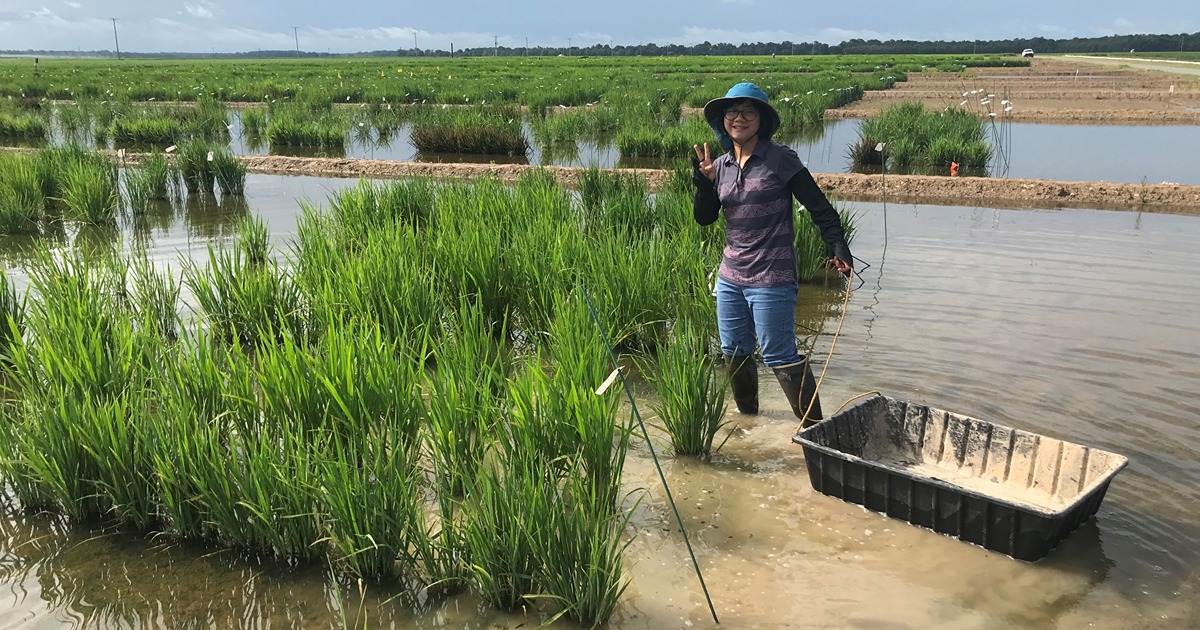 , opens larger image To-chia Ting in a rice paddy (Photo provided by To-Chia Ting).
 Diane Wang’s lab, where Ting works, studies rice, a staple crop for Asia, the Caribbean, Africa and Latin America. For them, phenotyping means optimizing their research — using the tools available at Purdue and maximizing their output. With process-based modeling, they can predict which lines and crosses of rice will be most beneficial for plant breeders in each region.
Wang’s lab also studies sunflowers using the AAPF, including wild sunflower species growing across Indiana. Ting uses them as a test subject to see if high-throughput phenotyping data can inform physiological models and later process-based modeling as the literature review suggests.
Since the hyperspectral cameras can see beyond what the human eye can, Ting also plans to press and dry some of the sunflowers. She thinks images from the hyperspectral camera and process-based modeling can accurately provide information about pest damage or environmental stressors from when it was still alive.
Featured Stories
The Office of Indiana State Chemist (OISC) is warning Indiana residents about an illegal...
A prominent protein on most human cells may be key to unlocking the code that makes humans...
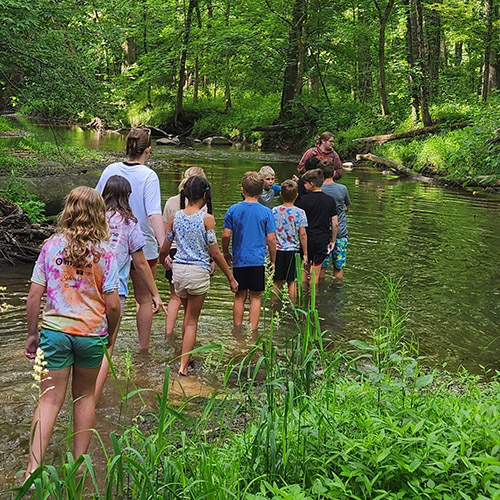
Ava Hoskins, a double major in aquatic sciences (fisheries concentration) and natural resources...
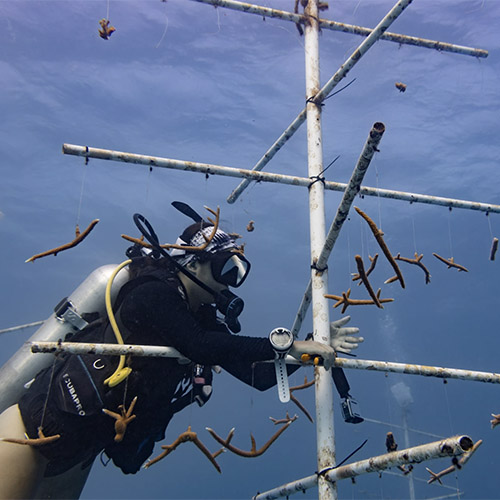
Ashlynn McLaughlin, a senior aquatic sciences major with a concentration in marine and freshwater...

For Brody Cox, preparing for the Indiana State Fair began long before he entered the show...
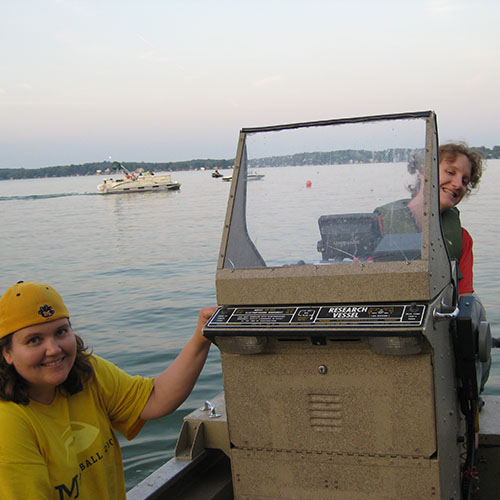
Carolyn Foley, a long-time member of the Purdue Forestry and Natural Resources (FNR) and...