

Aquaponics project seeks to boost Midwest seafood production
Half a billion years ago, a shallow sea covered an equatorial landmass today known as Indiana and much of the Midwest. Seafood, also known as blue food, was the major food type that nature produced in the region for hundreds of millions of years.
Since then, slow-acting geologic forces drove the region far north to its mostly landlocked, above-sea-level location. Humans migrated into the area at least 12,000 years ago, and in recent centuries, meat, dairy and crop production burgeoned.
In 2023, Purdue University researchers intensified efforts to elevate seafood production in the region. Their When Blue is Green (BiG) project aims to develop an economically viable, grid-independent system that generates no waste. Funded by a five-year, $10 million USDA grant, the project, co-led with Ohio State University, has passed its halfway mark. The BiG team has published 21 papers since the project began.
“We feel good about the data,” said Aya Hussain, a postdoctoral scientist in forestry and natural resources who has contributed extensively to the work. “It's all about the rigor, the durability and the validity of the data that we collect.”
Aquaponics combines aquaculture’s fish farming with hydroponics — growing vegetables in nutrient-enriched water without soil. Fish provide nutrients for the plants, while the plants help purify the water for the fish. The system uses less land and water than conventional food products. Unfortunately, it requires high energy inputs and creates substantial waste.
Overcoming these challenges could help the U.S. address a major trade imbalance. The U.S. imports almost 90% of its seafood consumption, according to the National Oceanic and Atmospheric Administration, with about half the total coming from aquaculture. The most recent U.S. fisheries report ranks the U.S. 17th in global aquaculture production. As of 2023, the USDA reported that 19 aquaculture farms were operating in Indiana, out of 3,553 nationwide.
Challenges that impede more locally produced blue food stem from costs dominated by water and power usage. But if costs can be met, aquaponics could provide new opportunities for rural communities. “The point is, diversify the economy,” said Jen-Yi Huang of Ohio State University, who leads the BiG project. “Grow more food here. Make it cheaper.”
In the project’s first year, the BiG team commissioned a pilot-scale aquaponics system with a 600-gallon operating volume that produced over 300 pounds of microbially safe tilapia and 400 pounds of lettuce in each production cycle. Along with fish and lettuce, the team also harvested microalgae for multiple uses.
Tilapia can grow to two pounds or more in four to six months, Hussain noted. And heads of lettuce can reach 1.5 pounds or more. “In the middle of production, they look small,” Hussain said of the lettuce. “In week four, these tiny lettuce double in size.”
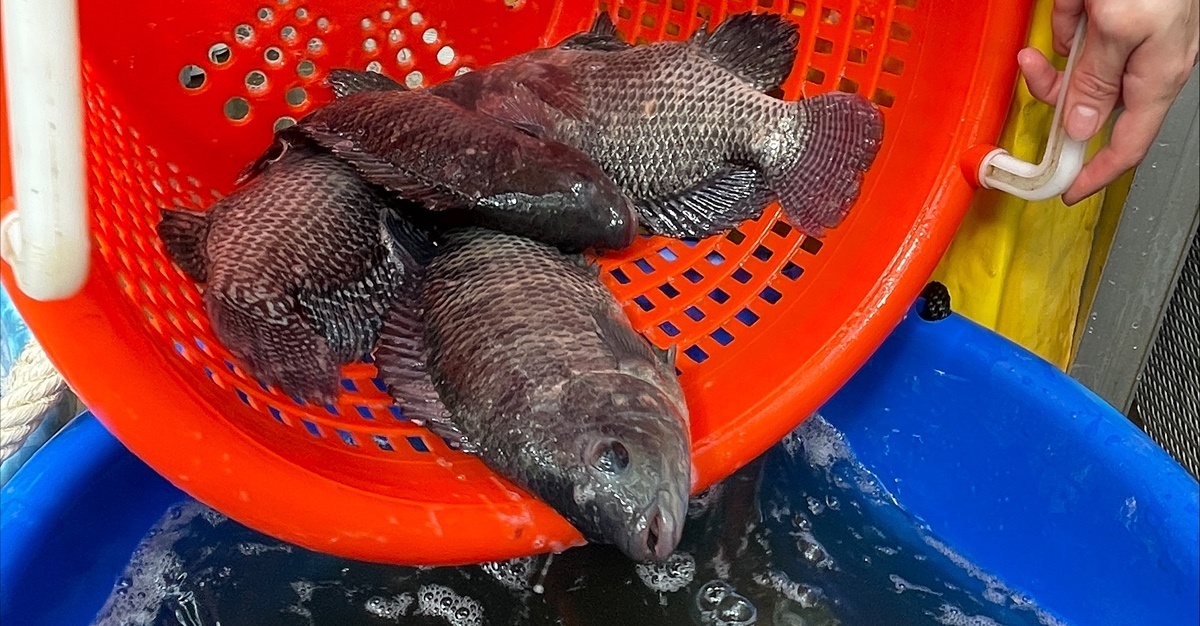 , opens larger image Purdue researchers raise tilapia, a popular aquacultural fish, in their aquaponics experiments. (Credit: Purdue Forestry & Natural Resources/Aya Hussain)
 Lettuce grows more slowly on dry land, where it needs watering, rainfall, or fertilizer. Aquaponics offers ever-present nutrients. “You can get a full head of lettuce in a much shorter cycle. That’s one big advantage of aquaponics.”
Until last December, the Purdue team operated six aquaculture systems in a greenhouse that tested two treatments in triplicate. “There will always be variation between aquaculture systems, so we can't run research with only one system per treatment. We have to replicate each treatment we do,” Hussain said.
The team has replaced its pilot-scale systems with two larger systems that better mimic commercial operations. A basic aquaponics system consists of fish, plants, tanks and a water pump. BiG researchers have added algal cultivation, anaerobic digesters, and a biogas boiler (coming later) to reduce waste, recycle nutrients, and generate energy. Computer simulations, meanwhile, evaluate how well system components work together under various scenarios to verify their sustainability and profitability.
For years, growers have added iron to their systems, fearing that commercially available fish feeds provide less of these nutrients than their plants need. “They don’t want to see tip burn, for example,” Hussain said, noting that a lack of iron leads to dry tips in lettuce.
Purdue’s pilot-scale tests show no difference between supplementing or withholding iron from the systems. “When we move to the bigger, commercial-size system, we may repeat to see if the effect will continue or change,” she said.
U.S. aquaponics research began in the 1970s, setting the standards for much of the work that followed regarding fish stock density and other factors.
Hussain, working with colleagues in Pakistan, has found that multiple factors can affect optimum tilapia stocking density, including dietary supplements in their feed, as reported in 2024 and 2025. A study published last January highlighted how adjusting fish stocking densities can foster beneficial microalgae as an integrated aquaponics subsystem.
The project derives multiple benefits from microalgae, including water purification. Aquaponics operators must discharge solid waste and wastewater collected by the biofilter, which accounts for one-fifth of the water in those systems to maintain quality. In 2024, Purdue researchers published four studies showing how using microalgae can effectively treat excess nutrients from aquacultural wastewater to prevent fouling the environment. Yet another Purdue study, published in December 2025, describes how to apply microalgae more cost-effectively to biofuel production.
BiG researchers recycle fish tank sludge along with wastewater. When concentrated into a biomass, the dissolved nutrients captured by microalgae also become available for conversion into ingredients for dietary supplements, cosmetics and food products, as published in January, February and April 2026. Several Purdue-led studies recently documented how anaerobic digestion can generate biogas energy from fish tank sludge when combined with manure, corn husks or corn stover.
In the past, people have associated blue food production with coastal areas. “They never thought of inland,” said Huang. “The Midwest could have a blue economy.”
Featured Stories

In recent years attendees at Purdue Agriculture alumni, donor, and faculty and staff events have...
People think grass is simple. Lawns, right? Mow regularly and add some water and fertilizer. What...

The Office of Indiana State Chemist (OISC) is warning Indiana residents about an illegal...
A prominent protein on most human cells may be key to unlocking the code that makes humans...
Ava Hoskins, a double major in aquatic sciences (fisheries concentration) and natural resources...
Ashlynn McLaughlin, a senior aquatic sciences major with a concentration in marine and freshwater...