

Prototype forest growth model demonstrated for Peru application
The U.S. Forest Service invested decades of work and tens of millions of dollars to develop a massive forest growth simulation model for the contiguous 48 states. With artificial intelligence, Purdue University’s Jingjing Liang developed a Global Forest MATRIX Model within two years.
“That truly shows the capacity of AI in assisting the development of forest growth models,” said Liang, an associate professor of forestry and natural resources. Now Liang and colleagues at the Food and Agriculture Organization of the United Nations (FAO) are collaborating with colleagues in Peru to adapt the model for regional needs.
Liang’s Forest Advanced Computing and Artificial Intelligence Lab, FAO and Peru’s national forestry and wildlife service (SERFOR) launched the effort during a three-day workshop in August. Peru is among the first nations to join the MATRIX model initiative.
As Peru adopts the MATRIX model for its forest growth simulations, Liang expects more countries to do likewise. “We are also working with Honduras, and Kenya and Ghana in Africa. Those partners bring a diversity of expertise and voices into the development of this platform.”
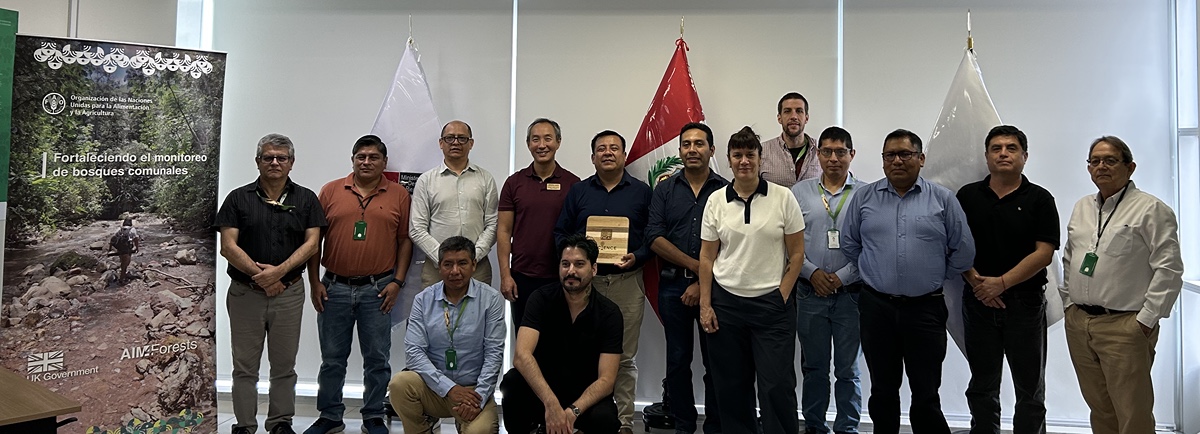 , opens larger image Specialists from Purdue University, the Food and Agriculture Organization of the United Nations (FAO), and Peru’s National Forest and Wildlife Service (SERFOR) convened for the MATRIX Peru Forest Dynamics Workshop to discuss forest monitoring and the adaptation of the MATRIX forest growth model for Peru.
Workshop activities included enhancing AI training with human expertise. “If we do not supervise its training well, AI does not do a good job,” he said. “We ensure that AI is trained by the best human teachers possible, in addition to using forest inventory data that has already been collected.”
During the workshop Liang and his associates demonstrated the Global Forest Matrix Model, MATRIX Indiana and a MATRIX Peru prototype. The Global Forest Matrix Model, an AI-enabled forest dynamics modeling system, helps countries project forest change under different environmental and management scenarios.
Liang’s lab developed MATRIX Indiana for the Indiana Department of Natural Resources. It’s designed for local forest landowners. The MATRIX Peru prototype is being adapted to support forest monitoring, sustainable forest management and biodiversity conservation in Peru.
Workshop activities included technical training, software demonstrations, discussion of model customization using Peruvian forest inventory data, and a field exercise in the educational forest of Universidad Agraria La Molina.
During the field exercise, workshop participants collected data from every tree growing in a newly established plot using the protocol that crews in Peru use to conduct forest inventories. “This helped us to better understand how to standardize and harmonize their data with the rest of our global forest inventory data,” Liang said.
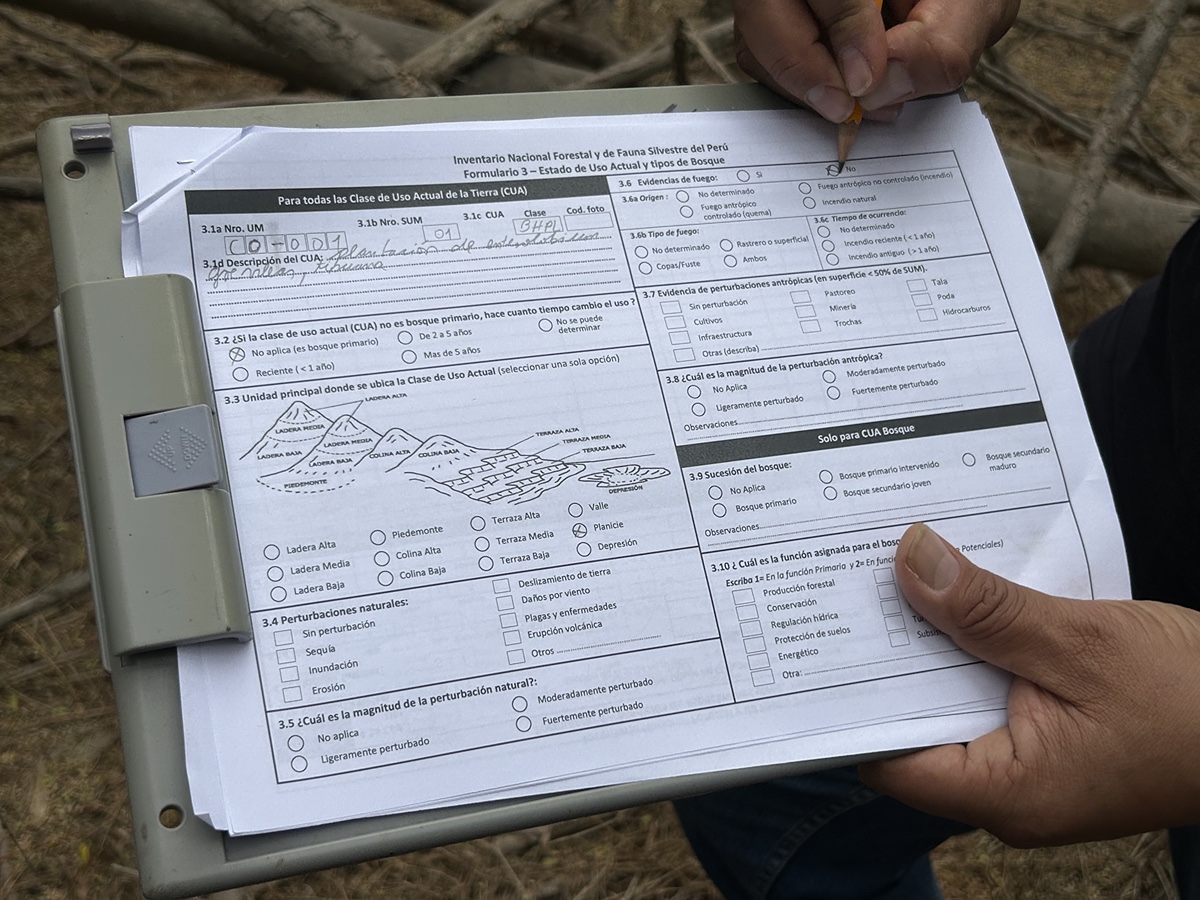 , opens larger image Workshop participants record forest inventory data during a field exercise in Peru. The data collection exercise helped the team explore how Peru’s forest inventory data can be standardized and harmonized for use with the MATRIX model.
Participants also gained experience with a new tool called the forest data harmonizer, which was developed to make forest inventory data from different parts of the world AI-ready and modeling-ready. The tool translates raw data from various countries, collected via different protocols and languages, into a standard format that can be compatibly modeled with data collected elsewhere.
The latest versions of AI make it possible to offer a more user-friendly type of forest growth model, Liang said. Users may now provide information to AI and ask how their forest stand will grow.
“This is the direction the MATRIX model is going. We want to make it as convenient as possible for humans to use, especially the landowners who may not have any experience in spreadsheets and growth models.”
Liang, a University Faculty Scholar and Global Forest Informatics Fellow, founded the nonprofit organization InterNodes to support global forest modeling collaborations. InterNodes serves as an umbrella organization that supports Science-i and Global Forest Biodiversity Initiative (GFBI). An open-science platform, Science-i fosters collaborations among hundreds of scientists worldwide, while the GFBI studies and manages the world’s largest tree-level forest inventory database.
Featured Stories
Researchers are working to scale up the green production of maple syrup in the Central Hardwood...

The eyes are the window to the soul, according to an old saying. But Purdue University’s...

For her contributions to and impact on wildlife management in the state of Indiana, Geriann...

PFAS have been shown to increase risks to immunity, reproductive health, developmental delays,...
Senior Isaac Johnson, a forestry major with a concentration in forest management, worked as an...

Alisa Tilson (BS '96, Natural Resources and Environmental Science) works for CDOT’s...