

A shift in focus: Evan Hunt finds his path in animal genetics
Evan Hunt, a senior in animal sciences from Crothersville, Indiana, came to Purdue with a background in agriculture and a plan to pursue pre-veterinary medicine, but one class changed his career path, shifting his interest to animal genetics.
Hunt chose animal sciences because of his experience with livestock and his interest in the swine industry. As an undergraduate student, he gained hands-on industry experience through internships at Martin Family Farms as a swine production intern and at Indiana Packers Corporation as a quality assurance intern.
A Turning Point in the Classroom
However, his career path pivoted in the fall 2025 semester when he enrolled in ANSC 311: Animal Breeding and Genetics, taught by Luiz Brito, PhD. While Hunt had previously taken a genetics course, this was his first exposure to genetics within the context of animal agriculture.
After class, Hunt connected with Brito to explore research opportunities, becoming involved in the lab as an undergraduate researcher — an experience that ultimately led him to plan to pursue a master’s degree in animal genetics. Since then, he has continued to build his experience by serving as a grader for ANSC 311 and taking a graduate-level animal breeding course with Allan Schinckel, PhD.
In Brito’s lab, Hunt is contributing to a research project focused on identifying genetic traits associated with boar trainability in breeding programs. His role includes working with large datasets, including cleaning and organizing data, creating visualizations and preparing it for further genetic analysis using tools such as R and BLUP.
Hunt said he decided to pursue a master’s degree in animal genetics at Purdue because he was influenced not only by his interest in the subject, but also by the environment within Brito’s lab.
"Everyone is super welcoming, and I really enjoyed interacting with the other graduate students and faculty. That kind of environment made me excited to stay and continue learning here," Hunt said.
Hunt also recognizes the broader impact of genetics on the future of animal agriculture.
“Genetics is one of the main driving factors in improving production systems,” Hunt said. “It can be applied to so many traits, whether that’s growth, efficiency or even disease resistance.”
Building Experience and Involvement
According to Hunt, Purdue has prepared him well for graduate school. His solid foundation in math and science, along with the development of communication and collaboration skills, has helped equip him for future success. He also credits Purdue with strengthening his work ethic and ability to ask questions.
Outside of academics, Hunt is actively involved in Delta Upsilon fraternity. He serves on the judicial board, has supported associated membership education and currently serves as the chapter ministry leader.
 Evan Hunt is actively involved in Delta Upsilon, where he serves as chapter ministry leader.
 Reflecting and Looking Ahead
Hunt also encourages undergraduate students who may be considering a similar path to take initiative and explore their interests early.
“If you’re interested in something, reach out to your professors and get involved,” Hunt said. “The best way to figure out if you like something is to actually do it. Ask questions, look for opportunities and don’t be afraid to try something new.”
Reflecting on his own experience, Hunt said he wishes he had gotten more involved earlier in his college career.
“I would tell my freshman-year self to do more and put myself out there,” Hunt said. “Getting involved and building connections really makes a difference.”
In the future, Hunt plans to remain in the swine industry, but his role within it has evolved. After completing his undergraduate degree, he plans to pursue a master’s degree beginning in fall 2026 under Brito and, eventually, a doctoral degree, with a focus on swine genetics.
Featured Stories
Ashlynn McLaughlin, a senior aquatic sciences major with a concentration in marine and freshwater...
For Brody Cox, preparing for the Indiana State Fair began long before he entered the show...
Carolyn Foley, a long-time member of the Purdue Forestry and Natural Resources (FNR) and...

In the September Purdue University/CME Group Ag Economy Barometer survey, 52% of respondents...
Purdue University’s College of Agriculture recognized nine alumni at the Distinguished...
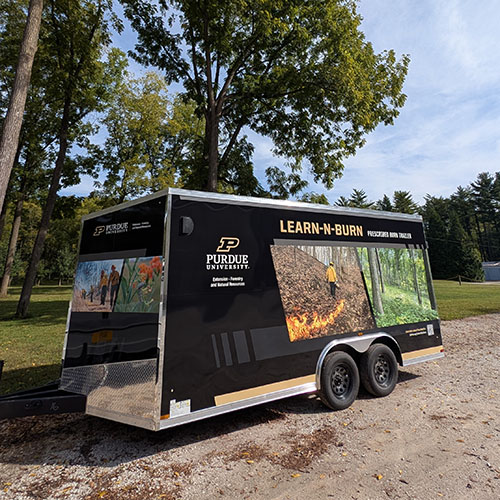
Keep your eyes peeled across Indiana for the newly minted Purdue Forestry and Natural Resources...