
Alumna Lauren Wetterau's Research Featured on Animal Planet's Saving Yellowstone with David Quaid
2023 wildlife alumna Lauren Wetterau is coming to a television screen or streaming service near you.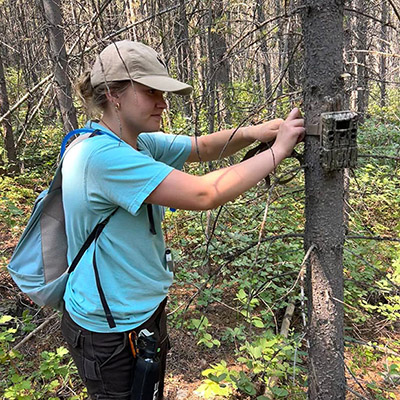 Wetterau, now a master’s student at the University of Wyoming, is among the researchers that are featured in the series “Saving Yellowstone with David Quaid” airing on Animal Planet. Wetterau’s research on red squirrels is featured in episode four of the four-part series, which “explores the beauty and fragility of the Greater Yellowstone ecosystem.”
Wetterau, who graduated from Purdue FNR in December 2023, said her research focuses on understanding the effects of red squirrel middens on species abundance and biodiversity in the Greater Yellowstone ecosystem, or GYE. A midden, referred to as nature’s refrigerator on the show, is a large pile of discarded conifer cone scales or other food debris created by a red squirrel as a central food cache or feeding station.
“The show is such a unique and exciting way to get to tell a broad audience about how important this small squirrel really is within its ecosystem,” Lauren said. “I got both my wildlife and communication degrees at Purdue, which may sound like a strange combination, but I did it because I knew I wanted to do science but also communicate it to the public in some way. That’s often how we can make a real difference for the environment; if people realize and care about what’s going on.”
Wetterau’s research on red squirrels focuses on the impact middens may have on wildlife in Yellowstone beyond the squirrel community.
“Red squirrels, like most other squirrels, are such an important but underappreciated species,” she explained. “While red squirrels can be found in coniferous forests across most of the northern part of the continent, the GYE is an ideal place to study them because it is one of the largest intact temperate zone ecosystems left, which means it has retained much of its biodiversity. The GYE has the highest overlap of species that might be benefitting from red squirrels.
“These squirrels are larder hoarders, which means that they store all of the cones they find in centralized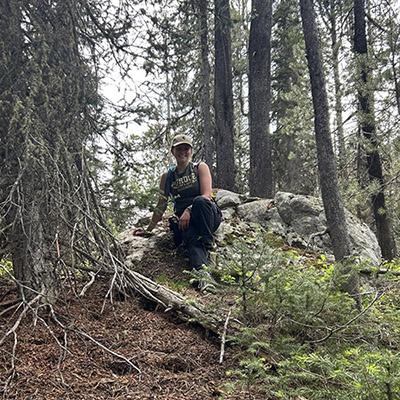 locations within their territory. They also eat from those cones at those central spots. As they chew off the outer cone bits to get to the seeds inside, those cone bits fall to the ground and eventually create a big pile over time. This becomes the midden. They make tunnels within the midden to better store their cones, not only to protect them from getting stolen by other squirrels but also to keep them moist so they don't dry out and crack open. Middens are like refrigerators in that way; they serve as a moist microclimate and keep the cones at a relatively regulated temperature under the surface. There can be thousands of these cones stored at just one midden, so it's not just the red squirrels that may be interested in taking advantage of that. There are plenty of other animals that also like to eat seeds, and coming across a midden within the forest means that they've found an abundant supply of seed nutrients. We already know that animals like bears and rodents excavate middens, but we don't know the broader ecological significance of middens beyond those individual associations. So, we're interested in seeing how middens affect the wildlife community as a whole.”
Lauren said that spreading the word about the importance of red squirrels was gratifying, but also challenged her to utilize both her science and communication skills simultaneously.
“Filming for the Saving Yellowstone show was intimidating and exciting at the same time because I finally got to put my science communication to the test,” she said. “It can be hard at times to articulate something that's super complex to people outside of the wildlife field, but having this experience gave me the opportunity to figure it out a little bit more. Dr. John Koprowski, my advisor, is really great at finding ways to make science communication more like storytelling, and I think that's truly the key to being an effective communicator of science. It was inspiring to see his storytelling in action.”
Being a part of the Animal Planet show reminded Wetterau of the impact the channel had on her as a child in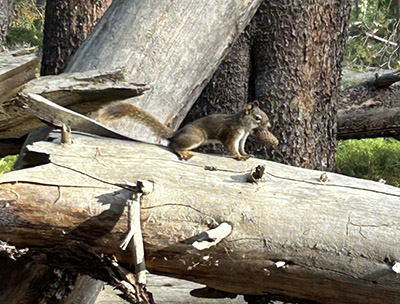 eventually shaping her career path.
“It felt like a full circle moment for me when I found out the docuseries was picked up by Animal Planet because that’s the channel that made me fall in love with wildlife as a child,” she recalled. “I grew up wanting to work with animals in some way, but the only jobs I knew of in that realm were to be a veterinarian or a zookeeper. I started at Purdue studying communication because that’s where my skills are, but I wanted to apply those skills to something I was passionate about. I soon discovered the wildlife field after scrolling through the available majors on Purdue's website, and I fell in love with it!”
While at Purdue, Lauren was an officer within the student chapter of The Wildlife Society for two years. She also attended two TWS national conferences and was introduced to her master’s degree advisor through Dr. Elizabeth Flaherty.
“My time as an undergrad in Purdue FNR was so formative in my development as a future wildlife ecologist, especially the Summer Practicum and the Student Chapter of The Wildlife Society,” she shared. “I'm so grateful to Purdue FNR for serving as a launching pad for my master's work at the University of Wyoming!”
For more on Wetterau’s FNR experience, including her study abroad trip to Australia which closed out her degree program, check out her “FNR Field Report” from January 2024.
See Lauren and her colleagues in action “Saving Yellowstone” on Animal Planet or on Discovery+, HBO Max and Hulu as well as other streaming platforms that carry Animal Planet content.
- Episode 1: In the Mountains – Aired Nov. 26
- Episode 2: Valleys and Grasslands – Aired Dec. 3
- Episode 3: Riparian Habitats – Aired Dec. 10
- Episode 4: “The Bellweathers” – Aired Dec. 17
Featured Stories
Do you want to learn more about trees, forests and how to better manage your woodlands for a...
For Collin Morris, choosing Purdue Agriculture meant choosing a place that was close to home but...
This quarter’s Agrifood Economy Index (AEI) reveals that industry sentiment has stabilized...
In Peru’s Colca River Valley, a project with the National University of San Agustín de...

Purdue University College of Agriculture awarded the Frederick L. Hovde Award of Excellence in...
Marisol Sepúlveda, professor of forestry and natural resources, created a new course for...