

Natalie Allen - Graduate Ag Research Spotlight
[DeWoody’s lab] does a lot of whole genome sequencing research. It’s been a great way to dive into genomics, It’s been really exciting for me to learn these skills.
- Natalie Allen, PhD Candidate, Forestry and Natural Resources
The student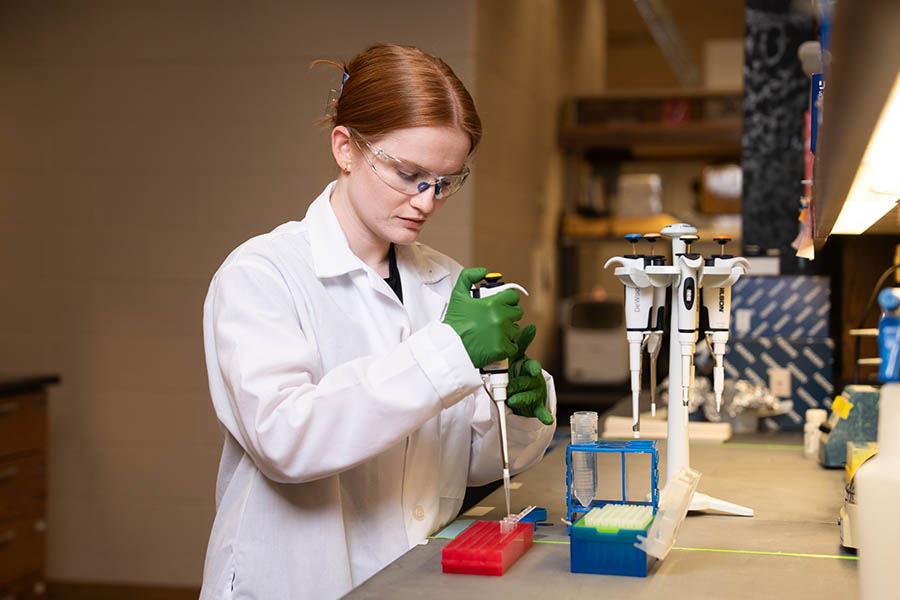
Growing up in lush northern Florida, Natalie Allen spent much of her childhood outdoors, catching lizards, collecting cicada exoskeletons and digging up crabs. She admits that some of her fondest memories may cause others to go “Ick!” “I’d go fishing off the Gulf Coast, and when my dad would clean the fish, I’d look at all the organs and go ‘Oh, what’s this?’” she says.
In other words, she was a scientist in training.
Allen studied biological sciences at Marquette University, where she got involved with gecko evolutionary biology research. She became an animal caretaker for the department’s gecko colony, which spurred her interest in genetics.
“I thought the geckos were cool and I wanted to learn more about them. Genetics was a good path to do that,” she says.
So, when applying for PhD programs, she focused on places she could work on genetics and genomics. She reached out to Andrew DeWoody, a professor in Purdue’s Department of Forestry and Natural Resources and a leader in animal conservation genetics. She arrived in West Lafayette in January 2023.
The research
DeWoody’s lab combines evolutionary biology and conservation biology.
“He does a lot of whole genome sequencing research. It’s been a great way to dive into genomics,” Allen says. “It’s been really exciting for me to learn these skills.”
Allen’s dissertation looks at several animal species, using genome sequencing to answer questions with conservation implications. The first chapter focuses on the western chicken turtle, a freshwater turtle found in the south-central U.S.
“They were thought to be in decline, but there were really no genome studies, so we didn’t know much about them,” Allen says.
Using data collected from Texas A&M University, Allen was able to use genome sequencing to gain insights into the turtles’ life cycle and population structure, including evidence that they likely return to their place of birth to breed. Her findings were published recently in the journal Conservation Genetics.
Her second chapter looks at gray whales, whose populations were hunted to near-extinction during the whaling era but have since rebounded. Allen used population genomics to examine whether different geographic groups of whales are genetically distinct, a question which has conservation implications. This work is currently in the peer-review process; a preprint can be found here.
Opportunities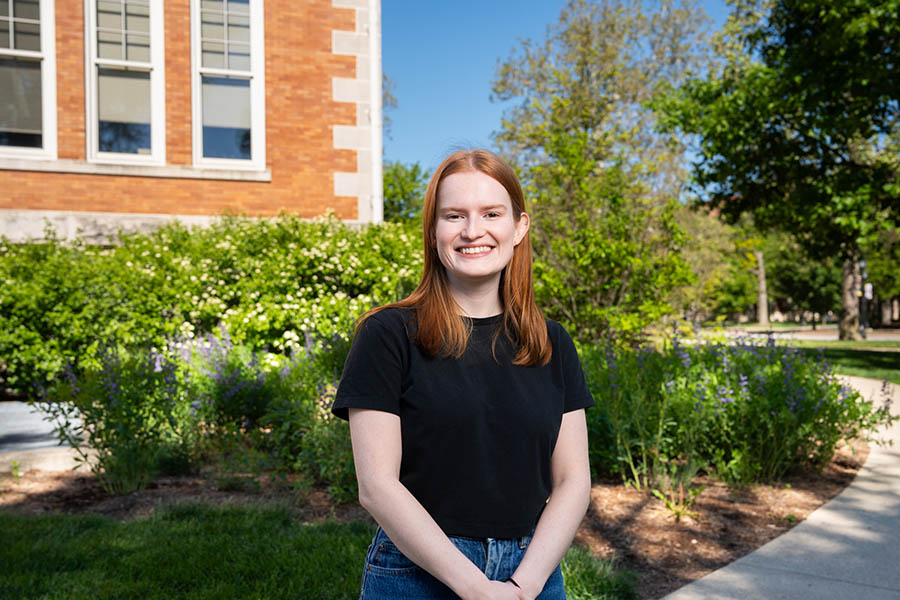
Allen has attended multiple conferences and given talks throughout her time at Purdue. Through a fellowship from the Welder Wildlife Foundation and support from Purdue’s D. Woods Thomas Memorial Fund, she traveled to Mexico to bring back genetic samples of Montezuma quail, the subject of another dissertation chapter. More recently, she traveled to Europe (Slovenia) to present her gray whale research to the International Whaling Commission’s Scientific Committee.
“The International Whaling Commission has a long history of setting guidelines for whaling, and the information passed to the committee goes into making decisions, so that was really cool,” she says.
Closer to home, Allen is the representative from the College of Agriculture to the Graduate Student Council.
Allen has a “super-supportive” advisor in DeWoody, she says.
“He’s very interested in what my future goals are, and he’s always checking in to see what things I’d be interested in doing,” she says. “He gives me the independence I want and also the support I want.”
Future plans
Though much of Allen’s current work is in conservation genetics, she’s eager to expand her knowledge of evolutionary biology with a postdoc after graduating in 2027. She plans to pursue a career in academia.
In the meantime, she enjoys camping and hiking with her loyal canine companion, Maisie. Shades State Park is a favorite.
Still the same person who delighted in catching lizards and examining fish anatomy as a child, Allen would love to be out in the field more as her career progresses.
“I haven’t had much chance to get out there and get my hands dirty,” she says.
More Graduate Spotlights

Growing up in lush northern Florida, Natalie Allen spent much of her childhood outdoors, catching...
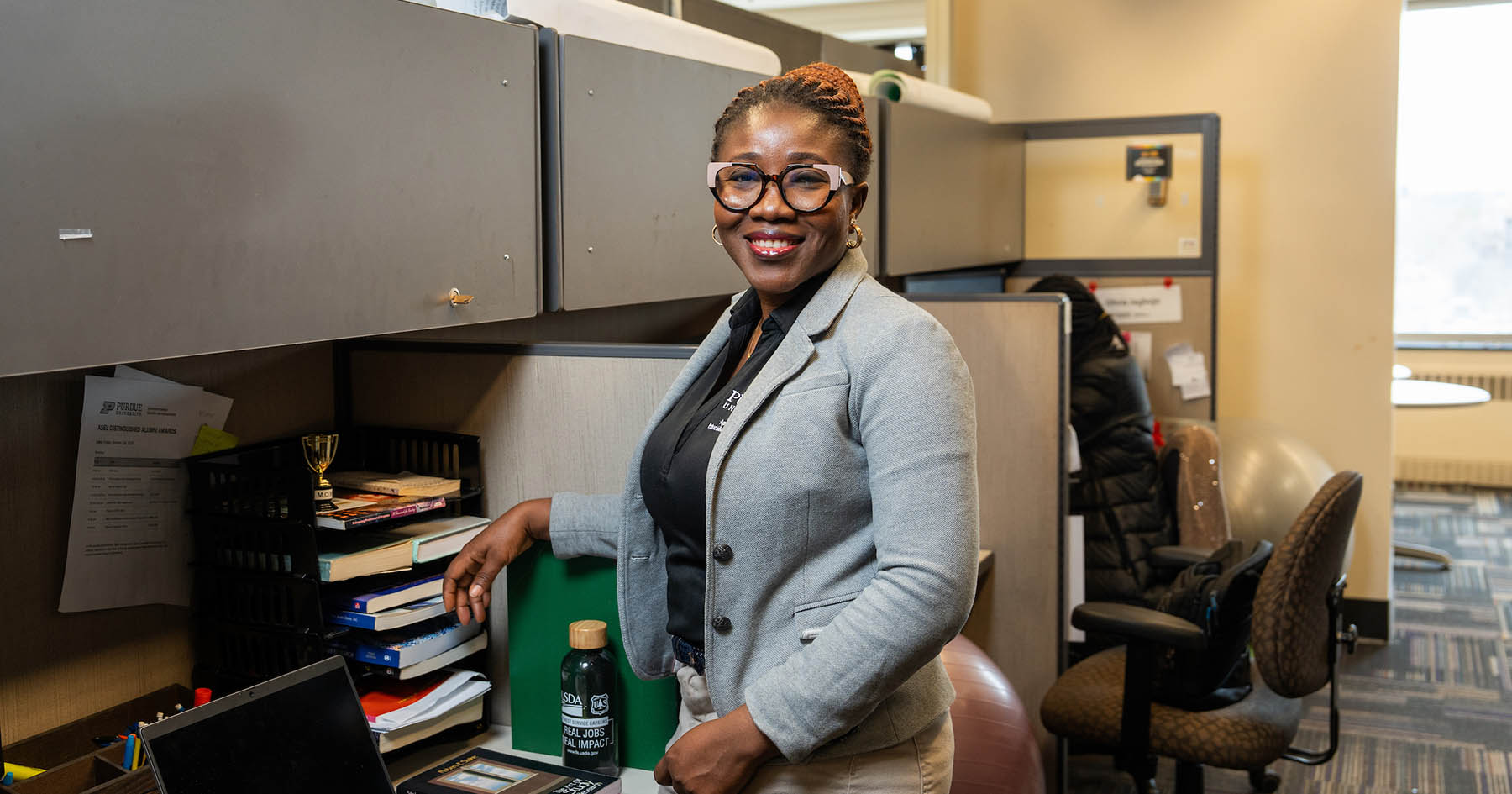
When Elizabeth Ogar was growing up in Nigeria, a weevil infestation hit her family’s corn...
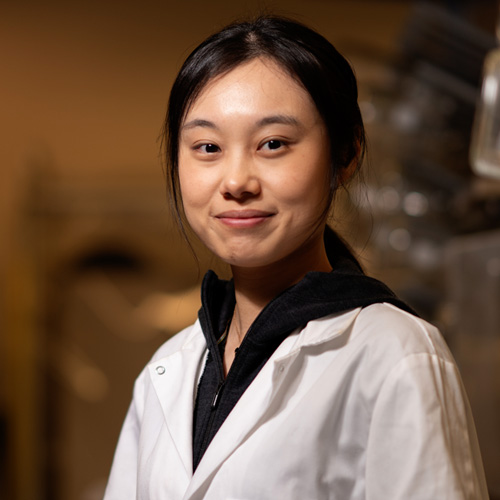
Luping Xu is proud to be from Ningbo, a port city in eastern China with a long history of...
“This might sound very weird,” Binayak Kunwar says, “but my first impression of...
Growing up in Bloomington, Kendall Cottingham was certain that she liked science and was a people...
Growing up in Greenwood, Indiana, Ian Rimer was the quintessential outdoor kid, spending most of...