December 28, 2022
Production Risk Management & Contingency Planning


In this second episode of a new series on Farm Risk Management, Jenna Nees, Ed Farris, and Michael Langemeier join Brady Brewer to discuss contingency planning for production risk. Minimizing risk through management practices, reducing production variability, and managing ways to transfer some of the production risk should be reevaluated every year. Implementing diversification, flexibility, vertical integration, and new technology while managing costs can help migrate risk for farms and agribusiness’. Having a written contract in place for production and marketing as well as carrying insurance are important strategies to transfer risk to a third party.
A Production Risk Checklist pdf can be found below.
Additional Resources:
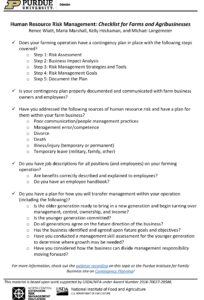
This series is based on the Six Pillars of Farm Risk Management course, funded by the North Central Extension Risk Management Education Center. More information on contingency planning is on the Purdue Institute for Family Business’ website, https://purdue.ag/fambiz, under the Strategic Business Planning Focus Area tab.
TAGS:
TEAM LINKS:




RELATED RESOURCES
UPCOMING EVENTS
Join educators from across the Midwest to build skills for communicating soil health concepts on Nov. 4-5, 2026. In the field, we’ll evaluate the relationship between soil health and water management focusing on irrigation and edge of field practices. The in-service will have both classroom and on farm demonstrations.
The Land of Opportunity: A Conference for Farmland Owners will be held at two locations on October 5 and October 6, providing farmland owners with valuable information and resources to help them make informed decisions about their land. The conference will feature keynote presentations, educational breakout sessions, and networking opportunities designed specifically for those who own, manage, or have an interest in farmland.