No results found!
resource
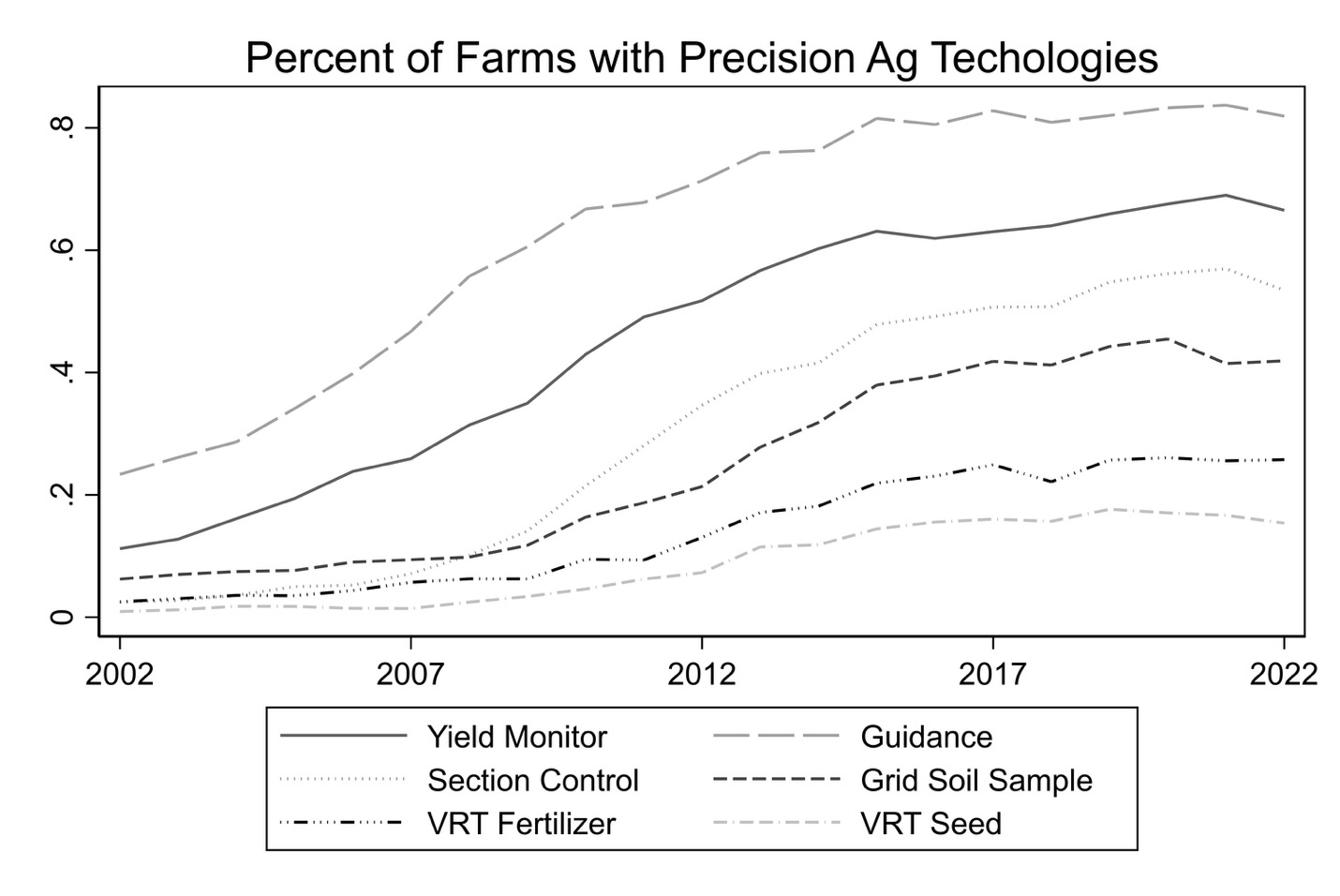
Extracting Value from Precision Agriculture Technology is Difficult
Precision agriculture technology promises efficiency gains, but evidence shows most tools don’t improve farm performance. This analysis of Kansas farms highlights which technologies deliver measurable returns—and why management, learning, and farm efficiency level matter more than adoption alone.
March 26, 2026
Brazil Soybean Boom Slowing? Profit Pressure Signals a Shift
Brazil is expected to produce a record soybean crop, but profitability is sharply declining due to rising costs and lower prices. Margins in key regions could fall to near break-even levels, potentially slowing acreage expansion and influencing global soybean supply and price dynamics.
March 25, 2026
AgCast 213: Farm Robotics, Labor, and the Future of Field Work, Lessons from the Delta, Part 5
A chance encounter in the Mississippi Delta leads to a closer look at how farm robotics are being used to address labor shortages and improve efficiency. This episode explores small autonomous machines designed for precision weeding, highlighting how automation is evolving from concept to practical field application.
paer_article
From Assets to Well-being: A Conceptual Framework for Community Vitality
This article presents a conceptual framework integrating the Community Capitals Framework (CCF) and the Policy, Systems, and Environment (PSE) approach to understand community vitality and well-being. Community vitality links community assets to well-being outcomes through a dynamic process in which communities pursue shared aspirations of well-being. The framework positions Cooperative Extension and community partners to align asset-based, community-focused programming with well-being-aligned initiatives.
March 23, 2026
The Outlook for the U.S. Economy in 2026
The U.S. economy in 2026 is expected to grow slowly, primarily due to slower consumer spending growth. Unemployment should remain around 4.6%, as the growth in job openings matches the growth in job searchers. Inflation is likely to hold steady near 2.5%, due to lower oil prices and slower growth in housing costs. Tariffs will add to goods inflation. The Federal Reserve may make further modest reductions in the federal funds rate, leading to somewhat lower interest rates. Barring unexpected shocks, the outlook is for another year of slow expansion rather than recession.
Learning International Economics the Hard Way
U.S. trade policy is being made without even a textbook understanding of International Economics. The policies of 2025 will largely continue in 2026, hurting export-oriented agriculture and eroding U.S. standing in the world.
Is There a Future for the U.S. Farm Bill?
The U.S. Farm Bill, as we typically think of it, remains in limbo. Changes to major spending programs on commodities and SNAP were incorporated into the 2025 budget reconciliation act, while remaining programs were left to end-of-year extensions. The uncertainty about returning to a normal farm bill process, coupled with rapidly adjusting trade policies, makes government action a significant source of uncertainty for U.S. agriculture.
The Economic Situation of the North Central Region and a Zoom in on Indiana: An Analysis Using the NCR-Stat Baseline Survey
Quantitatively understanding the socio-economic characteristics of an area conveys important information on its capacity for financial self-sufficiency, resistance to economic shocks, and overall quality of living. In this report, we provide key socio-economic information on the states of the North Central region of the United States, with a more careful look at Indiana.
Employment and Wage Trends in the U.S., the Midwest and Indiana: Overall and in Agriculture
Measuring employment fluctuations reveals essential information about the economy, particularly when compared with the responses of different areas in the same time frame. For an essential industry like agriculture, observing trends in wages and employment shares conveys important information on the labor market in the short, medium, and long term. In this brief, we analyze key labor market data using data from the Occupational Employment and Wage Statistics (OEWS) from the U.S. Bureau of Labor Statistics.
Farm Income Outlook for Indiana
Net farm income is projected to increase from $3.26 million in 2024 to $4.71 million in 2025. Lower crop receipts were offset by higher livestock receipts and government payments.
2026 Purdue Crop Cost and Return Guide
Production costs and breakeven prices in 2026 are expected to be similar to those experienced in 2025. However, production costs are still considerably higher than they were prior to the advent of COVID-19.
Corn and Soybean Outlook
This article examines the corn and soybean near-term outlook, taking into consideration the stocks, global competition, and current profitability of both crops.
“What to Watch” in Dairy Markets in 2026
Dairy markets are facing changes in domestic consumer demand across products. Dairy farmers in 2026 will navigate a challenging environment in which cheaper feed inputs initially look good, but margins remain squeezed with softening milk prices.
2026 Agricultural Credit Outlook
For the second year in a row, agricultural credit market conditions have deteriorated in the St. Louis and Chicago Districts. While crop prices have decreased, input costs have increased. Decreasing farm profits over the past three years have contributed to an increased demand for agricultural loans and lower agricultural loan repayment rates.
2026 Farmland and Cash Rent Outlook
Indiana farmland values are expected to remain stable to slightly higher in 2026, while cash rents may soften as producers face tighter margins. Overall, the market appears headed for a steady 2026, without sharp movement in either direction.
Caring Stress Index: What is Happening in Indiana and the Midwest?
In this report, we show details on Indiana’s caring stress index (CSI) at the county level in both 2013 and 2023, and a map of its county-level changes between these two years.