

New study to examine how plants transport water from soil to atmosphere
Purdue University’s Elin Jacobs, has received a three-year, $911,000 grant from the U.S. Department of Energy to explore how tree roots help redistribute water in the soil. She will study how water flow from soils through plants and into the atmosphere and the impact of increasingly occurring droughts on that process.
“Plants through roots can passively transport water from wet areas of the soil to drier areas. They use their roots as straws and suck water from the wet areas and release it out into dry areas. Usually, they do this to access deep water,” said Jacobs, research assistant professor in Forestry and Natural Resources.
In this way, wetter soil draws closer to the surface, where most of the nutrients reside.
“When water mixes with those nutrients, they become accessible to the plants, which lets them grow and photosynthesize better for more than a day, even when it’s technically a drought or dry out,” Jacobs said.
Collaborating with Jacobs on the project are: Zoe Cardon, Marine Biological Laboratory, Woods Hole, Mass.; Jeff Dukes, Carnegie Institution for Science, Stanford, Calif.; Lisa Welp, Earth, Atmospheric and Planetary Sciences, Purdue; and Yilin Fang, Pacific Northwest National Laboratory, Richland, Wash.
The fieldwork will occur in the Martell Forest about eight miles west of Purdue’s West Lafayette campus. Jacobs will perform the modeling on Purdue’s Bell supercomputer and, for large-scale simulations, on a DOE supercomputer. The data will help inform a planetwide computer simulation of earth processes. The model includes elements of the atmosphere, ocean, sea and land ice, and terrestrial ecosystems.
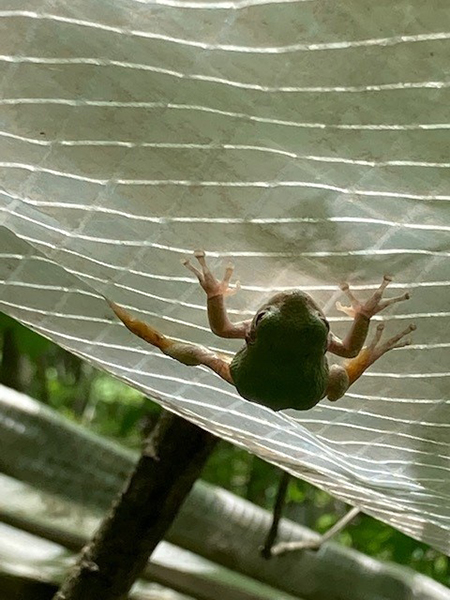 This frog hangs from a waterproof sheet in the Martell Forest that diverts water from tree roots as part of a U.S. Department of Energy study that monitors how plots of forest respond to drought. DOE has now funded a second, related study. Purdue’s Elin Jacobs and her associates are working both studies. (Photo Credit: Theresa Hudson)
Efforts to build the model followed a 2013 U.S. Department of Energy report on U.S. Energy Sector Vulnerabilities to Climate Change and Extreme Weather. That report noted that increasing weather and climate impact on energy systems and the types of energy the nation uses would come with climate change.
Plant hydraulics models have been too complicated to plug into large-scale Earth system models like DOE’s. Today’s bigger, faster computers can do it, but too little data exists to verify that the models work properly, Jacobs said.
During the first year, the team will define the field project based on what the model needs. In the second year, the team will see if the simulations follow what they see in the field, then adjust the measurements as needed.
“We’re going to imitate drought, manipulate the environmental conditions, cutting off water to certain trees by putting plastic skirts around the trees to keep water from going in,” said Theresa Hudson, a field research technician in Forestry and Natural Resources. “Then we’re going to see to what extent the trees use hydraulic redistribution to compensate for the reduced rainfall.”
The researchers will use sensors and non-radioactive isotopes to track water flow from the soil into the roots and from there to the treetops. A key project goal is to measure how much water the trees move around.
“There’s evidence of trees and other plants doing this, especially in climates where there are distinct wet and dry seasons. In the western U.S., for example,” Jacobs said. “Here, we haven’t had a lot of droughts historically, but climate is changing and they’re becoming more prominent.”
Jacobs’ team will assess what tree species can redistribute water, when they do it, and under what conditions. Do the trees need to attain a certain size or age? How deep the roots reach may be a factor. Some tree species sink deep roots while others have shallow root systems.
The study will monitor red oak, black walnut and sugar maple trees. All are common to the region and throughout eastern forests. The researchers chose those three species because their response to drought varies.
“When plants photosynthesize, they open the leaf pores, known as stomata, to let the carbon dioxide into the leaves. But in that process, they lose water through transpiration,” Jacobs explained. “In a drought, when there’s not much water, some trees will close the stomata or limit the opening so that they lose minimal amounts of water. But that means less CO2 gets into the tree through the leaves and they don’t grow.”
Some trees, however, hoard as much carbon so that they can keep growing. They continue photosynthesis for as long as they can despite their water loss.
“The three species represent a spectrum of these strategies, and we suspect that the degree to which the species are able to redistribute soil water is tied to the strategy they use,” Jacobs said.
Featured Stories

For Brody Cox, preparing for the Indiana State Fair began long before he entered the show...
Carolyn Foley, a long-time member of the Purdue Forestry and Natural Resources (FNR) and...

In the September Purdue University/CME Group Ag Economy Barometer survey, 52% of respondents...

Purdue University’s College of Agriculture recognized nine alumni at the Distinguished...
Keep your eyes peeled across Indiana for the newly minted Purdue Forestry and Natural Resources...

“Being at Purdue has changed my thinking entirely,” says Mingyu Zhao, a third-year...